01 / Morfologi

Ciri dan struktur

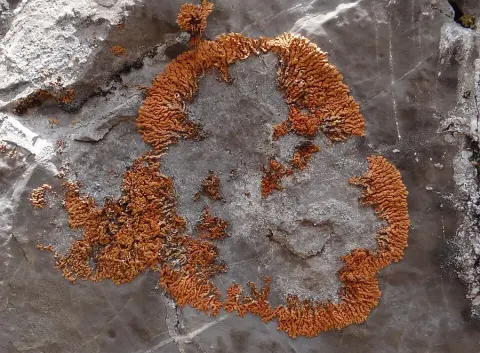
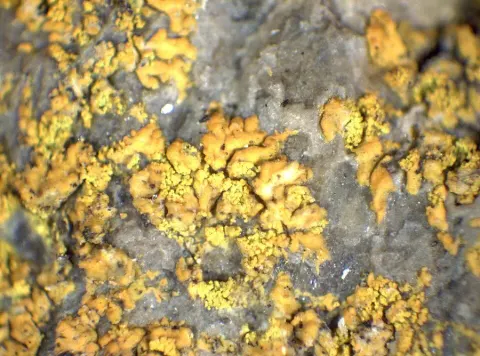
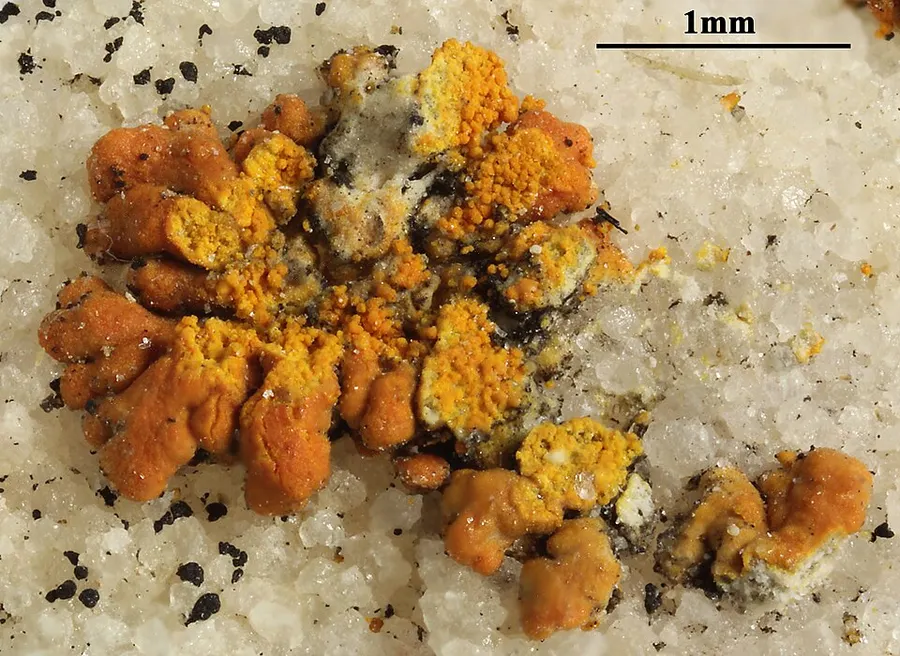
Leproplaca proteus has a well-developed thallus that lies closely pressed against the rock and is arranged in a conspicuously radiating pattern of small, scale-like or short lobes. A visible prothallus is absent. Its appearance is unusually variable because the inner parts of the thallus often break down into confluent soralia, while the outer lobes remain narrow, usually about 0.5–1 mm long and 0.2–0.5 mm wide, and are commonly forked at the tips. The species lacks isidia. The soralia are granular and orange. Areas within the sorediate parts often become pale and begin to die back, and the apothecia usually develop from these ageing patches. These fruiting bodies are small, about 0.12–0.15 mm across, with flat to slightly convex that are orange to reddish and surrounded by a rather thick margin, which may become uneven or slightly depressed with age. The is developed mainly on the upper and lateral parts of the lobes and is about 30 μm thick, with abundant yellow-orange pigment granules. Beneath it, the medulla is made of more loosely woven hyphae, while the algal cells are scattered rather than arranged in a sharply defined layer. In section, the apothecial margin resembles the thallus, the hymenium is 60–80 μm tall, and the asci contain eight spores measuring 9–15 by 5–7 μm, with a septum up to 6 μm thick. Poelt also reported pycnidia about 70–80 μm in diameter and narrow conidia 3–6 by 0.8–1 μm. Chemically, the medulla is iodine-negative, whereas the hymenium stains an intense blue with iodine, and the orange pigment granules dissolve in potassium hydroxide solution (K) with a crimson reaction.

Sebagian uraian ditampilkan dalam bahasa sumber; terjemahannya belum tersedia atau belum lolos pemeriksaan.

Rujukan: [1]

Pengukuran mengikuti objek, spesimen atau kultur, dan metode yang disebutkan sumber. Baca uraian asli untuk konteks lengkap.

02 / Kehidupan

Habitat dan peran ekologis

At the time of its description, Leproplaca proteus was reported from sheltered calcareous rock in European mountain districts. Poelt described it as growing on partly shaded to shaded, more or less vertical or overhanging faces of limestone and dolomite, and perhaps occasionally on calcareous schist, from low elevations to about 2,000 m or slightly higher. He said it tended to establish on relatively hard rock surfaces that were beginning to weather, often among other crustose lichens, and regarded it as a pioneer species. The localities he assembled were concentrated in the Alps, from Bavaria through Tyrol and South Tyrol to Lombardy, with outlying records from the Küstenland region and the Carpathians. Weddellomyces protearius and Lichenochora xanthoriae are two lichenicolous (lichen-dwelling) fungi that have been recorded parasitizing Leproplaca proteus in Germany and Austria.

Sebagian uraian ditampilkan dalam bahasa sumber; terjemahannya belum tersedia atau belum lolos pemeriksaan.

Rujukan: [1]

Habitat atau konteks temuan
Informasi belum tersedia pada sumber rilis ini.
Substrat
Informasi belum tersedia pada sumber rilis ini.
Peran atau konteks
Pembentuk liken
Temukan hubungan serupa
03 / Siklus hidup

Reproduksi

Leproplaca proteus has a well-developed thallus that lies closely pressed against the rock and is arranged in a conspicuously radiating pattern of small, scale-like or short lobes. A visible prothallus is absent. Its appearance is unusually variable because the inner parts of the thallus often break down into confluent soralia, while the outer lobes remain narrow, usually about 0.5–1 mm long and 0.2–0.5 mm wide, and are commonly forked at the tips. The species lacks isidia. The soralia are granular and orange. Areas within the sorediate parts often become pale and begin to die back, and the apothecia usually develop from these ageing patches. These fruiting bodies are small, about 0.12–0.15 mm across, with flat to slightly convex that are orange to reddish and surrounded by a rather thick margin, which may become uneven or slightly depressed with age.

Sebagian uraian ditampilkan dalam bahasa sumber; terjemahannya belum tersedia atau belum lolos pemeriksaan.

Rujukan: [1]

Sinonim menurut acuan taksonomi rilis: Caloplaca proteus
04 / Batas informasi

Catatan identitas dan cakupan

  • Nama diterima mengikuti Catalogue of Life Base2026-09-11; uraian mempertahankan konsep dan nama sumber aslinya.
  • Original geographic, specimen and life-cycle scope retained; source import awaits individual editorial review.
  • Impor dan terjemahan otomatis belum diperiksa editorial per profil. Struktur reproduktif yang disebutkan tidak membuktikan seluruh siklus hidup diketahui.
  • Pengukuran pada uraian mengikuti spesimen, kultur, dan metode sumber; angka tidak diperluas ke semua populasi.

Catatan distribusi dalam narasi mengikuti sumbernya. Dokumentasi spesimen atau foto mengikuti catatan sumber. Bukti wilayah Indonesia dan penilaian konservasi tidak disimpulkan dari gambar.

05 / Dokumentasi

Melihat dengan konteks

Dokumentasi Leproplaca proteus dari Wikimedia Commons. The rock-dwelling crustose lichen Leproplaca proteus ; location: Autria, at 1450 m elevation Identifikasi mengikuti record berkas sumber.

Jenis
Fotografi
Kredit
Felix Schumm
Sumber media
Buka entri sumber

Gambar menunjukkan objek menurut identifikasi sumber, bukan verifikasi independen spesimen oleh Fungi. Tidak ada skala baru yang ditambahkan.

06 / Rujukan

Sumber profil

  1. [1] Leproplaca proteus — Wikipedia (en)Bagian sumber: Frozen revision 1348586251
    Tanggal penghimpunan sumber: 2026-10-12
    Teks sumber: CC BY-SA4.0 · Wikipedia contributors
  2. [2] Catalogue of Life Base2026-09-11 — Leproplaca proteusBagian sumber: ColDP NameUsage.tsv ID 3TGNV; accepted species; source 2073
    Tanggal penghimpunan sumber: 2026-10-12
  3. [3] Dokumentasi visual — Leproplaca proteusBagian sumber: Individual media record; identification follows the source, not independent determination
    Tanggal penghimpunan sumber: 2026-10-12
    Media sumber: CC BY-SA 4.0 · Felix Schumm

Adaptasi teks: CC BY-SA 4.0. Wikipedia contributors — Leproplaca proteus — Wikipedia (en)

Uraian asli dan riwayat sumber

Riwayat atau halaman sumber

Ringkasan sumber

Leproplaca proteus is a species of rock-dwelling, crustose lichen-forming fungus in the family Teloschistaceae. First described by Josef Poelt in 1953 from the Bavarian Alps, the lichen forms small orange crusts on shaded limestone and dolomite, with a radiating pattern of narrow lobes that break down into granular soredia toward the centre. It is known mainly from mountain districts across the Alps and the Carpathian Mountains.

Revisi sumber

Morfologi sumber

Leproplaca proteus has a well-developed thallus that lies closely pressed against the rock and is arranged in a conspicuously radiating pattern of small, scale-like or short lobes. A visible prothallus is absent. Its appearance is unusually variable because the inner parts of the thallus often break down into confluent soralia, while the outer lobes remain narrow, usually about 0.5–1 mm long and 0.2–0.5 mm wide, and are commonly forked at the tips. The species lacks isidia. The soralia are granular and orange. Areas within the sorediate parts often become pale and begin to die back, and the apothecia usually develop from these ageing patches. These fruiting bodies are small, about 0.12–0.15 mm across, with flat to slightly convex that are orange to reddish and surrounded by a rather thick margin, which may become uneven or slightly depressed with age. The is developed mainly on the upper and lateral parts of the lobes and is about 30 μm thick, with abundant yellow-orange pigment granules. Beneath it, the medulla is made of more loosely woven hyphae, while the algal cells are scattered rather than arranged in a sharply defined layer. In section, the apothecial margin resembles the thallus, the hymenium is 60–80 μm tall, and the asci contain eight spores measuring 9–15 by 5–7 μm, with a septum up to 6 μm thick. Poelt also reported pycnidia about 70–80 μm in diameter and narrow conidia 3–6 by 0.8–1 μm. Chemically, the medulla is iodine-negative, whereas the hymenium stains an intense blue with iodine, and the orange pigment granules dissolve in potassium hydroxide solution (K) with a crimson reaction.

Revisi sumber

Ekologi sumber

At the time of its description, Leproplaca proteus was reported from sheltered calcareous rock in European mountain districts. Poelt described it as growing on partly shaded to shaded, more or less vertical or overhanging faces of limestone and dolomite, and perhaps occasionally on calcareous schist, from low elevations to about 2,000 m or slightly higher. He said it tended to establish on relatively hard rock surfaces that were beginning to weather, often among other crustose lichens, and regarded it as a pioneer species. The localities he assembled were concentrated in the Alps, from Bavaria through Tyrol and South Tyrol to Lombardy, with outlying records from the Küstenland region and the Carpathians. Weddellomyces protearius and Lichenochora xanthoriae are two lichenicolous (lichen-dwelling) fungi that have been recorded parasitizing Leproplaca proteus in Germany and Austria.

Revisi sumber

Struktur reproduksi sumber

Leproplaca proteus has a well-developed thallus that lies closely pressed against the rock and is arranged in a conspicuously radiating pattern of small, scale-like or short lobes. A visible prothallus is absent. Its appearance is unusually variable because the inner parts of the thallus often break down into confluent soralia, while the outer lobes remain narrow, usually about 0.5–1 mm long and 0.2–0.5 mm wide, and are commonly forked at the tips. The species lacks isidia. The soralia are granular and orange. Areas within the sorediate parts often become pale and begin to die back, and the apothecia usually develop from these ageing patches. These fruiting bodies are small, about 0.12–0.15 mm across, with flat to slightly convex that are orange to reddish and surrounded by a rather thick margin, which may become uneven or slightly depressed with age.

Revisi sumber

Rujukan halaman ini

Fungi. Leproplaca proteus. Rilis data fungi-2026-10-12-expansion-2. https://fungi-atlas.mgadib.chatgpt.site/jamur/leproplaca-proteus/.

Status: impor sumber; pemeriksaan editorial per profil belum selesai. Untuk klaim biologis, gunakan rujukan pada bagian terkait dan periksa konteks sumber aslinya.