Ciri dan struktur
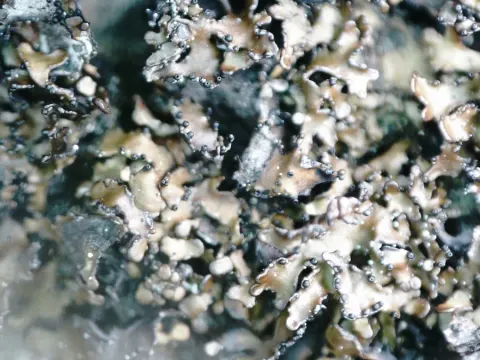
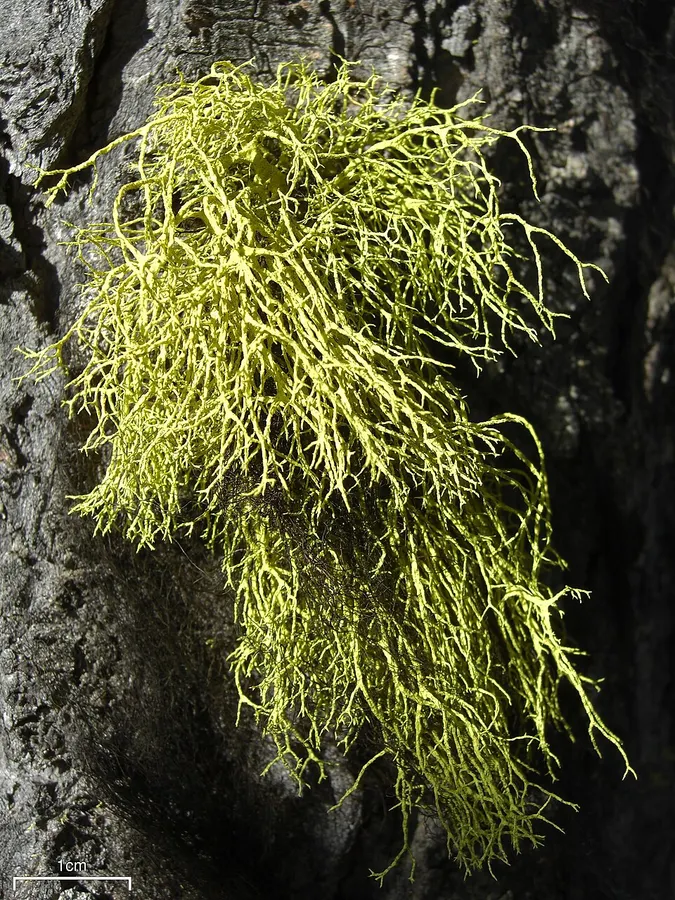
The thallus is shrubby and bushy (fruticose), often a vivid lemon yellow to chartreuse green, typically with darker brown to blackened branch tips and a paler (often whitish) base. Mature thalli are commonly 5 – 20 cm long and 4 – 8 cm wide, with coarse branches that are usually 1–3 mm wide near the base. Branches are round or more often angular-ridged in cross-section, irregularly branched overall but tending towards roughly equal (dichotomous) forking near the tips. The ridges bear pseudocyphellae (small pores or breaks in the outer skin, or ), which in turn usually carry small vegetative propagules (isidia) that may be sparse or dense. These are typically globular to weakly cylindrical and about 0.1–0.3 mm long, and may later be replaced by weakly corticate outgrowths (gymnidia). Apothecia (fruiting bodies) are reported as rare and usually appear late in development, generally on large thalli. They are typically 0.75–1.50 mm across (occasionally larger), with a pale to dark brown that is strongly concave when young. The is raised and when young and may have few (or no) short fibrils. The underside of the margin is strongly pitted and sorediate. Ascospores are , hyaline, ellipsoid, and measured at 5–7 × 3–4 μm. Pycnidia are also rare, and conidia were reported as straight and 7–9 × 1 μm. The cortex contains vulpinic acid and atranorin, and the hymenium of the apothecia contains norstictic acid.
Habitat dan peran ekologis
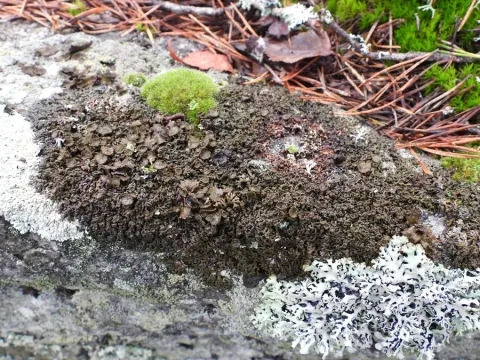
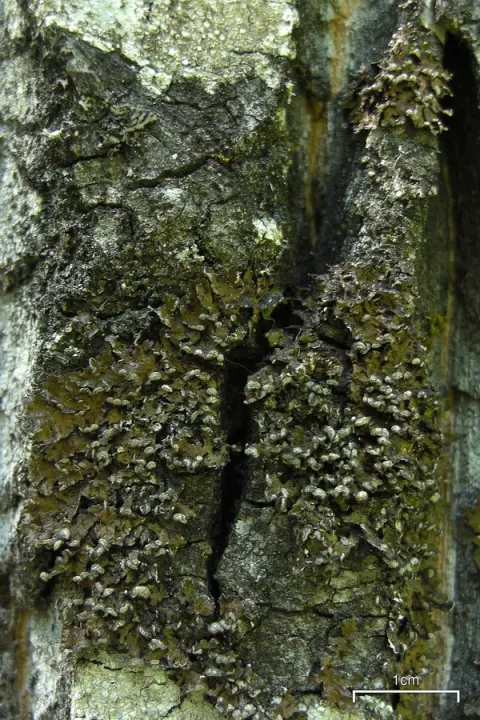
In western North America, Letharia lupina is widely distributed and, in the authors' assessment, is encountered more often than L. vulpina s. str.; sequenced material in their study identified L. lupina as the predominant lineage among North American samples. It is also the more widespread of the two lineages in North America, extending east of the Continental Divide into Alberta and Saskatchewan and southwards through parts of the interior western United States (including Montana, Wyoming, south-western South Dakota, Utah, and Nevada). In mountainous regions it spans a broad elevational range, from valley bottoms to treeline, roughly 190 – 3370 m. It has also been reported from Veracruz in eastern Mexico. In North America, the lineage later described as L. lupina was reported as most common in the interior western mountains, whereas L. vulpina more often occurs in warmer coastal mountains near the Pacific, although the two can occur together locally. The species commonly grows on old fence posts and on the bare (decorticated) trunks and branches of conifers (especially Pinus), but also occurs on conifer bark, including that of Abies, Calocedrus, Picea, and Pseudotsuga. On hardwoods it most often colonizes exposed wood (reported from Arbutus, Arctostaphylos, Populus and Salix), but it has also been observed on bark-covered (corticated) branches of Betula and Quercus.
- Habitat atau konteks temuan
- Informasi belum tersedia pada sumber rilis ini.
- Substrat
- kulit kayu
- Peran atau konteks
- Pembentuk liken
Reproduksi
The thallus is shrubby and bushy (fruticose), often a vivid lemon yellow to chartreuse green, typically with darker brown to blackened branch tips and a paler (often whitish) base. Mature thalli are commonly 5 – 20 cm long and 4 – 8 cm wide, with coarse branches that are usually 1–3 mm wide near the base. Branches are round or more often angular-ridged in cross-section, irregularly branched overall but tending towards roughly equal (dichotomous) forking near the tips. The ridges bear pseudocyphellae (small pores or breaks in the outer skin, or ), which in turn usually carry small vegetative propagules (isidia) that may be sparse or dense. These are typically globular to weakly cylindrical and about 0.1–0.3 mm long, and may later be replaced by weakly corticate outgrowths (gymnidia).
Catatan identitas dan cakupan
- Nama diterima mengikuti Catalogue of Life Base2026-09-11; uraian mempertahankan konsep dan nama sumber aslinya.
- Original geographic, specimen and life-cycle scope retained; source import awaits individual editorial review.
- Impor dan terjemahan otomatis belum diperiksa editorial per profil. Struktur reproduktif yang disebutkan tidak membuktikan seluruh siklus hidup diketahui.
- Pengukuran pada uraian mengikuti spesimen, kultur, dan metode sumber; angka tidak diperluas ke semua populasi.
Catatan distribusi dalam narasi mengikuti sumbernya. Dokumentasi spesimen atau foto mengikuti catatan sumber. Bukti wilayah Indonesia dan penilaian konservasi tidak disimpulkan dari gambar.
Melihat dengan konteks
Dokumentasi Letharia lupina dari Wikimedia Commons. Letharia lupina in ed. 20090601.3 Wells Gray Provincial Park, BC Identifikasi mengikuti record berkas sumber.
- Jenis
- Fotografi
- Kredit
- Jason Hollinger
- Lisensi
- CC BY 2.0
- Sumber media
- Buka entri sumber
Sumber profil
- [1] Letharia lupina — Wikipedia (en)
- [2] Catalogue of Life Base2026-09-11 — Letharia lupina
- [3] Dokumentasi visual — Letharia lupina
Rujukan halaman ini
Fungi. Letharia lupina. Rilis data fungi-2026-10-12-expansion-2. https://fungi-atlas.mgadib.chatgpt.site/jamur/letharia-lupina/.
Status: impor sumber; pemeriksaan editorial per profil belum selesai. Untuk klaim biologis, gunakan rujukan pada bagian terkait dan periksa konteks sumber aslinya.