Ciri dan struktur
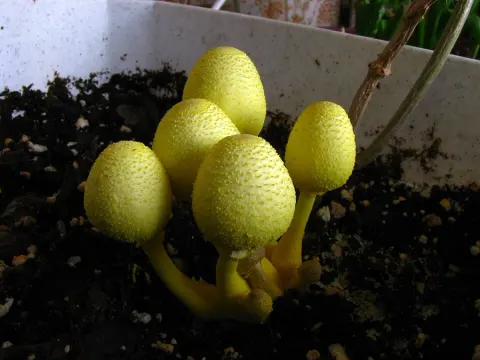
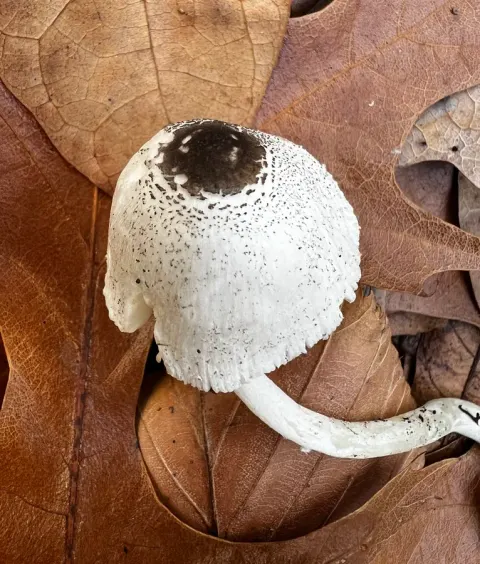
Leucocoprinus biornatus is a small dapperling mushroom with white flesh that may tinge yellow, pinkish or brown. Cap: 8–10 cm wide with brittle flesh. White and silky but discolouring pinkish with age. Conical when young expanding to convex or campanulate (bell shaped) and becoming irregularly shaped with age but with a persistent umbo throughout. It is covered in light brown woolly scales (floccose or squamulose) which become a darker brown or reddish with age. The cap edges are striated and start white but become pinkish and then brown when bruised or as it matures. Stem: 5–15 cm tall and 2-2.5 cm thick with a bulging centre (fusiform) and slightly bulbous base. White and silky on the outside with white internal flesh that begins solid but hollows with age. The membranous, ascending stem ring is white but bordered by brownish mottled edges. The base is scaly and discolours slightly yellow and then pink or brown with age or with damage. Gills: Free and crowded, swollen in the middle and whitish but turning yellowish with age. The edges are crenelated and tinged brown. Orange-brown or dark red-brown staining is visible when damaged. Spore print: Creamy white. Spores: Elliptical or globose. 10 x 8 μm. Smell: Unpleasantly pungent, acidic and noxious. Taste: Unpleasant flavour similar to that of Lepiota species. When dry the stem and cap develop a pink or reddish colour.
Habitat dan peran ekologis
L. biornatus is scarcely recorded and little known. Berkeley and Broome only say that the specimens studied were found on the ground in Peradeniya, Sri Lanka (then known as Ceylon) in 1868. The majority of the observations documented in their paper (which provide a location) were made there so it is possible that they were in or around the vicinity of the Royal Botanical Gardens, Peradeniya, which were founded in 1843. In their introduction to On the Fungi of Ceylon it is remarked how closely the agarics documented resembled those of species found in Britain. The specimens studied by Locquin were found growing in clusters (cespitose) or individually on soil in Lyon, France in September 1944. A stove or stovehouse was the common term used at the time to refer to a heated greenhouse, since they were often warmed via the exhaust flue of a wood stove to enable the growing of exotic tropical plants which could not otherwise survive the cold temperatures of Britain.
- Habitat atau konteks temuan
- Informasi belum tersedia pada sumber rilis ini.
- Substrat
- tanah
- Peran atau konteks
- Belum dikategorikan pada rilis ini.
Reproduksi
Cap: 8–10 cm wide with brittle flesh. White and silky but discolouring pinkish with age. Conical when young expanding to convex or campanulate (bell shaped) and becoming irregularly shaped with age but with a persistent umbo throughout. It is covered in light brown woolly scales (floccose or squamulose) which become a darker brown or reddish with age. The cap edges are striated and start white but become pinkish and then brown when bruised or as it matures. Stem: 5–15 cm tall and 2-2.5 cm thick with a bulging centre (fusiform) and slightly bulbous base. White and silky on the outside with white internal flesh that begins solid but hollows with age. The membranous, ascending stem ring is white but bordered by brownish mottled edges.
Catatan identitas dan cakupan
- Nama diterima mengikuti Catalogue of Life Base2026-09-11; uraian mempertahankan konsep dan nama sumber aslinya.
- Original geographic, specimen and life-cycle scope retained; source import awaits individual editorial review.
- Impor dan terjemahan otomatis belum diperiksa editorial per profil. Struktur reproduktif yang disebutkan tidak membuktikan seluruh siklus hidup diketahui.
- Pengukuran pada uraian mengikuti spesimen, kultur, dan metode sumber; angka tidak diperluas ke semua populasi.
Catatan distribusi dalam narasi mengikuti sumbernya. Dokumentasi spesimen atau foto mengikuti catatan sumber. Bukti wilayah Indonesia dan penilaian konservasi tidak disimpulkan dari gambar.
Melihat dengan konteks
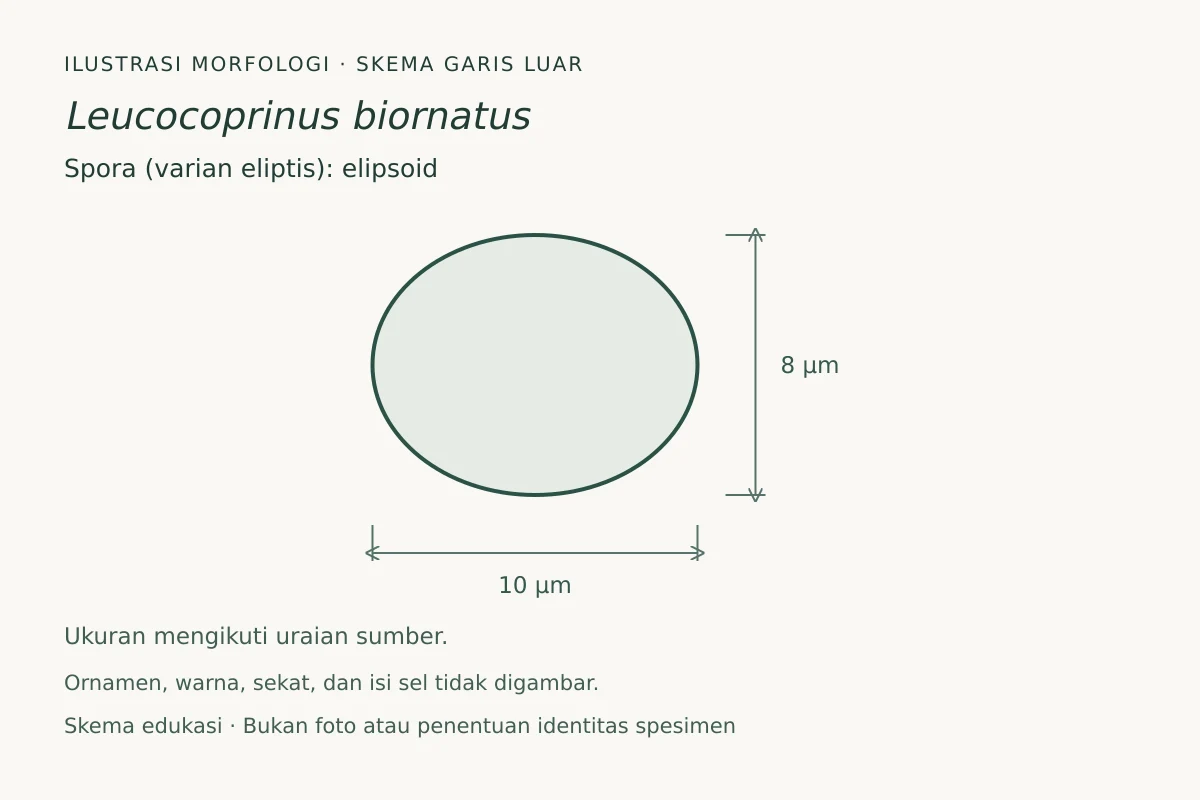
Ilustrasi skematis garis luar spora (varian eliptis) Leucocoprinus biornatus, berdasarkan uraian sumber; ukuran yang dilaporkan 10 × 8 µm. Proporsi disederhanakan, bukan salinan satu spesimen. Ornamen permukaan, warna, sekat, dan isi sel tidak direkonstruksi. Varian spora eliptis; pasangan ukuran tunggal yang dilaporkan 10 × 8 µm, bukan rentang populasi. Ornamen, warna, sekat, dan isi sel tidak digambar. Skema edukasi, bukan alat identifikasi.
- Jenis
- Ilustrasi skematis
- Kredit
- Fungi, ilustrasi orisinal (2026); fakta morfologi berdasarkan Wikipedia contributors
- Lisensi
- CC BY-SA 4.0
- Sumber media
- Buka entri sumber
Sumber profil
- [1] Leucocoprinus biornatus — Wikipedia (en)
- [2] Catalogue of Life Base2026-09-11 — Leucocoprinus biornatus
Rujukan halaman ini
Fungi. Leucocoprinus biornatus. Rilis data fungi-2026-10-12-expansion-2. https://fungi-atlas.mgadib.chatgpt.site/jamur/leucocoprinus-biornatus/.
Status: impor sumber; pemeriksaan editorial per profil belum selesai. Untuk klaim biologis, gunakan rujukan pada bagian terkait dan periksa konteks sumber aslinya.