Ciri dan struktur
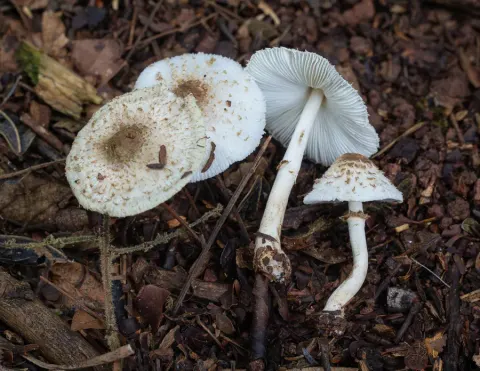
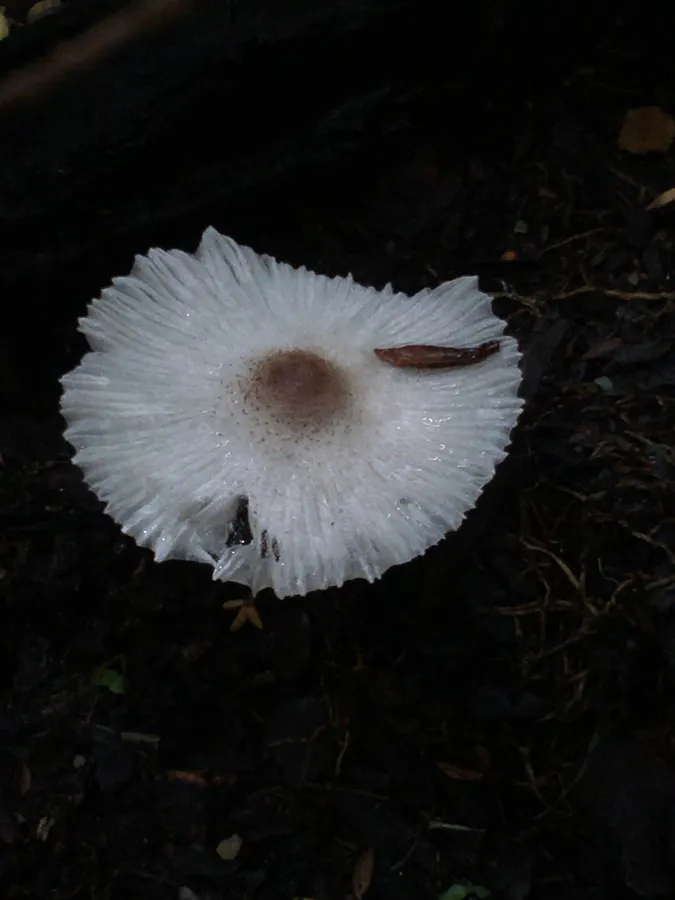
Leucocoprinus truncatus is a small white dapperling mushroom with white flesh which does not discolour. Cap: Starts cylindrical with a flat top or like an 'inverted bucket' before becoming conical and then expanding to up to 1.5 cm wide, campanulate and finally flat convex and is 'rather fleshy'. The cap surface is white at first with a brown centre disc that remains truncate and flattened on the top, the disc breaks up into brown scales which are easily rubbed off to reveal the silky white surface beneath. The cap surface is covered in fine granules or a fine woolly coating (tomentose) and discolours brownish with age or with damage. Stem: Up to 2.5 cm long and 1.5mm thick gradually tapering up from a 4mm wide base. The surface is cream coloured, smooth above the ring but covered in short, fine felty hairs below which can be rubbed off. The base of the stem has some slight brown scales and white mycelium showing. The ascending, membranous stem ring is white but discolours brown with a frayed edge with age and it becomes movable with age. Gills: Free, crowded and whitish at first becoming creamy. Spores: Ovoid to amygdaliform. Dextrinoid and metachromatic. 10-12 x 5.5-6.5 μm. Also noted is the secretion of light brown droplets or guttation on the cap, stem and ring. Most specimens began to discolour brown, wither and go moldy shortly after maturing. Pearson's description of Lepiota truncata from 1950 broadly agrees with the description of Leucocoprinus truncatus but contains some additional details not noted in the more recent description. These differences are noted here: Cap: 1–6 cm wide.
Habitat dan peran ekologis
The specimens studied by Pearson were found growing in trooping groups near various trees and shrubs in the South-West corner of the former Cape Province of South Africa. They were said to be common during April to June and were also noted as sometimes growing on burnt ground.
- Habitat atau konteks temuan
- Informasi belum tersedia pada sumber rilis ini.
- Substrat
- Informasi belum tersedia pada sumber rilis ini.
- Peran atau konteks
- Belum dikategorikan pada rilis ini.
Reproduksi
Cap: Starts cylindrical with a flat top or like an 'inverted bucket' before becoming conical and then expanding to up to 1.5 cm wide, campanulate and finally flat convex and is 'rather fleshy'. The cap surface is white at first with a brown centre disc that remains truncate and flattened on the top, the disc breaks up into brown scales which are easily rubbed off to reveal the silky white surface beneath. The cap surface is covered in fine granules or a fine woolly coating (tomentose) and discolours brownish with age or with damage. Stem: Up to 2.5 cm long and 1.5mm thick gradually tapering up from a 4mm wide base. The surface is cream coloured, smooth above the ring but covered in short, fine felty hairs below which can be rubbed off.
Catatan identitas dan cakupan
- Nama diterima mengikuti Catalogue of Life Base2026-09-11; uraian mempertahankan konsep dan nama sumber aslinya.
- Original geographic, specimen and life-cycle scope retained; source import awaits individual editorial review.
- Impor dan terjemahan otomatis belum diperiksa editorial per profil. Struktur reproduktif yang disebutkan tidak membuktikan seluruh siklus hidup diketahui.
- Pengukuran pada uraian mengikuti spesimen, kultur, dan metode sumber; angka tidak diperluas ke semua populasi.
Catatan distribusi dalam narasi mengikuti sumbernya. Dokumentasi spesimen atau foto mengikuti catatan sumber. Bukti wilayah Indonesia dan penilaian konservasi tidak disimpulkan dari gambar.
Melihat dengan konteks
Dokumentasi Leucocoprinus truncatus menurut asosiasi foto pada record takson iNaturalist. Kredit: Simon Tamblyn. Identitas mengikuti sumber; bukan penentuan spesimen independen.
- Jenis
- Fotografi
- Kredit
- (c) Simon Tamblyn, some rights reserved (CC BY)
- Lisensi
- CC BY 4.0
- Sumber media
- Buka entri sumber
Sumber profil
- [1] Leucocoprinus truncatus — Wikipedia (en)
- [2] Catalogue of Life Base2026-09-11 — Leucocoprinus truncatus
- [3] Dokumentasi visual — Leucocoprinus truncatus
Rujukan halaman ini
Fungi. Leucocoprinus truncatus. Rilis data fungi-2026-10-12-expansion-2. https://fungi-atlas.mgadib.chatgpt.site/jamur/leucocoprinus-truncatus/.
Status: impor sumber; pemeriksaan editorial per profil belum selesai. Untuk klaim biologis, gunakan rujukan pada bagian terkait dan periksa konteks sumber aslinya.