Ciri dan struktur
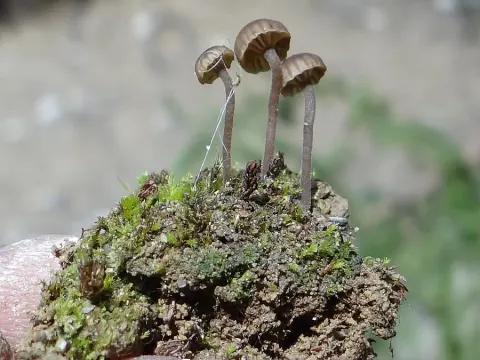
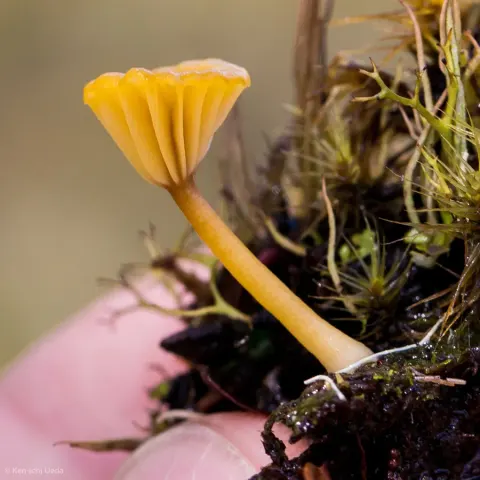
The thallus of Lichenomphalia meridionalis is a Botrydina-type structure consisting of small green to dark-green globules, typically 20–55 micrometres (μm) in diameter but sometimes reaching 80 μm. Each globule contains Coccomyxa algae cells enclosed by fungal hyphae. The basidiomata (fruiting bodies) are small and omphalinoid in shape. The caps are 3.5–10 mm wide, convex to flattened or slightly depressed, and translucent-striate. They range in colour from ochraceous to yellowish red, light brown, or brown, and often become paler with age or when dried. The gills are widely spaced (distant) and run down the stem (decurrent), typically whitish to pale greyish white or sometimes matching the cap colour. The stipe (stem) is slender, 5–20 mm long, covered in fine short hairs (densely velutinous or pubescent), and white-tomentose at the base where it connects to the thallus. Under the microscope, the pileipellis (cap surface) consists of cylindrical hyphae with club-shaped (clavate) tips, arranged in a cutis to subtrichodermium (a layer of hyphae lying flat to slightly upright). Cystidia are absent, and the basidia (spore-bearing cells) are mostly four-spored, though they may also bear two spores or, rarely, just one. The basidiospores are colourless (hyaline), thin-walled, inamyloid (not staining with iodine), and ellipsoid to cylindrical or elongate in shape, with a prominent apiculus (a small projection at the point of attachment). Most tissues lack clamp connections, though specimens from Japan have shown them in some of the hyphae connecting thallus globules. A diagnostic feature of L. meridionalis is the faintly encrusting pigment of the pileipellis, which does not form the dark zebroid stripes seen in L. velutina.
Habitat dan peran ekologis
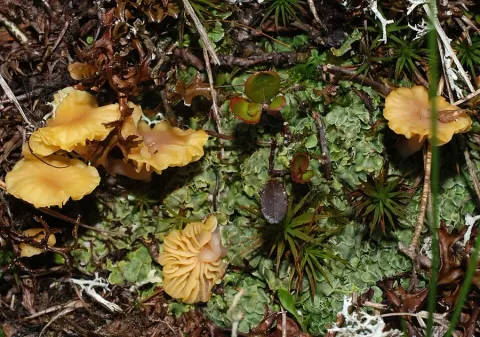
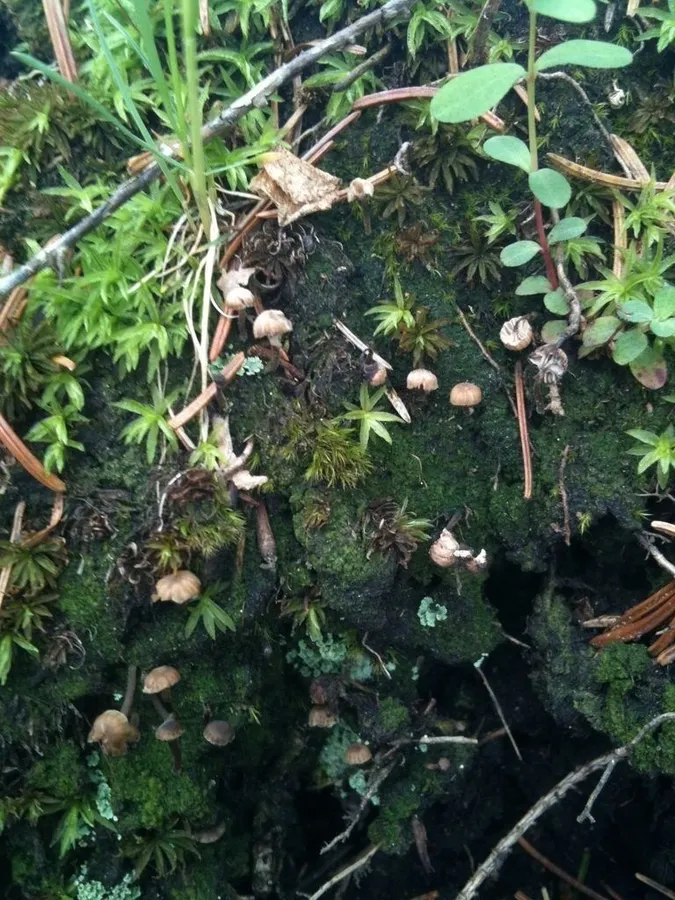
Lichenomphalia meridionalis grows on bare or mossy acid soil, often on slopes, road banks, or open ground in oak woodland and shrub vegetation, including sites with Cistus, Calluna vulgaris, Quercus pyrenaica, and Quercus ilex. In the Iberian Peninsula it has been treated as a Mediterranean species of humid montane sites, especially in the mesomediterranean and supramediterranean elevation belts, and Spanish material studied for symbiont composition came from 533 to 2,200 m elevation. Fruiting bodies have been recorded in cool, moist parts of the year, especially winter, spring, and autumn. The species was first described from Sardinia and is now known from Spain, Corsica, Greece (Lesvos), and central Japan, where it occurs on Andosols along montane to subalpine road banks at about 1,200–1,900 m elevation. It was documented for the first time from Middle Europe in 2020, when it was recorded from Hungary. A study of Spanish populations found that the fungus associates with two strains of Coccomyxa subellipsoidea that are distributed in part by altitude, and that one of those algal strains consistently occurred with cyanobacteria in the thallus.
- Habitat atau konteks temuan
- hutan
- Substrat
- Informasi belum tersedia pada sumber rilis ini.
- Peran atau konteks
- Pembentuk liken
Reproduksi
The thallus of Lichenomphalia meridionalis is a Botrydina-type structure consisting of small green to dark-green globules, typically 20–55 micrometres (μm) in diameter but sometimes reaching 80 μm. Each globule contains Coccomyxa algae cells enclosed by fungal hyphae. The basidiomata (fruiting bodies) are small and omphalinoid in shape. The caps are 3.5–10 mm wide, convex to flattened or slightly depressed, and translucent-striate. They range in colour from ochraceous to yellowish red, light brown, or brown, and often become paler with age or when dried. The gills are widely spaced (distant) and run down the stem (decurrent), typically whitish to pale greyish white or sometimes matching the cap colour.
Catatan identitas dan cakupan
- Nama diterima mengikuti Catalogue of Life Base2026-09-11; uraian mempertahankan konsep dan nama sumber aslinya.
- Original geographic, specimen and life-cycle scope retained; source import awaits individual editorial review.
- Impor dan terjemahan otomatis belum diperiksa editorial per profil. Struktur reproduktif yang disebutkan tidak membuktikan seluruh siklus hidup diketahui.
- Pengukuran pada uraian mengikuti spesimen, kultur, dan metode sumber; angka tidak diperluas ke semua populasi.
Catatan distribusi dalam narasi mengikuti sumbernya. Dokumentasi spesimen atau foto mengikuti catatan sumber. Bukti wilayah Indonesia dan penilaian konservasi tidak disimpulkan dari gambar.
Melihat dengan konteks
Dokumentasi Lichenomphalia meridionalis menurut asosiasi foto pada record takson iNaturalist. Kredit: Atsushi Nakajima. Identitas mengikuti sumber; bukan penentuan spesimen independen.
- Jenis
- Fotografi
- Kredit
- (c) Atsushi Nakajima, some rights reserved (CC BY)
- Lisensi
- CC BY 4.0
- Sumber media
- Buka entri sumber
Dokumentasi tambahan
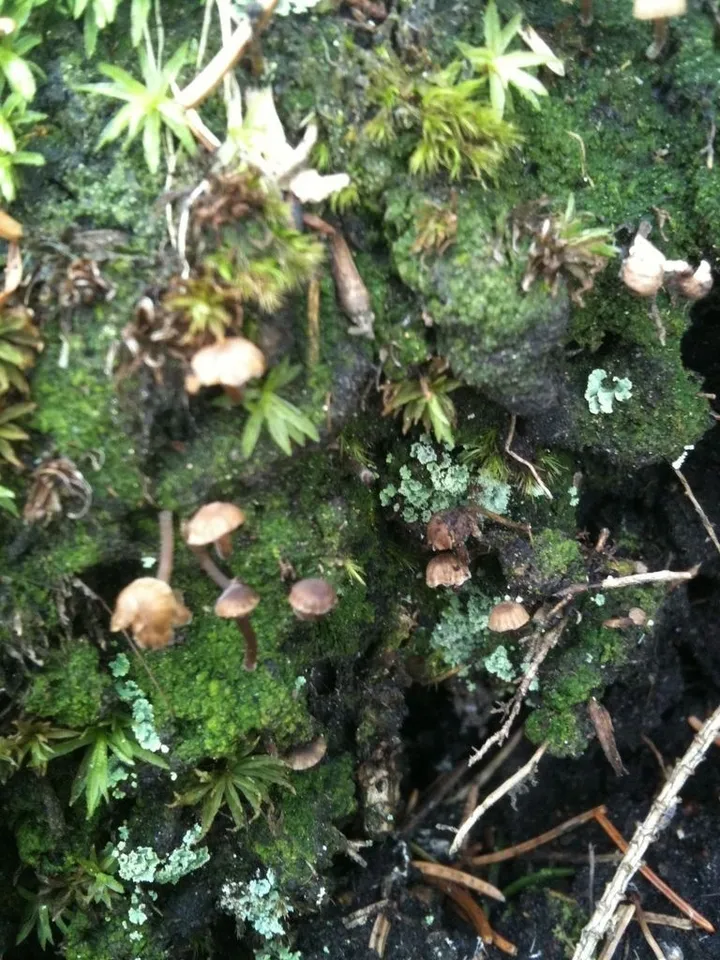
Foto yang diasosiasikan dengan Lichenomphalia meridionalis pada iNaturalist. Identifikasi mengikuti sumber; bukan penentuan spesimen independen.
Kredit dan penggunaan
(c) Atsushi Nakajima, some rights reserved (CC BY)
Ukuran dan format gambar disesuaikan tanpa pemotongan, retus, atau penambahan skala. Lisensi sumber dipertahankan.
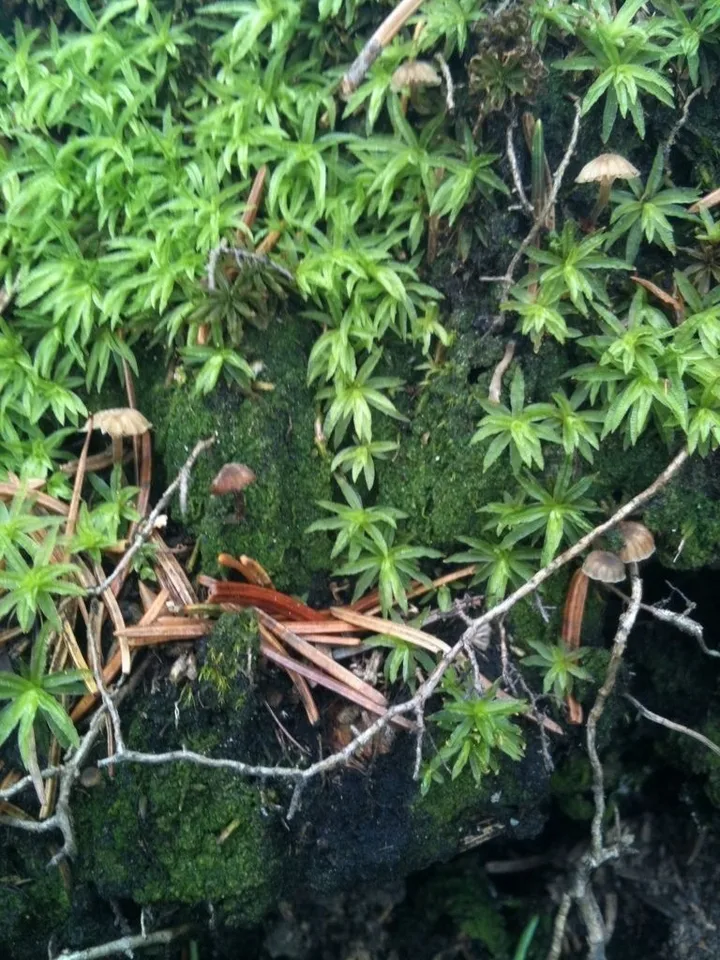
Foto yang diasosiasikan dengan Lichenomphalia meridionalis pada iNaturalist. Identifikasi mengikuti sumber; bukan penentuan spesimen independen.
Kredit dan penggunaan
(c) Atsushi Nakajima, some rights reserved (CC BY)
Ukuran dan format gambar disesuaikan tanpa pemotongan, retus, atau penambahan skala. Lisensi sumber dipertahankan.
Sumber profil
- [1] Lichenomphalia meridionalis — Wikipedia (en)
- [2] Catalogue of Life Base2026-09-11 — Lichenomphalia meridionalis
- [3] Dokumentasi visual — Lichenomphalia meridionalis
- [4] Dokumentasi visual — Lichenomphalia meridionalis
- [5] Dokumentasi visual — Lichenomphalia meridionalis
Rujukan halaman ini
Fungi. Lichenomphalia meridionalis. Rilis data fungi-2026-10-12-expansion-2. https://fungi-atlas.mgadib.chatgpt.site/jamur/lichenomphalia-meridionalis/.
Status: impor sumber; pemeriksaan editorial per profil belum selesai. Untuk klaim biologis, gunakan rujukan pada bagian terkait dan periksa konteks sumber aslinya.