01 / Morfologi

Ciri dan struktur

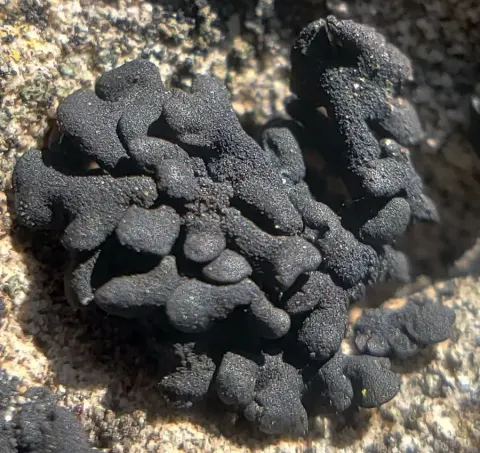
The thallus is blackish and dull to slightly glossy, forming spreading, irregularly crusts or small, roundish to irregular squamules with minutely margins and a finely granular center. Individual areoles or squamules are about 0.4–1(–1.4) mm wide, and attach by tufts of arising from the main thallus hyphae. Internally the thallus is , with robust fungal hyphae forming a dense network around large unicellular cyanobacterial cells that have thick, yellowish-brown gelatinous sheaths (the sheath reacting K+). Fruiting bodies are thallinocarpous and small (about 0.15–0.4(–0.5) mm wide), initially semi-immersed to and sometimes becoming stipitate. The is black and remains unchanged when moistened, with a thin but persistent (though indistinct) and no . The hymenium is hyaline and covered by small packets of thalline tissue, giving an IKI+ (blue) reaction that rapidly turns reddish-brown. Asci are thin-walled and typically 16–24(–32)-spored, and the ascospores are , hyaline, broadly ellipsoid, about 5–7 × 3–4 μm. Pycnidia are immersed, producing small ellipsoid conidia about 3–3.5 × 1 μm, and no lichen substances were detected. Spot tests are reported to be negative, and no secondary metabolites were detected.

Sebagian uraian ditampilkan dalam bahasa sumber; terjemahannya belum tersedia atau belum lolos pemeriksaan.

Rujukan: [1]

Pengukuran mengikuti objek, spesimen atau kultur, dan metode yang disebutkan sumber. Baca uraian asli untuk konteks lengkap.

02 / Kehidupan

Habitat dan peran ekologis

Lichinella granulosa grows on a range of rock types, including limestone, caliche, rhyolite, sandstone, and granite, and has been recorded from roughly 500 to 1750 m elevation. It occurs in desert to woodland settings, including lower Colorado and upland Sonoran Desert habitats, dry Chihuahuan Desert habitats, and pine-oak woodlands. In the Greater Sonoran Desert flora, the species is described as "very common" in Arizona but easy to overlook or misidentify, especially when sterile, when it can resemble a non-fruiting member of the Lichinaceae. When fertile, the thallus becomes more irregular in outline and the surface granules tend to proliferate. Thin sections can help confirm the thallinocarpous fruiting bodies and the characteristic thallus anatomy with large photobiont cells surrounded by short-celled hyphae. The species tends to favor seepage tracks and bare rock surfaces on inclined boulders that are often north-facing, where periodic water flow appears to create suitable microsites for establishment and persistence. As treated by Schultz, the known distribution was based on more than 30 collections from central, southern, and southeastern Arizona, with additional records from southern California, southern New Mexico, northwestern Texas, and Sinaloa in Mexico.

Sebagian uraian ditampilkan dalam bahasa sumber; terjemahannya belum tersedia atau belum lolos pemeriksaan.

Rujukan: [1]

Habitat atau konteks temuan
hutan
Substrat
Informasi belum tersedia pada sumber rilis ini.
Peran atau konteks
Pembentuk liken
Temukan hubungan serupa
03 / Siklus hidup

Reproduksi

Fruiting bodies are thallinocarpous and small (about 0.15–0.4(–0.5) mm wide), initially semi-immersed to and sometimes becoming stipitate. The is black and remains unchanged when moistened, with a thin but persistent (though indistinct) and no . The hymenium is hyaline and covered by small packets of thalline tissue, giving an IKI+ (blue) reaction that rapidly turns reddish-brown. Asci are thin-walled and typically 16–24(–32)-spored, and the ascospores are , hyaline, broadly ellipsoid, about 5–7 × 3–4 μm. Pycnidia are immersed, producing small ellipsoid conidia about 3–3.5 × 1 μm, and no lichen substances were detected. Spot tests are reported to be negative, and no secondary metabolites were detected.

Sebagian uraian ditampilkan dalam bahasa sumber; terjemahannya belum tersedia atau belum lolos pemeriksaan.

Rujukan: [1]

04 / Batas informasi

Catatan identitas dan cakupan

  • Nama diterima mengikuti Catalogue of Life Base2026-09-11; uraian mempertahankan konsep dan nama sumber aslinya.
  • Original geographic, specimen and life-cycle scope retained; source import awaits individual editorial review.
  • Impor dan terjemahan otomatis belum diperiksa editorial per profil. Struktur reproduktif yang disebutkan tidak membuktikan seluruh siklus hidup diketahui.
  • Pengukuran pada uraian mengikuti spesimen, kultur, dan metode sumber; angka tidak diperluas ke semua populasi.

Catatan distribusi dalam narasi mengikuti sumbernya. Dokumentasi spesimen atau foto mengikuti catatan sumber. Bukti wilayah Indonesia dan penilaian konservasi tidak disimpulkan dari gambar.

05 / Dokumentasi

Melihat dengan konteks

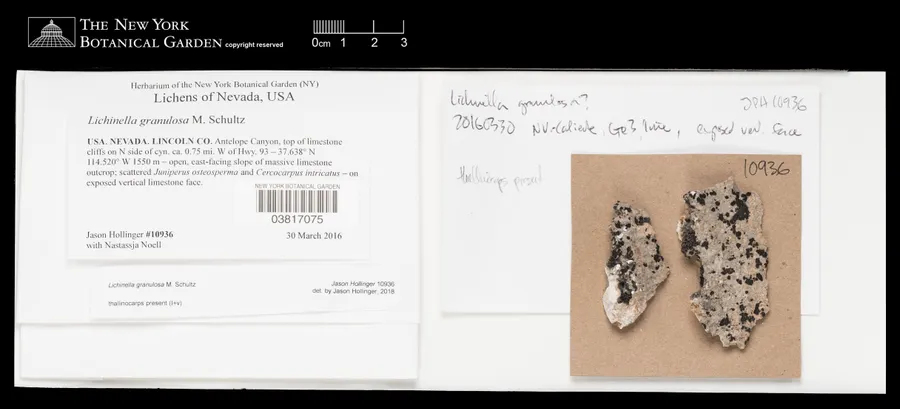
Voucher herbarium Lichinella granulosa (03817075), The New York Botanical Garden. Identifikasi mengikuti record spesimen sumber. Foto bahan, kemasan, atau label herbarium sebagaimana tersedia pada record institusi; bukan foto lapangan atau penentuan spesimen independen.

Jenis
Voucher herbarium
Kredit
The New York Botanical Garden
Lisensi
CC BY 4.0
Sumber media
Buka entri sumber

Gambar menunjukkan objek menurut identifikasi sumber, bukan verifikasi independen spesimen oleh Fungi. Tidak ada skala baru yang ditambahkan.

06 / Rujukan

Sumber profil

  1. [1] Lichinella granulosa — Wikipedia (en)Bagian sumber: Frozen revision 1341958761
    Tanggal penghimpunan sumber: 2026-10-12
    Teks sumber: CC BY-SA4.0 · Wikipedia contributors
  2. [2] Catalogue of Life Base2026-09-11 — Lichinella granulosaBagian sumber: ColDP NameUsage.tsv ID 6PY2W; accepted species; source 2073
    Tanggal penghimpunan sumber: 2026-10-12
  3. [3] Dokumentasi visual — Lichinella granulosaBagian sumber: Individual media record; identification follows the source, not independent determination
    Tanggal penghimpunan sumber: 2026-10-12
    Media sumber: CC BY 4.0 · The New York Botanical Garden

Adaptasi teks: CC BY-SA 4.0. Wikipedia contributors — Lichinella granulosa — Wikipedia (en)

Uraian asli dan riwayat sumber

Riwayat atau halaman sumber

Ringkasan sumber

Lichinella granulosa is a species of rock-dwelling lichen-forming fungus in the family Lichinellaceae. It is a small, blackish, crust-forming lichen that grows on various rock types in desert and woodland habitats of the southwestern United States and northwestern Mexico. Its algal partner is a cyanobacterium rather than a green alga, and the thallus surface bears distinctive granular outgrowths that may serve as vegetative dispersal units. The species was described in 2005 and is reported as very common in Arizona, though it is easily overlooked when not fertile.

Revisi sumber

Morfologi sumber

The thallus is blackish and dull to slightly glossy, forming spreading, irregularly crusts or small, roundish to irregular squamules with minutely margins and a finely granular center. Individual areoles or squamules are about 0.4–1(–1.4) mm wide, and attach by tufts of arising from the main thallus hyphae. Internally the thallus is , with robust fungal hyphae forming a dense network around large unicellular cyanobacterial cells that have thick, yellowish-brown gelatinous sheaths (the sheath reacting K+). Fruiting bodies are thallinocarpous and small (about 0.15–0.4(–0.5) mm wide), initially semi-immersed to and sometimes becoming stipitate. The is black and remains unchanged when moistened, with a thin but persistent (though indistinct) and no . The hymenium is hyaline and covered by small packets of thalline tissue, giving an IKI+ (blue) reaction that rapidly turns reddish-brown. Asci are thin-walled and typically 16–24(–32)-spored, and the ascospores are , hyaline, broadly ellipsoid, about 5–7 × 3–4 μm. Pycnidia are immersed, producing small ellipsoid conidia about 3–3.5 × 1 μm, and no lichen substances were detected. Spot tests are reported to be negative, and no secondary metabolites were detected.

Revisi sumber

Ekologi sumber

Lichinella granulosa grows on a range of rock types, including limestone, caliche, rhyolite, sandstone, and granite, and has been recorded from roughly 500 to 1750 m elevation. It occurs in desert to woodland settings, including lower Colorado and upland Sonoran Desert habitats, dry Chihuahuan Desert habitats, and pine-oak woodlands. In the Greater Sonoran Desert flora, the species is described as "very common" in Arizona but easy to overlook or misidentify, especially when sterile, when it can resemble a non-fruiting member of the Lichinaceae. When fertile, the thallus becomes more irregular in outline and the surface granules tend to proliferate. Thin sections can help confirm the thallinocarpous fruiting bodies and the characteristic thallus anatomy with large photobiont cells surrounded by short-celled hyphae. The species tends to favor seepage tracks and bare rock surfaces on inclined boulders that are often north-facing, where periodic water flow appears to create suitable microsites for establishment and persistence. As treated by Schultz, the known distribution was based on more than 30 collections from central, southern, and southeastern Arizona, with additional records from southern California, southern New Mexico, northwestern Texas, and Sinaloa in Mexico.

Revisi sumber

Struktur reproduksi sumber

Fruiting bodies are thallinocarpous and small (about 0.15–0.4(–0.5) mm wide), initially semi-immersed to and sometimes becoming stipitate. The is black and remains unchanged when moistened, with a thin but persistent (though indistinct) and no . The hymenium is hyaline and covered by small packets of thalline tissue, giving an IKI+ (blue) reaction that rapidly turns reddish-brown. Asci are thin-walled and typically 16–24(–32)-spored, and the ascospores are , hyaline, broadly ellipsoid, about 5–7 × 3–4 μm. Pycnidia are immersed, producing small ellipsoid conidia about 3–3.5 × 1 μm, and no lichen substances were detected. Spot tests are reported to be negative, and no secondary metabolites were detected.

Revisi sumber

Rujukan halaman ini

Fungi. Lichinella granulosa. Rilis data fungi-2026-10-12-expansion-2. https://fungi-atlas.mgadib.chatgpt.site/jamur/lichinella-granulosa/.

Status: impor sumber; pemeriksaan editorial per profil belum selesai. Untuk klaim biologis, gunakan rujukan pada bagian terkait dan periksa konteks sumber aslinya.