Ciri dan struktur
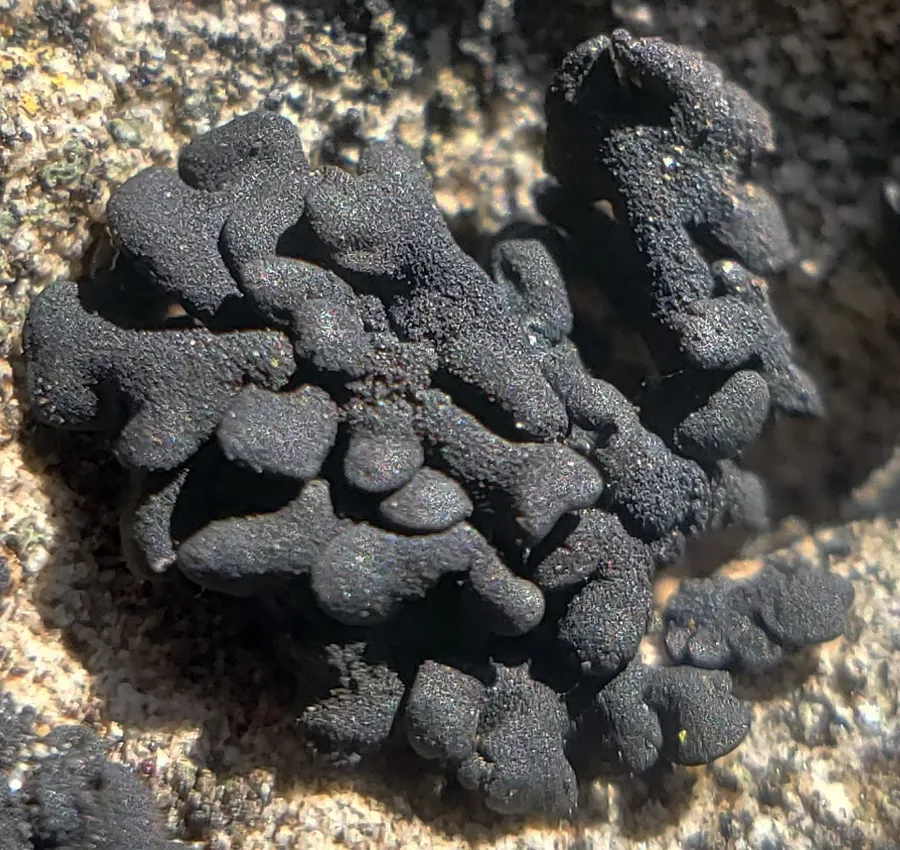
Lichinella iodopulchra forms small, rosette-like growths on rock surfaces, with individual rosettes 5–20 mm across, built from contiguous lobules whose margins often curve downward to form a subtle rim. The thallus (the main body of the lichen) is flat and closely attached to the substrate, with a surface that appears smooth to finely granular on both upper and lower sides. The edges are distinctly ridged and pressed tightly against the rock surface, creating characteristic pleated folds as the lichen develops. The thallus is divided into distinct sections by narrow grooves 600–800 μm wide. Each section is formed by tightly packed, short cellular filaments that are predominantly arranged in a radial pattern. The medulla (inner tissue layer) consists of a loose network of branching filaments measuring 1.5–2.5 micrometres (μm) in width. cells (the algal partner that provides nutrients through photosynthesis) are spherical or slightly oval, measuring 4–6 × 2–5 μm, and are distributed in dense, closely packed layers throughout the thallus interior. The fruiting bodies are located at or near the margins of the thallus and measure 2–4.6 mm in diameter. These structures appear sunken or only slightly raised above the surface, with an irregularly grooved appearance. The outer layer is 20–50 μm thick and divided into compartments by algal filaments that penetrate from the underlying tissue in a wedge-like pattern. This creates chambers that open to the surface through sterile filaments from the (the layer beneath the reproductive tissue). Thallinocarpic fruiting bodies are usually immersed to slightly raised and can be hard to see; wetting the thallus helps, as sterile parts darken green whereas fertile portions show a paler, brownish tinge.
Habitat dan peran ekologis
Lichinella iodopulchra is a saxicolous cyanolichen that grows directly on rock, occurring on both calcareous and siliceous substrates; specimens have been documented on exposed granite outcrops in the semi-arid Caatinga of north-eastern Brazil. In the Sonoran Desert region it occupies sun-exposed desert rock faces, and regional accounts treat it under a broad species concept when summarising its ecology. In the Southwestern United States, most collections are from steep, inclined, shaded rock faces, often on north-northwest exposures and along seepage tracks, and the species is fairly common inland but mostly absent from coastal localities. The species has a broad, mainly warm-region (temperate) distribution. In North America it is recorded from the south-western United States and north-western Mexico (with specific Sonoran occurrences in Arizona and Baja California Sur); in Macaronesia it is recorded from the Canary Islands; in the Mediterranean basin it occurs in south-eastern Spain and in North Africa (including Algeria); it extends through the Middle East (e.g., Iran) and into the Caucasus (Georgia); and it has been verified from north-eastern Brazil.
- Habitat atau konteks temuan
- Informasi belum tersedia pada sumber rilis ini.
- Substrat
- Informasi belum tersedia pada sumber rilis ini.
- Peran atau konteks
- Pembentuk liken
Reproduksi
The fruiting bodies are located at or near the margins of the thallus and measure 2–4.6 mm in diameter. These structures appear sunken or only slightly raised above the surface, with an irregularly grooved appearance. The outer layer is 20–50 μm thick and divided into compartments by algal filaments that penetrate from the underlying tissue in a wedge-like pattern. This creates chambers that open to the surface through sterile filaments from the (the layer beneath the reproductive tissue). Thallinocarpic fruiting bodies are usually immersed to slightly raised and can be hard to see; wetting the thallus helps, as sterile parts darken green whereas fertile portions show a paler, brownish tinge.
Catatan identitas dan cakupan
- Nama diterima mengikuti Catalogue of Life Base2026-09-11; uraian mempertahankan konsep dan nama sumber aslinya.
- Original geographic, specimen and life-cycle scope retained; source import awaits individual editorial review.
- Impor dan terjemahan otomatis belum diperiksa editorial per profil. Struktur reproduktif yang disebutkan tidak membuktikan seluruh siklus hidup diketahui.
- Pengukuran pada uraian mengikuti spesimen, kultur, dan metode sumber; angka tidak diperluas ke semua populasi.
Catatan distribusi dalam narasi mengikuti sumbernya. Dokumentasi spesimen atau foto mengikuti catatan sumber. Bukti wilayah Indonesia dan penilaian konservasi tidak disimpulkan dari gambar.
Melihat dengan konteks
Dokumentasi Lichinella iodopulchra menurut asosiasi foto pada record takson iNaturalist. Kredit: aarongunnar. Identitas mengikuti sumber; bukan penentuan spesimen independen.
- Jenis
- Fotografi
- Kredit
- (c) aarongunnar, some rights reserved (CC BY), uploaded by aarongunnar
- Lisensi
- CC BY 4.0
- Sumber media
- Buka entri sumber
Sumber profil
- [1] Lichinella iodopulchra — Wikipedia (en)
- [2] Catalogue of Life Base2026-09-11 — Lichinella iodopulchra
- [3] Dokumentasi visual — Lichinella iodopulchra
Rujukan halaman ini
Fungi. Lichinella iodopulchra. Rilis data fungi-2026-10-12-expansion-2. https://fungi-atlas.mgadib.chatgpt.site/jamur/lichinella-iodopulchra/.
Status: impor sumber; pemeriksaan editorial per profil belum selesai. Untuk klaim biologis, gunakan rujukan pada bagian terkait dan periksa konteks sumber aslinya.