Ciri dan struktur
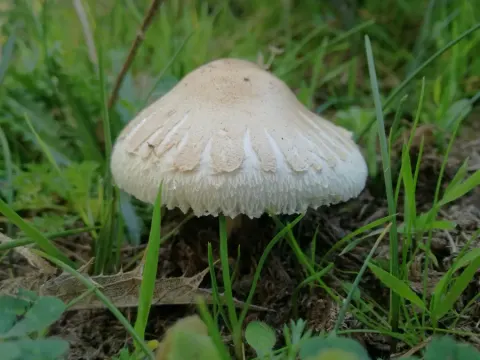
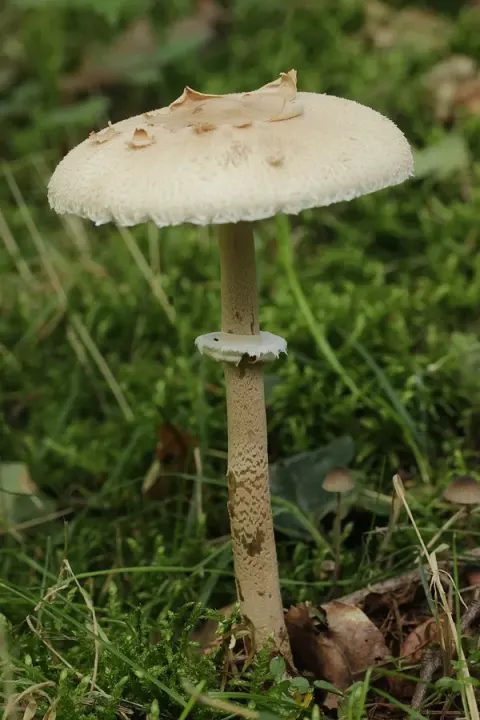
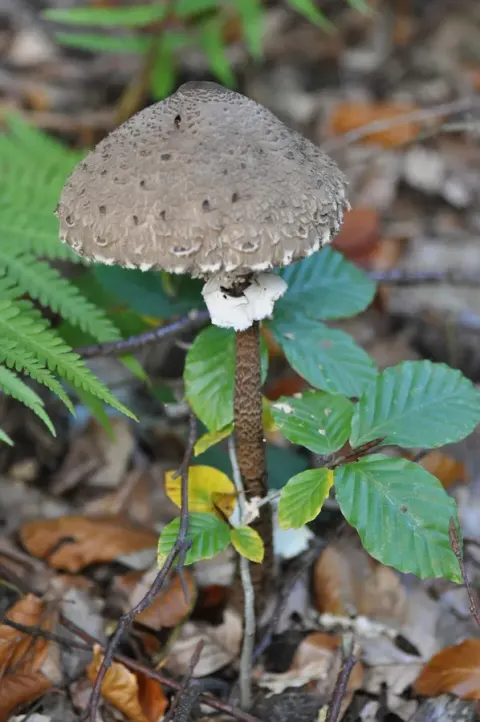
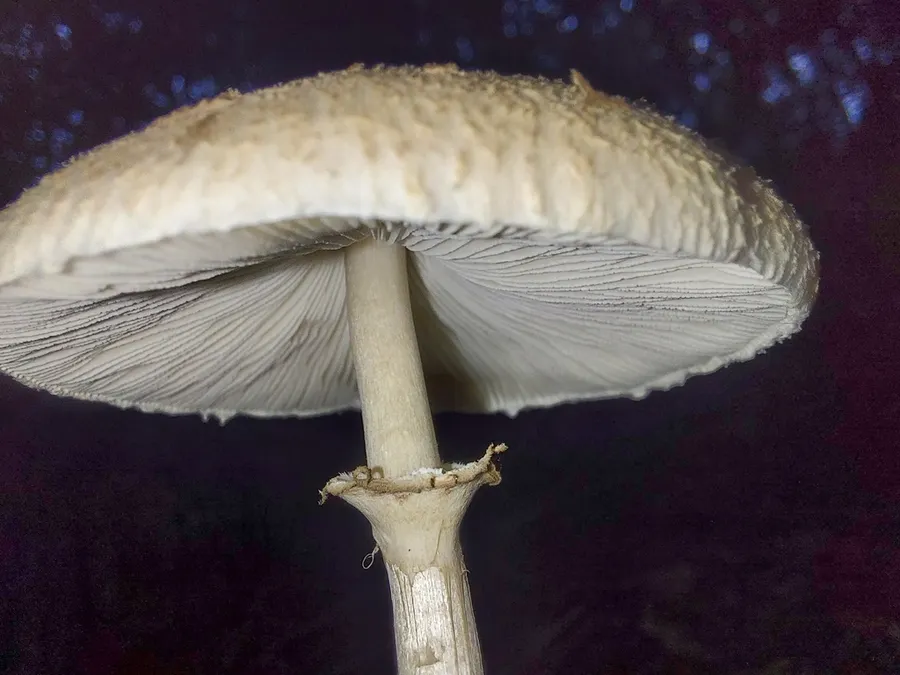
The fruitbody of Macrolepiota clelandii has a cap that is initially egg-shaped, later becoming convex and then flattened in maturity, reaching diameters of 7.6 – 12.5 cm. It has a dark brown umbo and small dark brown scales that show the whitish flesh underneath. These scales are arranged in concentric rings that become increasingly crowded until the umbo, which is completely covered in scales. Small fragments of the partial veil may be left hanging on the cap margin. The white gills are free from attachment to the stipe and closely spaced. The slender, hollow stipe measures up to 18.7 cm long, and has a somewhat bulbous base. It has a pale brown colour, and features a ring on its upper half that often detaches to become freely movable up and down the stipe. The mushrooms have no distinctive odour. Its tall stature means the gills are usually clean, having avoided rain splash from the forest floor. According to Peter Roberts and Shelley Evans, all "parasol" species (i.e., M. procera and its close relatives, including M. clelandii) are edible. Anthony M. Young notes the similarity of M. clelandii to the edible European species M. konradii, but warns "the toxicity of the Australian species is unknown." Macrolepiota clelandii produces a white spore print. Individual spores are ellipsoid with a small germ pore, smooth, thick-walled, and measure 13.4–24.8 by 9.6–16.0 μm. They have a dextrinoid staining reaction (reddish-brown) with Melzer's reagent. The basidia (spore-bearing cells) are club-shaped, measuring 38.0–50 by 10.2–13.6 μm. They are two-, three-, or four-spored, with sterigmata up to 8.0 μm long.
Habitat dan peran ekologis
Macrolepiota clelandii fruits singly or in small groups on the ground in grass or among leaf litter. It is typically found in eucalypt forest and subtropical rainforests. It has been recorded from Queensland, New South Wales, Victoria, South Australia, and Western Australia. In southwest Australia it is found in jarrah (Eucalyptus marginata) and karri (Eucalyptus diversicolor) forests, where fruiting usually occurs in late autumn and early winter. The fungus appears to prefer disturbed ground, as it is often found at roadsides by forests, on lawns, grassy areas of parks, and among the slash of thinned karri regrowth forests. It is common in river red gum (Eucalyptus camaldulensis) woodlands. M. clelandii also occurs in New Zealand, where it is found in mixed mānuka (Leptospermum scoparium), kānuka (Kunzea ericoides), and kauri (Agathis) forest, and in conifer plantations. It is the smallest and most slender of the Macrolepiota species that occur there.
- Habitat atau konteks temuan
- hutan
- Substrat
- tanah
- Peran atau konteks
- Belum dikategorikan pada rilis ini.
Reproduksi
Macrolepiota clelandii produces a white spore print. Individual spores are ellipsoid with a small germ pore, smooth, thick-walled, and measure 13.4–24.8 by 9.6–16.0 μm. They have a dextrinoid staining reaction (reddish-brown) with Melzer's reagent. The basidia (spore-bearing cells) are club-shaped, measuring 38.0–50 by 10.2–13.6 μm. They are two-, three-, or four-spored, with sterigmata up to 8.0 μm long. Collections with predominantly four-spored basidia will generally have smaller spores than those with two-spored basidia. Two-spored basidia produce spores with four nuclei. Cheilocystidia are plentiful on the edge of the gill. They have dimensions of 24.8–42.4 by 7.2–10.4 μm, with a cylindrical to club shape.
Catatan identitas dan cakupan
- Nama diterima mengikuti Catalogue of Life Base2026-09-11; uraian mempertahankan konsep dan nama sumber aslinya.
- Original geographic, specimen and life-cycle scope retained; source import awaits individual editorial review.
- Impor dan terjemahan otomatis belum diperiksa editorial per profil. Struktur reproduktif yang disebutkan tidak membuktikan seluruh siklus hidup diketahui.
- Pengukuran pada uraian mengikuti spesimen, kultur, dan metode sumber; angka tidak diperluas ke semua populasi.
Catatan distribusi dalam narasi mengikuti sumbernya. Dokumentasi spesimen atau foto mengikuti catatan sumber. Bukti wilayah Indonesia dan penilaian konservasi tidak disimpulkan dari gambar.
Melihat dengan konteks
Dokumentasi Macrolepiota clelandii menurut asosiasi foto pada record takson iNaturalist. Kredit: Robert Vennell. Identitas mengikuti sumber; bukan penentuan spesimen independen.
- Jenis
- Fotografi
- Kredit
- (c) Robert Vennell, some rights reserved (CC BY), uploaded by Robert Vennell
- Lisensi
- CC BY 4.0
- Sumber media
- Buka entri sumber
Dokumentasi tambahan
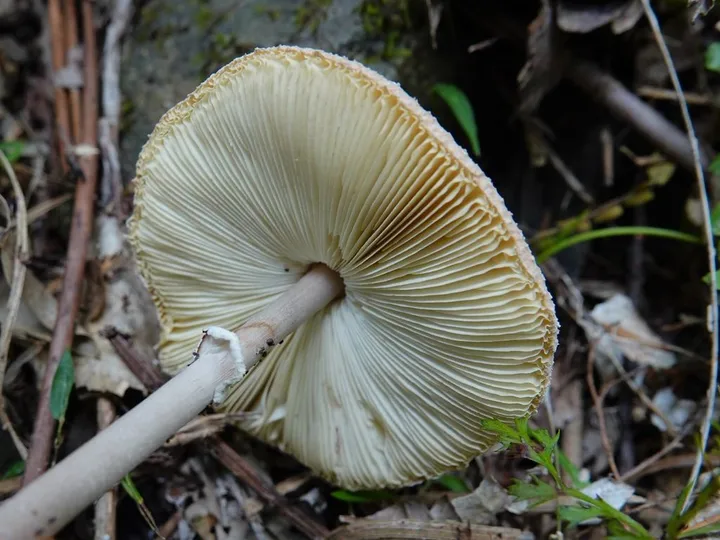
Foto yang diasosiasikan dengan Macrolepiota clelandii pada iNaturalist. Identifikasi mengikuti sumber; bukan penentuan spesimen independen.
Kredit dan penggunaan
(c) Jacqui Geux, some rights reserved (CC BY), uploaded by Jacqui Geux
Ukuran dan format gambar disesuaikan tanpa pemotongan, retus, atau penambahan skala. Lisensi sumber dipertahankan.
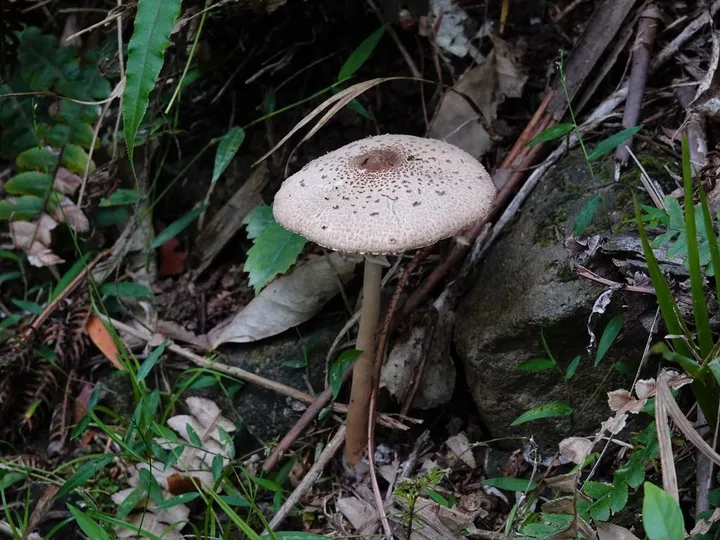
Foto yang diasosiasikan dengan Macrolepiota clelandii pada iNaturalist. Identifikasi mengikuti sumber; bukan penentuan spesimen independen.
Kredit dan penggunaan
(c) Jacqui Geux, some rights reserved (CC BY), uploaded by Jacqui Geux
Ukuran dan format gambar disesuaikan tanpa pemotongan, retus, atau penambahan skala. Lisensi sumber dipertahankan.
Sumber profil
- [1] Macrolepiota clelandii — Wikipedia (en)
- [2] Catalogue of Life Base2026-09-11 — Macrolepiota clelandii
- [3] Dokumentasi visual — Macrolepiota clelandii
- [4] Dokumentasi visual — Macrolepiota clelandii
- [5] Dokumentasi visual — Macrolepiota clelandii
Rujukan halaman ini
Fungi. Macrolepiota clelandii. Rilis data fungi-2026-10-12-expansion-2. https://fungi-atlas.mgadib.chatgpt.site/jamur/macrolepiota-clelandii/.
Status: impor sumber; pemeriksaan editorial per profil belum selesai. Untuk klaim biologis, gunakan rujukan pada bagian terkait dan periksa konteks sumber aslinya.