Ciri dan struktur
Basidiomata small-sized, marasmioid. Pileus 5–10 mm diam., orbicular when young and then convex at age, streaked from disc to margin, margin entire, wavy to irregular, decurved or greatly reflexed, surface dry, smooth, white pruinose, white to grayish orange (5B4–5), grayish orange (5B4) at the margin. Lamellae adnate, subdistant, with 2–3 series of lamellulae, 14–16 major lamellae, unequal, narrow, pale white at face and edge. Smell and taste none. Stipe 4–6 × 1–2 mm, often curved, lateral or central, disc at the base, dry, surface smooth, whitish to pale orange (5A3); Context thick, fistulose, orange white (5A2–3). Basidiospores 7–9(–10) × (3)3.5–4.5(–6) µm (average = 8 × 4.5 μm), Q = 1.4–1.8(–2), Qm = 1.74 ± 0.11, broadly ellipsoid, smooth, hyaline, inamyloid, thin-walled. Basidia 10–12.5 × 3–4.5 µm, clavate, 4-spored, sterigmata up to 1.5 µm. Cheilocystidia abundant, 15–17(–22) × 8–9(–11) µm, broom-cell type with finger-like excrescences in the upper half, hyaline, thin-walled. Pleurocystidia absent. Pileipellis with poorly Ramealis -structure, trama hyphae 4–9 µm, negative in Melzer’s reagent. Stipitipellis hyphae up to 5 μm wide, smooth, thin-walled, trama not observed, negative in Melzer’s reagent. Clamp connections present.
Habitat dan peran ekologis
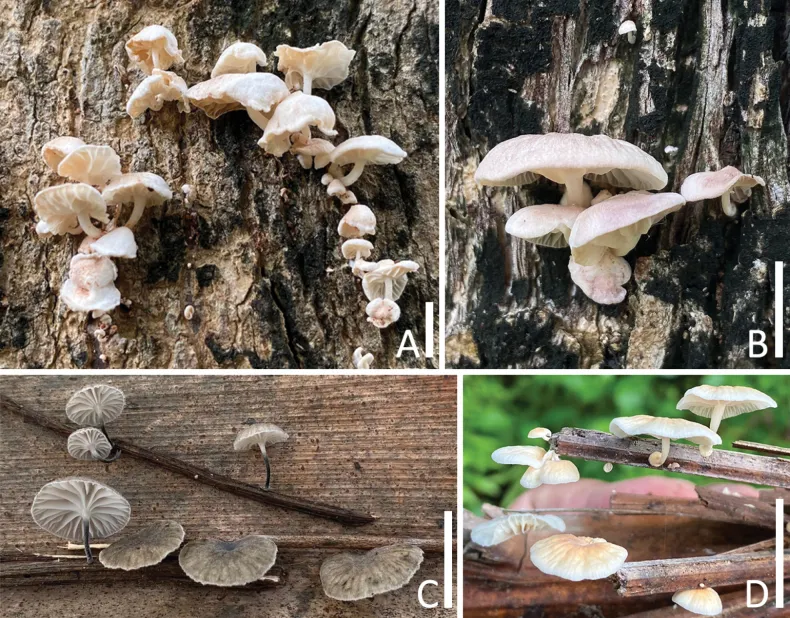
Caespitose, in small groups on decaying leaf of Metroxylon sagu in southern Thailand (This study), on Aquilaria sinensis (agarwood) trees in China (Zhang et al. 2023), and on the stem of mangosteen in Malaysia (Turner 1971), on cocoa in Australia, Ghana, Caribbean, Papua New Guinea, and Solomon Islands (Amoako-Attah et al. 2020; Ali et al. 2021), on coffee in Fiji, Guinea, and Sierra Leone (Lu et al. 2022).
- Habitat atau konteks temuan
- Informasi belum tersedia pada sumber rilis ini.
- Substrat
- Informasi belum tersedia pada sumber rilis ini.
- Peran atau konteks
- Belum dikategorikan pada rilis ini.
Reproduksi
Basidiomata small-sized, marasmioid. Pileus 5–10 mm diam., orbicular when young and then convex at age, streaked from disc to margin, margin entire, wavy to irregular, decurved or greatly reflexed, surface dry, smooth, white pruinose, white to grayish orange (5B4–5), grayish orange (5B4) at the margin. Lamellae adnate, subdistant, with 2–3 series of lamellulae, 14–16 major lamellae, unequal, narrow, pale white at face and edge. Smell and taste none. Stipe 4–6 × 1–2 mm, often curved, lateral or central, disc at the base, dry, surface smooth, whitish to pale orange (5A3); Context thick, fistulose, orange white (5A2–3). Basidiospores 7–9(–10) × (3)3.5–4.5(–6) µm (average = 8 × 4.5 μm), Q = 1.4–1.8(–2), Qm = 1.74 ± 0.11, broadly ellipsoid, smooth, hyaline, inamyloid, thin-walled.
Catatan identitas dan cakupan
- Nama diterima mengikuti Catalogue of Life Base2026-09-11; uraian mempertahankan konsep dan nama sumber aslinya.
- Preserve original treatment localities, hosts and substrate scope. Materials examined describe documented specimens, not the full global range.
- Impor dan terjemahan otomatis belum diperiksa editorial per profil. Struktur reproduktif yang disebutkan tidak membuktikan seluruh siklus hidup diketahui.
- Pengukuran pada uraian mengikuti spesimen, kultur, dan metode sumber; angka tidak diperluas ke semua populasi.
Catatan distribusi dalam narasi mengikuti sumbernya. Dokumentasi spesimen atau foto mengikuti catatan sumber. Bukti wilayah Indonesia dan penilaian konservasi tidak disimpulkan dari gambar.
Melihat dengan konteks
Habitat of Marasmiellus species in the present study A, B Marasmiellus thailandicus (CMUB40052, holotype) C Marasmiellus minutisporus (CMUB40054, holotype) D Marasmiellus scandens (CMUB40056, new record). Scale bars: 10 mm (A–D).
- Jenis
- Pelat ilmiah
- Kredit
- Wenhua Lu, Pumin Nutaratat, Jaturong Kumla, Saowaluck Tibpromma, Abdallah M. Elgorban, Samantha C. Karunarathna, Nakarin Suwannarach
- Lisensi
- CC BY 4.0
- Sumber media
- Buka entri sumber
Dokumentasi tambahan
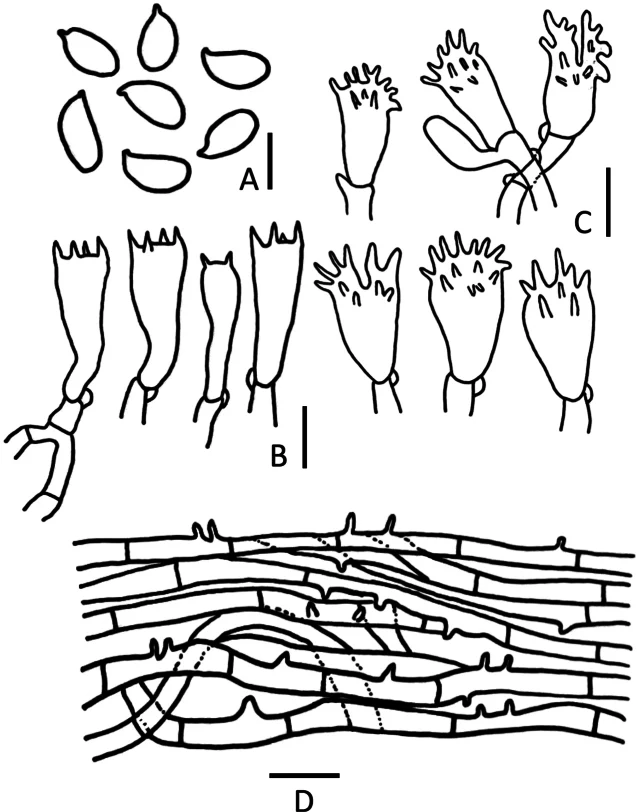
Marasmiellus scandens (CMUB40056, new record) A basidiospores B basidia C cheilocystidia D terminal elements of pileipellis. Scale bars: 5 µm (A–C); 10 µm (D).
Kredit dan penggunaan
Wenhua Lu, Pumin Nutaratat, Jaturong Kumla, Saowaluck Tibpromma, Abdallah M. Elgorban, Samantha C. Karunarathna, Nakarin Suwannarach
Ukuran dan format gambar disesuaikan tanpa pemotongan, retus, atau penambahan skala. Lisensi sumber dipertahankan.
Sumber profil
- [1] Morphological and molecular identification of two new Marasmiellus species (Omphalotaceae, Agaricales) from Thailand — Marasmiellus scandens
- [2] Catalogue of Life Base2026-09-11 — Marasmiellus scandens
- [3] Dokumentasi visual — Marasmiellus scandens
- [4] Dokumentasi visual — Marasmiellus scandens
Rujukan halaman ini
Fungi. Marasmiellus scandens. Rilis data fungi-2026-10-12-expansion-2. https://fungi-atlas.mgadib.chatgpt.site/jamur/marasmiellus-scandens/.
Status: impor sumber; pemeriksaan editorial per profil belum selesai. Untuk klaim biologis, gunakan rujukan pada bagian terkait dan periksa konteks sumber aslinya.