01 / Morfologi

Ciri dan struktur

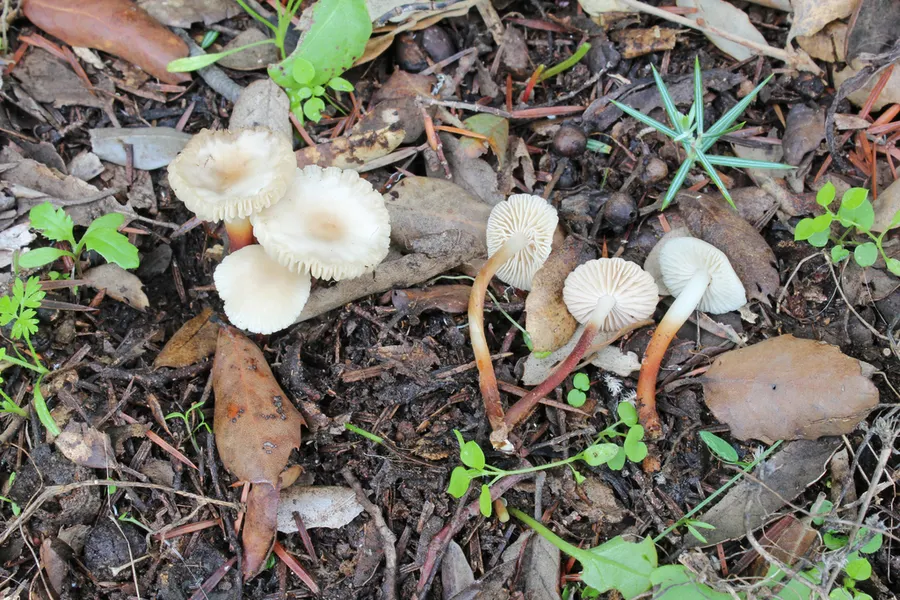
The same set of references applies to this section throughout. The hygrophanous cap is hemispherical and white to greyish or ochre when young. Later it expands to become flat and may turn grey or also take on violet tints. The diameter is from about 1 cm to 5 cm. The whitish thick and distant gills are almost free to emarginate. There is no ring or other veil remnant. The tough stem is up to about 7 cm long and up to 0.5 cm in diameter. Initially it is whitish and it becomes red brown from the base. The taste is mild and the smell is pleasant initially (of hay, melilot or bitter almonds) but after a moment it becomes unpleasant (of acid, or a drying facecloth). The spore powder is white and the spores are ellipsoid, sometimes elongated (with an aspect ratio up to about 2) and are around 6-8 μm by 3.5-4.5 μm. There are cheilocystidia which are club-shaped to spindle-shaped with lobes at one end.

Sebagian uraian ditampilkan dalam bahasa sumber; terjemahannya belum tersedia atau belum lolos pemeriksaan.

Rujukan: [1]

Pengukuran mengikuti objek, spesimen atau kultur, dan metode yang disebutkan sumber. Baca uraian asli untuk konteks lengkap.

02 / Kehidupan

Habitat dan peran ekologis

This saprobic mushroom grows in clusters on humus and litter in beech woods or other broad-leaved woods. The conspicuous white mycelium can bind leaf litter together in sheets. This mushroom is widespread from August to January in Europe, and has been reported from Algeria, Morocco, and Texas, but not from other regions. It is common in western temperate Europe, especially under beech.

Sebagian uraian ditampilkan dalam bahasa sumber; terjemahannya belum tersedia atau belum lolos pemeriksaan.

Rujukan: [1]

Habitat atau konteks temuan
Informasi belum tersedia pada sumber rilis ini.
Substrat
Informasi belum tersedia pada sumber rilis ini.
Peran atau konteks
Pengurai
Temukan hubungan serupa
03 / Siklus hidup

Reproduksi

The spore powder is white and the spores are ellipsoid, sometimes elongated (with an aspect ratio up to about 2) and are around 6-8 μm by 3.5-4.5 μm. There are cheilocystidia which are club-shaped to spindle-shaped with lobes at one end.

Sebagian uraian ditampilkan dalam bahasa sumber; terjemahannya belum tersedia atau belum lolos pemeriksaan.

Rujukan: [1]

Sinonim menurut acuan taksonomi rilis: Agaricus globularis; Agaricus oreades var. alnetorum; Chamaeceras carpathicus; Chamaeceras globularis; Chamaeceras wynneae; Collybia globularis; Marasmius archyropus var. suaveolens; Marasmius carpathicus; Marasmius globularis; Marasmius globularis var. carpathicus; Marasmius suaveolens; Marasmius wynneae f. carpathicus; Marasmius wynneae f. pachyphyllus; Marasmius wynneae var. odoratus; Marasmius wynneae var. versicolor
04 / Batas informasi

Catatan identitas dan cakupan

  • Nama diterima mengikuti Catalogue of Life Base2026-09-11; uraian mempertahankan konsep dan nama sumber aslinya.
  • Original geographic, specimen and life-cycle scope retained; source import awaits individual editorial review.
  • Impor dan terjemahan otomatis belum diperiksa editorial per profil. Struktur reproduktif yang disebutkan tidak membuktikan seluruh siklus hidup diketahui.
  • Pengukuran pada uraian mengikuti spesimen, kultur, dan metode sumber; angka tidak diperluas ke semua populasi.

Catatan distribusi dalam narasi mengikuti sumbernya. Dokumentasi spesimen atau foto mengikuti catatan sumber. Bukti wilayah Indonesia dan penilaian konservasi tidak disimpulkan dari gambar.

05 / Dokumentasi

Melihat dengan konteks

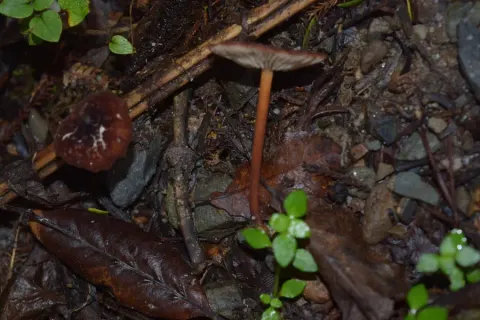
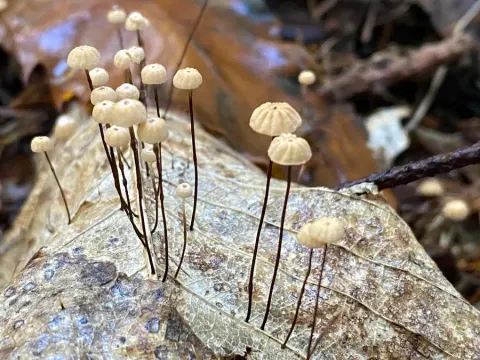
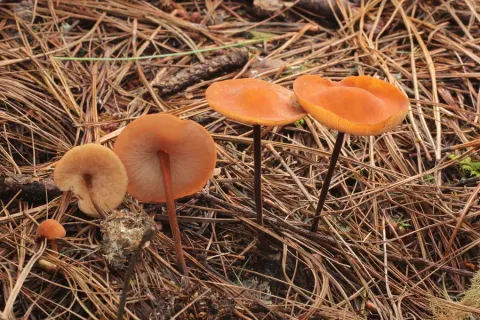
Dokumentasi Marasmius wynneae menurut asosiasi foto pada record takson iNaturalist. Kredit: Davide Puddu. Identitas mengikuti sumber; bukan penentuan spesimen independen.

Jenis
Fotografi
Kredit
(c) Davide Puddu, some rights reserved (CC BY), uploaded by Davide Puddu
Lisensi
CC BY 4.0
Sumber media
Buka entri sumber

Gambar menunjukkan objek menurut identifikasi sumber, bukan verifikasi independen spesimen oleh Fungi. Tidak ada skala baru yang ditambahkan.

06 / Rujukan

Sumber profil

  1. [1] Marasmius wynneae — Wikipedia (en)Bagian sumber: Frozen revision 1318539803
    Tanggal penghimpunan sumber: 2026-10-12
    Teks sumber: CC BY-SA4.0 · Wikipedia contributors
  2. [2] Catalogue of Life Base2026-09-11 — Marasmius wynneaeBagian sumber: ColDP NameUsage.tsv ID 3Y28P; accepted species; source 2073
    Tanggal penghimpunan sumber: 2026-10-12
  3. [3] Dokumentasi visual — Marasmius wynneaeBagian sumber: Individual media record; identification follows the source, not independent determination
    Tanggal penghimpunan sumber: 2026-10-12
    Media sumber: CC BY 4.0 · (c) Davide Puddu, some rights reserved (CC BY), uploaded by Davide Puddu

Adaptasi teks: CC BY-SA 4.0. Wikipedia contributors — Marasmius wynneae — Wikipedia (en)

Uraian asli dan riwayat sumber

Riwayat atau halaman sumber

Ringkasan sumber

Marasmius wynneae (sometimes incorrectly spelt Marasmius wynnei) is a species of gilled mushroom found in European woods.

Revisi sumber

Morfologi sumber

The same set of references applies to this section throughout. The hygrophanous cap is hemispherical and white to greyish or ochre when young. Later it expands to become flat and may turn grey or also take on violet tints. The diameter is from about 1 cm to 5 cm. The whitish thick and distant gills are almost free to emarginate. There is no ring or other veil remnant. The tough stem is up to about 7 cm long and up to 0.5 cm in diameter. Initially it is whitish and it becomes red brown from the base. The taste is mild and the smell is pleasant initially (of hay, melilot or bitter almonds) but after a moment it becomes unpleasant (of acid, or a drying facecloth). The spore powder is white and the spores are ellipsoid, sometimes elongated (with an aspect ratio up to about 2) and are around 6-8 μm by 3.5-4.5 μm. There are cheilocystidia which are club-shaped to spindle-shaped with lobes at one end.

Revisi sumber

Ekologi sumber

This saprobic mushroom grows in clusters on humus and litter in beech woods or other broad-leaved woods. The conspicuous white mycelium can bind leaf litter together in sheets. This mushroom is widespread from August to January in Europe, and has been reported from Algeria, Morocco, and Texas, but not from other regions. It is common in western temperate Europe, especially under beech.

Revisi sumber

Struktur reproduksi sumber

The spore powder is white and the spores are ellipsoid, sometimes elongated (with an aspect ratio up to about 2) and are around 6-8 μm by 3.5-4.5 μm. There are cheilocystidia which are club-shaped to spindle-shaped with lobes at one end.

Revisi sumber

Rujukan halaman ini

Fungi. Marasmius wynneae. Rilis data fungi-2026-10-12-expansion-2. https://fungi-atlas.mgadib.chatgpt.site/jamur/marasmius-wynneae/.

Status: impor sumber; pemeriksaan editorial per profil belum selesai. Untuk klaim biologis, gunakan rujukan pada bagian terkait dan periksa konteks sumber aslinya.