Ciri dan struktur
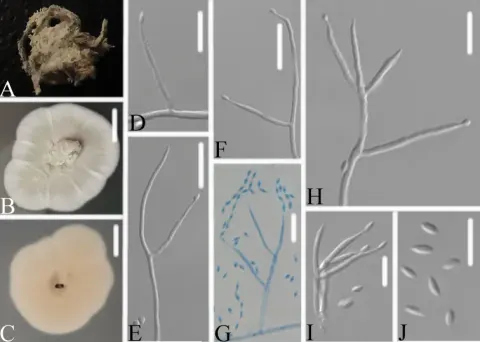
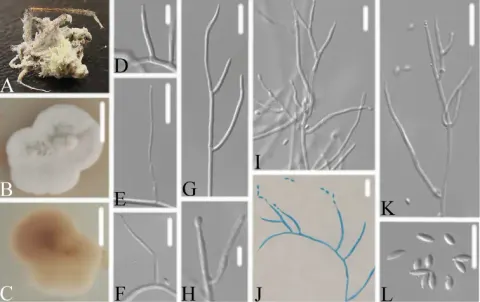
Paecilomyces marquandii is an anamorphic eurotiomycete. It forms brush-like conidiophores borne on thin-walled, hyaline, and smooth-walled stalks that reach lengths from 50 to 300 μm and 2.5 to 3 μm wide. Conidiophores of P. marquandii resemble those of the genus Penicillium where brush-like conidiophores terminate with phialides with swollen bases and tapered necks 8 to 15 μm long and 1.5 to 2 μm wide. Conidia are produced in connected chains consisting of smooth walled hyaline broadly ellipsoidal to spindle-shaped spores, 3 to 3.5 μm long and 2.2 μm wide. Single phialides are not associated with conidiophores but may arise on vegetative aerial hyphae. Globe to ellipsoid chlamydospores 3.5 μm in diameter may be produced submerged in the growth medium beneath the mycelium. No sexual state is known. Colonies are odorless. Paecilomyces marquandii can grow at wide range of temperature from 5-30 C with optimal growth at 25 °C but no growth above 37 °C. Temperature tolerance is a characteristic that distinguishes Paecilomyces marquandii from Purpureocillium lilacinum with the latter exhibiting growth above 37 °C. Colonies of P. marquandii grown on malt agar reach 5–7 cm in diameter in 14 days at 25 °C with a velvety, brownish-violet aerial mycelium occasionally producing short tufts of conidiophores called synnemata. Colonies begin as white becoming violet then dark vinaceous brown with bright yellow to orange yellow reverse at maturity. Optimal growth of P. marquandii occurs at a water potential of 45 bars. Growth is inhibited at atmospheric concentrations of carbon dioxide less than 3%.
Habitat dan peran ekologis
Paecilomyces marquandii has been isolated from soils in Netherlands, Austria, Czech Republic, Russia, United States, Canada, Spain, Turkey, Israel, Syria, Zaire, central Africa, the Ivory Coast, South Africa, India, Pakistan, Nepal, Jamaica, the Bahamas, Brazil, Central America, New Zealand, and Japan. It has been found in various types of soils including forest soils, under aspen forests, mixed hardwood with high humus accumulation, grasslands particularly in the upper soil layers, soils with steppe-type vegetation, arable and other cultivated soils down to a depth of 40 cm. This species has been found in agricultural fields treated with sewage sludge, in sewage sludge itself, streams with a lower degree of pollution, river sediments, estuarine slit, sand dunes, carst caves, and bat guano. It has been also isolated from pine litter, pine humus, peat, truffle grounds, roots of strawberry, the rhizosphere of corn, wheat, grasses, Beta vulgaris, and sugar cane and the rhizosphere of Lupinus angustifolius. Conidia of P. marquandii have been observed to germinate near roots of peas and radish. This effect is inhibited in the presence of the fungicide, miconazole.
- Habitat atau konteks temuan
- hutan
- Substrat
- Informasi belum tersedia pada sumber rilis ini.
- Peran atau konteks
- Belum dikategorikan pada rilis ini.
Reproduksi
Paecilomyces marquandii is an anamorphic eurotiomycete. It forms brush-like conidiophores borne on thin-walled, hyaline, and smooth-walled stalks that reach lengths from 50 to 300 μm and 2.5 to 3 μm wide. Conidiophores of P. marquandii resemble those of the genus Penicillium where brush-like conidiophores terminate with phialides with swollen bases and tapered necks 8 to 15 μm long and 1.5 to 2 μm wide. Conidia are produced in connected chains consisting of smooth walled hyaline broadly ellipsoidal to spindle-shaped spores, 3 to 3.5 μm long and 2.2 μm wide. Single phialides are not associated with conidiophores but may arise on vegetative aerial hyphae. Globe to ellipsoid chlamydospores 3.5 μm in diameter may be produced submerged in the growth medium beneath the mycelium.
Catatan identitas dan cakupan
- Nama diterima mengikuti Catalogue of Life Base2026-09-11; uraian mempertahankan konsep dan nama sumber aslinya.
- Original geographic, specimen and life-cycle scope retained; source import awaits individual editorial review.
- Impor dan terjemahan otomatis belum diperiksa editorial per profil. Struktur reproduktif yang disebutkan tidak membuktikan seluruh siklus hidup diketahui.
- Pengukuran pada uraian mengikuti spesimen, kultur, dan metode sumber; angka tidak diperluas ke semua populasi.
Catatan distribusi dalam narasi mengikuti sumbernya. Dokumentasi spesimen atau foto mengikuti catatan sumber. Bukti wilayah Indonesia dan penilaian konservasi tidak disimpulkan dari gambar.
Melihat dengan konteks
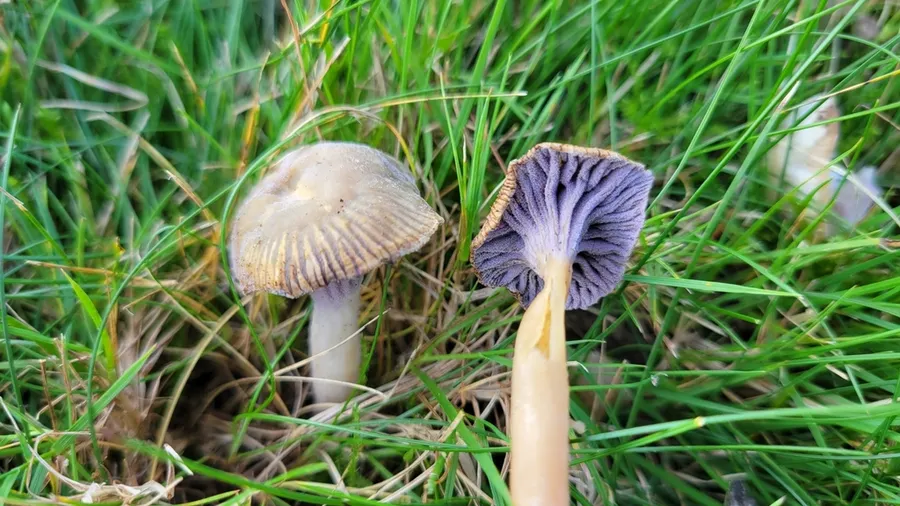
Dokumentasi Metarhizium marquandii menurut asosiasi foto pada record takson iNaturalist. Kredit: Virn Stothers. Identitas mengikuti sumber; bukan penentuan spesimen independen.
- Jenis
- Fotografi
- Kredit
- (c) Virn Stothers, some rights reserved (CC BY), uploaded by Virn Stothers
- Lisensi
- CC BY 4.0
- Sumber media
- Buka entri sumber
Sumber profil
- [1] Paecilomyces marquandii — Wikipedia (en)
- [2] Catalogue of Life Base2026-09-11 — Marquandomyces marquandii
- [3] Dokumentasi visual — Metarhizium marquandii
Rujukan halaman ini
Fungi. Marquandomyces marquandii. Rilis data fungi-2026-10-12-expansion-2. https://fungi-atlas.mgadib.chatgpt.site/jamur/marquandomyces-marquandii/.
Status: impor sumber; pemeriksaan editorial per profil belum selesai. Untuk klaim biologis, gunakan rujukan pada bagian terkait dan periksa konteks sumber aslinya.