Ciri dan struktur
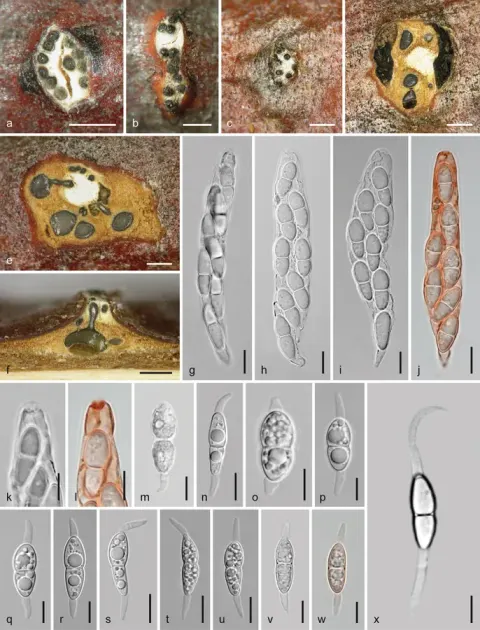
Sexual morph: Pseudostromata 1.3–3.6(–4.5) mm diam., scattered to aggregated, slightly or distinctly projecting from bark surface, pulvinate with bluntly conical centre (projecting disc), circular to elliptical in outline; consisting of an ectostromatic disc and perithecia embedded in an entostroma around a central column and often chambers filled with conidia. Ectostromatic discs 0.4–2.4(–2.7) mm diam. or length, fusoid to circular, projecting from the bark surface to 0.5 mm, less commonly 1 mm including pseudostroma, white or yellow, brown when old, flat, concave or convex, often completely filled by tips of ostiolar necks; central column beneath disc brightly white to yellow, consisting of hyaline hyphae and colourless crystals. Ostiolar necks cylindrical, laterally or centrally attached on perithecia, convergent and densely and irregularly or evenly disposed in the disc or around the margin; visible part in the discs (106–)139–231(–283) µm (n = 68) diam., 1–25 per disc, shiny black, convex papillate, discoid with depressed centre or conical to cylindrical and projecting to 300 µm. Entostroma paler than surrounding inner bark, consisting of hyaline to white hyphae and bark cells, sometimes forming white patches. Perithecia (450–)540–700(–780) µm (n = 45) diam., arranged in valsoid configuration around and below central column, globose to subglobose, collapsing upon drying. Peridium pseudoparenchymatous, consisting of a dark brown small-celled outer and a hyaline to brownish, large-celled inner layer. Hamathecium absent at maturity. Asci floating free at maturity, (69–)80–123(–141) × (10–)13–18(–21) µm (n = 64), fusoid to oblong or narrowly clavate, with an apical ring distinct in water and staining in Congo Red but invisible or indistinct in 3% KOH, containing 4–8 biseriate or obliquely uniseriate ascospores.
Habitat dan peran ekologis
Melanconis stilbostoma occurs frequently on Betula spp. on the northern Hemisphere in Asia, Europe and North America (Barr 1978; Fan et al. 2016, 2018; Kobayashi 1970; Sogonov et al. 2008).
- Habitat atau konteks temuan
- Informasi belum tersedia pada sumber rilis ini.
- Substrat
- Informasi belum tersedia pada sumber rilis ini.
- Peran atau konteks
- Belum dikategorikan pada rilis ini.
Reproduksi
Sexual morph: Pseudostromata 1.3–3.6(–4.5) mm diam., scattered to aggregated, slightly or distinctly projecting from bark surface, pulvinate with bluntly conical centre (projecting disc), circular to elliptical in outline; consisting of an ectostromatic disc and perithecia embedded in an entostroma around a central column and often chambers filled with conidia. Ectostromatic discs 0.4–2.4(–2.7) mm diam. or length, fusoid to circular, projecting from the bark surface to 0.5 mm, less commonly 1 mm including pseudostroma, white or yellow, brown when old, flat, concave or convex, often completely filled by tips of ostiolar necks; central column beneath disc brightly white to yellow, consisting of hyaline hyphae and colourless crystals.
Catatan identitas dan cakupan
- Nama diterima mengikuti Catalogue of Life Base2026-09-11; uraian mempertahankan konsep dan nama sumber aslinya.
- Preserve original treatment localities, hosts and substrate scope. Materials examined describe documented specimens, not the full global range.
- Impor dan terjemahan otomatis belum diperiksa editorial per profil. Struktur reproduktif yang disebutkan tidak membuktikan seluruh siklus hidup diketahui.
- Pengukuran pada uraian mengikuti spesimen, kultur, dan metode sumber; angka tidak diperluas ke semua populasi.
Catatan distribusi dalam narasi mengikuti sumbernya. Dokumentasi spesimen atau foto mengikuti catatan sumber. Bukti wilayah Indonesia dan penilaian konservasi tidak disimpulkan dari gambar.
Melihat dengan konteks
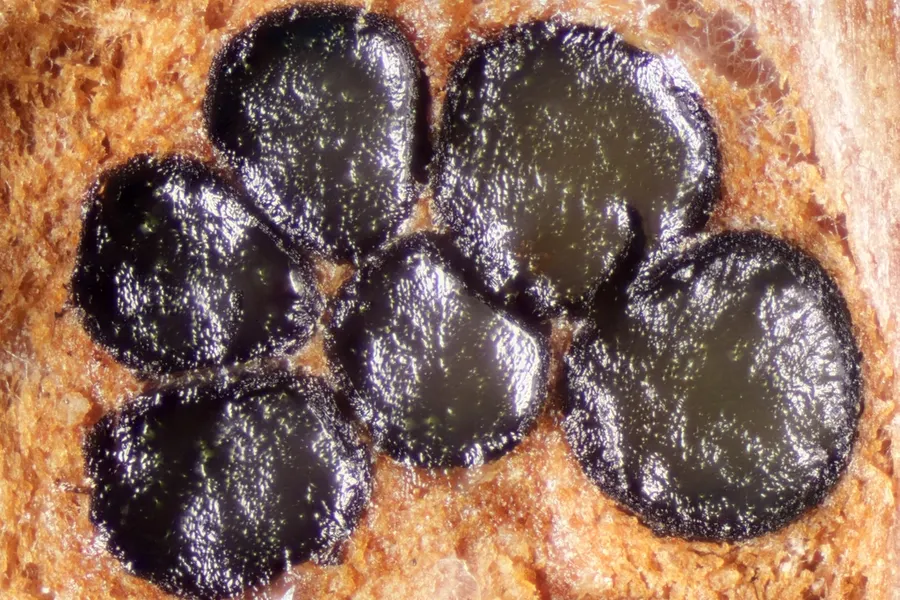
Dokumentasi Melanconis stilbostoma menurut asosiasi foto pada record takson iNaturalist. Kredit: Björn Sothmann. Identitas mengikuti sumber; bukan penentuan spesimen independen.
- Jenis
- Fotografi
- Kredit
- (c) Björn Sothmann, some rights reserved (CC BY-SA), uploaded by Björn Sothmann
- Lisensi
- CC BY-SA 4.0
- Sumber media
- Buka entri sumber
Dokumentasi tambahan
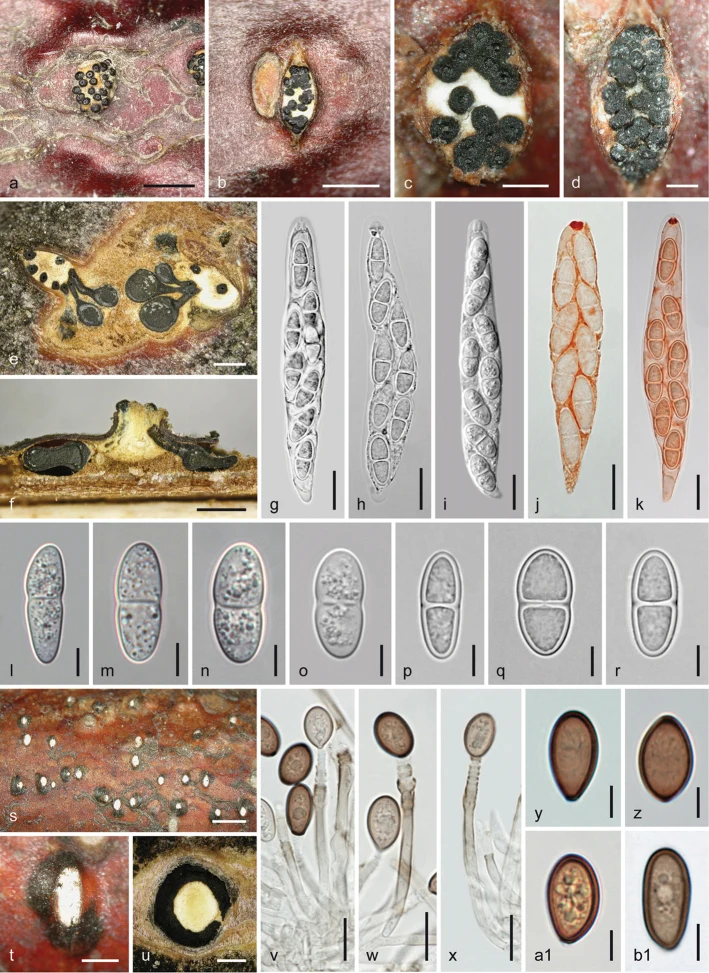
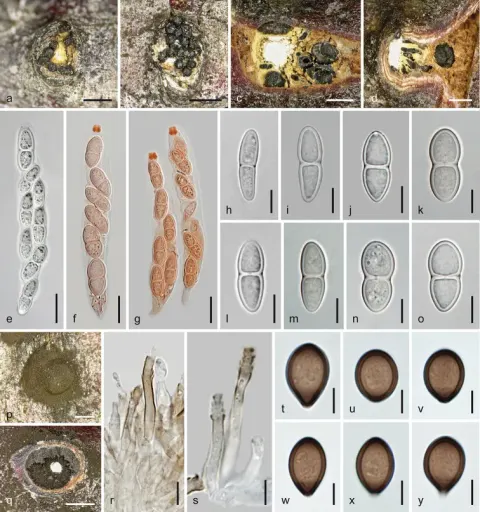
Melanconis stilbostoma. a–r Sexual morph a–d pseudostromata with ectostromatic discs in face view e cross section through 2 adjacent pseudostromata f vertical section showing 2 perithecia, ostiolar necks and central column g–k asci l–r ascospores j, k in aqueous Congo Red s–b1 Asexual morph s, t conidiomata in face view u conidioma in cross section v–x conidiophores and conidiogenous cells y–b1 α-conidia v–b1 in 3% KOH a, j, s, v–x iso-epitype WU 31897 = W.J. 1543 b–d WU 31896 e–g, i, k, o WU 38241 h, p, q WU 36779 l–n, a1 WU31899 r WU 37048 t WU 31894 u WU 15266 y M. betulinum B700016529 z M. betulinum B700016528 a1 WU31899 b1 WU 35970 = D143. Scale bars: 1 mm (a, b), 300 µm (c, d), 500 µm (e, f, t, u), 15 µm (g–k), 5 µm (l–r, y–b1), 2 mm (s), 10 µm (v–x).
Kredit dan penggunaan
Walter M. Jaklitsch, Hermann Voglmayr
Ukuran dan format gambar disesuaikan tanpa pemotongan, retus, atau penambahan skala. Lisensi sumber dipertahankan.
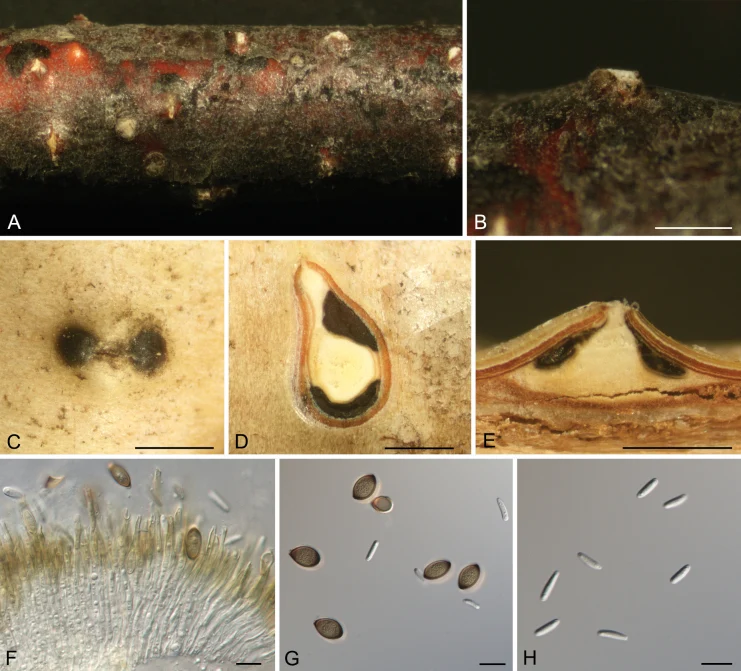
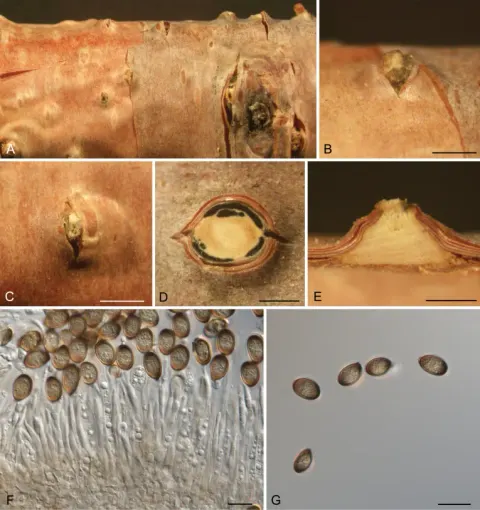
Morphology of Melanconis stilbostoma from Betula pendula. A–C. Habit of conidiomata on branch; D. Transverse section through conidiomata; E. Longitudinal section through conidiomata; F. Conidiophores and conidiogenous cells; G. Alpha conidia. H. Beta conidia. Scale bars: 500 μm (B–E); 10 μm (F–H).
Kredit dan penggunaan
Caixia Wang, Ning Jiang, Chuli Liu, ZiYan Xu, Hailong Lu, Rong Ma
Ukuran dan format gambar disesuaikan tanpa pemotongan, retus, atau penambahan skala. Lisensi sumber dipertahankan.
Sumber profil
- [1] The genus Melanconis (Diaporthales) — Melanconis stilbostoma
- [2] Catalogue of Life Base2026-09-11 — Melanconis stilbostoma
- [3] Dokumentasi visual — Melanconis stilbostoma
- [4] Dokumentasi visual — Melanconis stilbostoma
- [5] Dokumentasi visual — Melanconis stilbostoma
Rujukan halaman ini
Fungi. Melanconis stilbostoma. Rilis data fungi-2026-10-12-expansion-2. https://fungi-atlas.mgadib.chatgpt.site/jamur/melanconis-stilbostoma/.
Status: impor sumber; pemeriksaan editorial per profil belum selesai. Untuk klaim biologis, gunakan rujukan pada bagian terkait dan periksa konteks sumber aslinya.