Ciri dan struktur
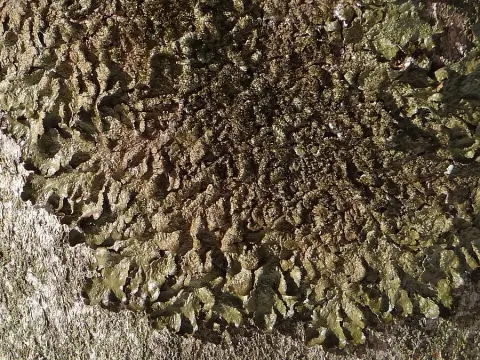
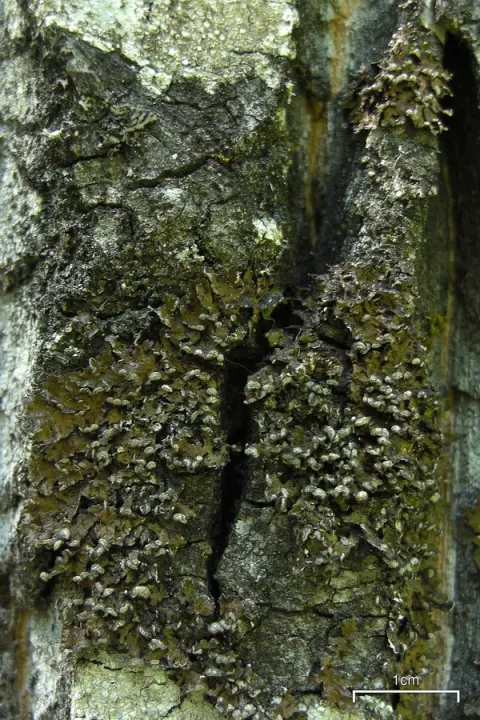
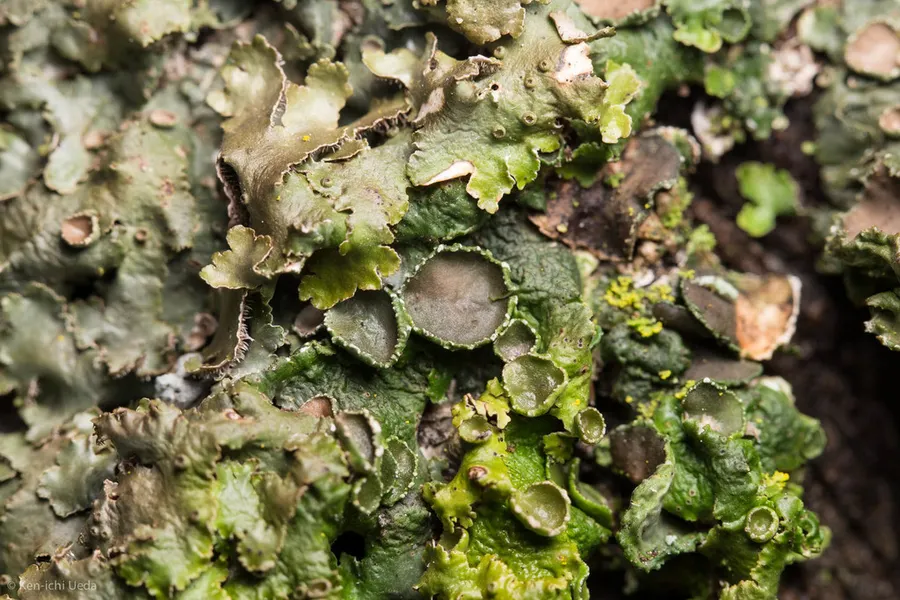
Melanelixia californica is a foliose (leaf-like) lichen that grows in flat, overlapping layers adhering closely to its . The thallus (main body) typically reaches 5 – 6 cm across, with individual measuring 3 – 6 mm wide. These lobes have rounded tips, overlap each other, and lie flat against the surface they grow on. The upper surface is olive green and has a wrinkled, mottled appearance. It lacks several features common to other lichens, such as isidia (coral-like outgrowths), soredia (powdery reproductive structures), and pseudocyphellae (small pores). The surface has a distinctive feature called a pored or fenestrated , meaning its outer layer contains microscopic holes. While the surface may have sparse, very short transparent hairs (up to 20 μm long), these are often absent except on the edges of the fruiting bodies. The medulla (internal layer) is white, while the lower surface is black with a brown margin extending up to 3 mm wide. Simple black rhizines (root-like attachments) with white tips anchor the lichen to its substrate. The species reproduces sexually through apothecia (-shaped fruiting bodies) that are 2 – 5 mm in diameter. These structures sit directly on the thallus surface and have brown disks that become flat or slightly convex with age. The apothecia contain asci (spore-producing cells) that each produce eight colorless, ellipsoid spores measuring 14.5–17 by 7.5–9.5 μm. Melanelixia californica also produces structures called pycnidia, which are small, black, immersed chambers that produce rod-shaped conidia (asexual spores) measuring 9–9.5 by 1 μm. When tested with chemical spot tests commonly used in lichen identification, the cortex shows no reaction with potassium hydroxide solution (K−) or nitric acid (HNO3−).
Habitat dan peran ekologis
Melanelixia californica is known primarily from southern California in the United States. The species is primarily epiphytic, meaning it grows on trees, with a strong preference for various oak species. It has been documented growing on several oak species including California black oak (Quercus kelloggii), coast live oak (Q. agrifolia), California scrub oak (Q. dumosa), blue oak (Q. douglasii), and interior live oak (Q. wislizeni). It occasionally occurs on bigleaf maple (Acer macrophyllum) and has rarely been found growing on rocks. The species has been collected at various elevations throughout its range, from relatively low elevations around 640 m to higher mountainous areas up to about 1700 m. Documented locations include: Palomar State Park, San Diego County San Joaquin Experimental Range, Madera County Plumas National Forest, Plumas County Sequoia National Forest, Kern County Areas near Monticello Dam, Solano County Melanelixia californica represents a case of regional endemism, being part of the distinctive Mediterranean flora of California. While it was previously thought to be the same species as the European Melanelixia glabra, genetic studies have shown it to be a distinct species that evolved separately in North America, demonstrating a pattern of parallel evolution between Mediterranean climate regions of California and Europe.
- Habitat atau konteks temuan
- hutan
- Substrat
- Informasi belum tersedia pada sumber rilis ini.
- Peran atau konteks
- Pembentuk liken
Reproduksi
The upper surface is olive green and has a wrinkled, mottled appearance. It lacks several features common to other lichens, such as isidia (coral-like outgrowths), soredia (powdery reproductive structures), and pseudocyphellae (small pores). The surface has a distinctive feature called a pored or fenestrated , meaning its outer layer contains microscopic holes. While the surface may have sparse, very short transparent hairs (up to 20 μm long), these are often absent except on the edges of the fruiting bodies. The medulla (internal layer) is white, while the lower surface is black with a brown margin extending up to 3 mm wide. Simple black rhizines (root-like attachments) with white tips anchor the lichen to its substrate.
Catatan identitas dan cakupan
- Nama diterima mengikuti Catalogue of Life Base2026-09-11; uraian mempertahankan konsep dan nama sumber aslinya.
- Original geographic, specimen and life-cycle scope retained; source import awaits individual editorial review.
- Impor dan terjemahan otomatis belum diperiksa editorial per profil. Struktur reproduktif yang disebutkan tidak membuktikan seluruh siklus hidup diketahui.
- Pengukuran pada uraian mengikuti spesimen, kultur, dan metode sumber; angka tidak diperluas ke semua populasi.
Catatan distribusi dalam narasi mengikuti sumbernya. Dokumentasi spesimen atau foto mengikuti catatan sumber. Bukti wilayah Indonesia dan penilaian konservasi tidak disimpulkan dari gambar.
Melihat dengan konteks
Dokumentasi Melanelixia californica menurut asosiasi foto pada record takson iNaturalist. Kredit: Ken-ichi Ueda. Identitas mengikuti sumber; bukan penentuan spesimen independen.
- Jenis
- Fotografi
- Kredit
- (c) Ken-ichi Ueda, some rights reserved (CC BY), uploaded by Ken-ichi Ueda
- Lisensi
- CC BY 4.0
- Sumber media
- Buka entri sumber
Dokumentasi tambahan
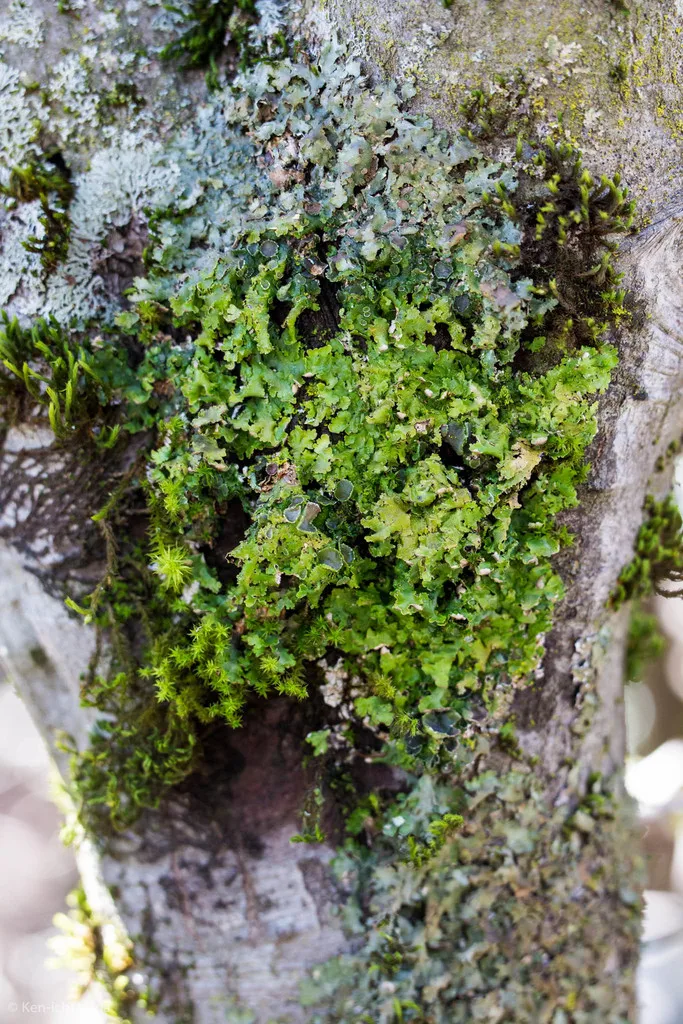
Foto yang diasosiasikan dengan Melanelixia californica pada iNaturalist. Identifikasi mengikuti sumber; bukan penentuan spesimen independen.
Kredit dan penggunaan
(c) Ken-ichi Ueda, some rights reserved (CC BY), uploaded by Ken-ichi Ueda
Ukuran dan format gambar disesuaikan tanpa pemotongan, retus, atau penambahan skala. Lisensi sumber dipertahankan.
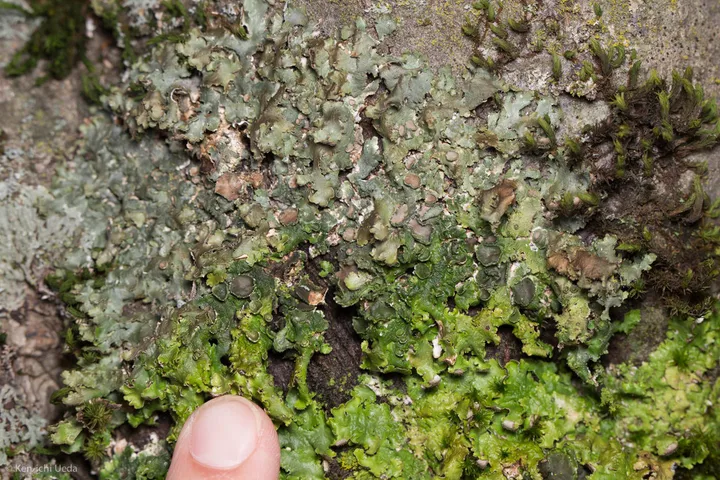
Foto yang diasosiasikan dengan Melanelixia californica pada iNaturalist. Identifikasi mengikuti sumber; bukan penentuan spesimen independen.
Kredit dan penggunaan
(c) Ken-ichi Ueda, some rights reserved (CC BY), uploaded by Ken-ichi Ueda
Ukuran dan format gambar disesuaikan tanpa pemotongan, retus, atau penambahan skala. Lisensi sumber dipertahankan.
Sumber profil
- [1] Melanelixia californica — Wikipedia (en)
- [2] Catalogue of Life Base2026-09-11 — Melanelixia californica
- [3] Dokumentasi visual — Melanelixia californica
- [4] Dokumentasi visual — Melanelixia californica
- [5] Dokumentasi visual — Melanelixia californica
Rujukan halaman ini
Fungi. Melanelixia californica. Rilis data fungi-2026-10-12-expansion-2. https://fungi-atlas.mgadib.chatgpt.site/jamur/melanelixia-californica/.
Status: impor sumber; pemeriksaan editorial per profil belum selesai. Untuk klaim biologis, gunakan rujukan pada bagian terkait dan periksa konteks sumber aslinya.