01 / Morfologi

Ciri dan struktur

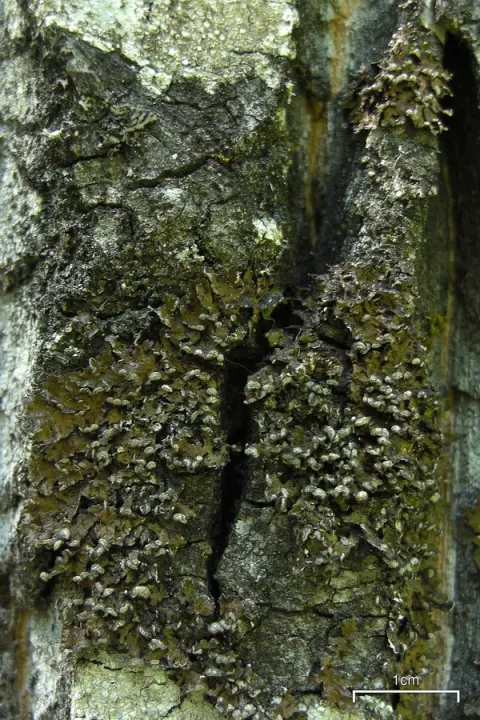
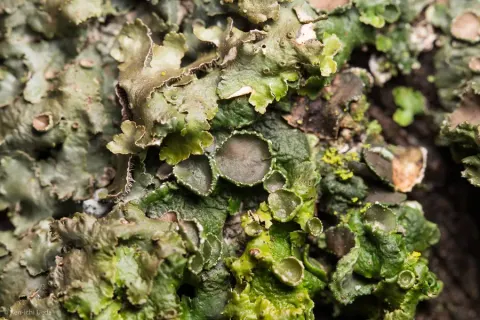
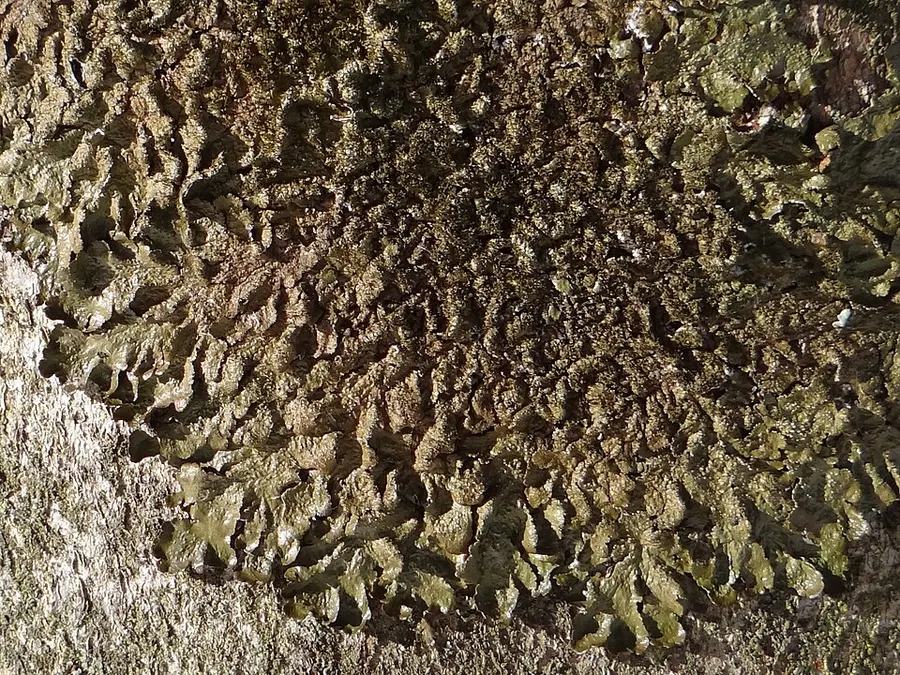
The lichen forms a foliose (leaf-like) thallus in rosettes up to about 10–15 cm in diameter. The individual lobes are small (typically 1–4 mm wide), contiguous to overlapping, with rounded tips that may be slightly upturned. The upper surface is greenish-brown when wet, drying to dark brown or blackish in strong light, and is usually smooth to faintly wrinkled and shiny (especially near the lobe ends). The lobe margins and surfaces bear abundant isidia – tiny cylindrical outgrowths of the thallus. These isidia are often branched and in form, and can detach easily; when they break off they leave behind distinct white scars or pits on the cortex. The lower surface of the thallus is black to dark brown, with a paler brown margin, and has simple, mostly unbranched rhizines (root-like attachments) up to about 1 mm long that anchor the lichen to its substrate. The thallus is (with a distinct ) and contains a green photobiont (algal partner) in the upper cortex. Reproduction in M. fuliginosa is primarily vegetative by dispersal of isidia, which can break off and establish new colonies. Sexual reproduction is uncommon – many thalli lack fruiting bodies. When present, the apothecia are small disk-like structures up to 5–6 mm across. The apothecia are lecanorine, meaning they have a rim of thallus tissue; in this species the apothecial margin is often adorned with isidia as well. The apothecial disk is usually concave to flat, dark red-brown to black, and without perforations. Inside the apothecia, the asci contain eight of the usual one-celled type for Parmeliaceae. The ascospores are hyaline (colourless), ellipsoid, and measure roughly 10–14 × 5–8 μm.

Sebagian uraian ditampilkan dalam bahasa sumber; terjemahannya belum tersedia atau belum lolos pemeriksaan.

Rujukan: [1]

Pengukuran mengikuti objek, spesimen atau kultur, dan metode yang disebutkan sumber. Baca uraian asli untuk konteks lengkap.

02 / Kehidupan

Habitat dan peran ekologis

Melanelixia fuliginosa is chiefly a saxicolous lichen – it grows on rock. It shows a preference for siliceous (acidic) rocks such as granite, sandstone, and other acidic outcrops. Typical habitats include boulders, rocky cliffs, scree, and stone walls in moorland or montane areas, especially in regions with clean air and ample rainfall. In these settings it can form extensive dark brown patches on rock faces, often alongside other acid-rock lichens. The species is described as mainly silicicolous (occurring on silica-rich rock). It is usually found in semi-exposed to well-lit conditions; too much deep shade inhibits its growth, while full sun can cause the thallus to become very dark and compact. Although primarily found on rock, M. fuliginosa has occasionally been recorded on the bark of trees or on old wood (such as fence posts or dead trunks). Such corticolous (bark-growing) occurrences are more common in humid, coastal or montane woodlands. However, many bark populations historically identified as M. fuliginosa have turned out to be Melanelixia glabratula, which favours bark and has a slightly different appearance. In terms of geography, Melanelixia fuliginosa has a broad Northern Hemisphere distribution.

Sebagian uraian ditampilkan dalam bahasa sumber; terjemahannya belum tersedia atau belum lolos pemeriksaan.

Rujukan: [1]

Habitat atau konteks temuan
Informasi belum tersedia pada sumber rilis ini.
Substrat
Informasi belum tersedia pada sumber rilis ini.
Peran atau konteks
Pembentuk liken
Temukan hubungan serupa
03 / Siklus hidup

Reproduksi

The lichen forms a foliose (leaf-like) thallus in rosettes up to about 10–15 cm in diameter. The individual lobes are small (typically 1–4 mm wide), contiguous to overlapping, with rounded tips that may be slightly upturned. The upper surface is greenish-brown when wet, drying to dark brown or blackish in strong light, and is usually smooth to faintly wrinkled and shiny (especially near the lobe ends). The lobe margins and surfaces bear abundant isidia – tiny cylindrical outgrowths of the thallus. These isidia are often branched and in form, and can detach easily; when they break off they leave behind distinct white scars or pits on the cortex. The lower surface of the thallus is black to dark brown, with a paler brown margin, and has simple, mostly unbranched rhizines (root-like attachments) up to about 1 mm long that anchor the lichen to its substrate.

Sebagian uraian ditampilkan dalam bahasa sumber; terjemahannya belum tersedia atau belum lolos pemeriksaan.

Rujukan: [1]

Sinonim menurut acuan taksonomi rilis: Imbricaria fuliginosa; Imbricaria fuliginosa f. laetevirens; Imbricaria olivacea laetevirens; Melanelia fuliginosa; Melanelia glabratula f. laetevirens; Melanelia glabratula subsp. fuliginosa; Parmelia fuliginosa f. aterrima; Parmelia fuliginosa var. laetevirens; Parmelia glabra subsp. fuliginosa; Parmelia glabratula f. aterrima; Parmelia glabratula subsp. fuliginosa; Parmelia glabratula var. fuliginosa; Parmelia glabratula var. laetevirens; Parmelia olivacea f. laetevirens; Parmelia olivacea fuliginosa; Parmelia prolixa subvar. aterrima; Parmelia prolixa subvar. laetevirens; Parmelia prolixa var. aterrima; Parmelia subaurifera var. fuliginosa
04 / Batas informasi

Catatan identitas dan cakupan

  • Nama diterima mengikuti Catalogue of Life Base2026-09-11; uraian mempertahankan konsep dan nama sumber aslinya.
  • Original geographic, specimen and life-cycle scope retained; source import awaits individual editorial review.
  • Impor dan terjemahan otomatis belum diperiksa editorial per profil. Struktur reproduktif yang disebutkan tidak membuktikan seluruh siklus hidup diketahui.
  • Pengukuran pada uraian mengikuti spesimen, kultur, dan metode sumber; angka tidak diperluas ke semua populasi.

Catatan distribusi dalam narasi mengikuti sumbernya. Dokumentasi spesimen atau foto mengikuti catatan sumber. Bukti wilayah Indonesia dan penilaian konservasi tidak disimpulkan dari gambar.

05 / Dokumentasi

Melihat dengan konteks

Dokumentasi Melanelixia fuliginosa dari Wikimedia Commons. Melanelixia fuliginosa (location: Poland, West Tatra Mountains, Dolina Kościeliska) Identifikasi mengikuti record berkas sumber.

Jenis
Fotografi
Kredit
Jerzy Opioła
Sumber media
Buka entri sumber

Gambar menunjukkan objek menurut identifikasi sumber, bukan verifikasi independen spesimen oleh Fungi. Tidak ada skala baru yang ditambahkan.

06 / Rujukan

Sumber profil

  1. [1] Melanelixia fuliginosa — Wikipedia (en)Bagian sumber: Frozen revision 1368585686
    Tanggal penghimpunan sumber: 2026-10-12
    Teks sumber: CC BY-SA4.0 · Wikipedia contributors
  2. [2] Catalogue of Life Base2026-09-11 — Melanelixia fuliginosaBagian sumber: ColDP NameUsage.tsv ID 3Z6S4; accepted species; source 2073
    Tanggal penghimpunan sumber: 2026-10-12
  3. [3] Dokumentasi visual — Melanelixia fuliginosaBagian sumber: Individual media record; identification follows the source, not independent determination
    Tanggal penghimpunan sumber: 2026-10-12
    Media sumber: CC BY-SA 4.0 · Jerzy Opioła

Adaptasi teks: CC BY-SA 4.0. Wikipedia contributors — Melanelixia fuliginosa — Wikipedia (en)

Uraian asli dan riwayat sumber

Riwayat atau halaman sumber

Ringkasan sumber

Melanelixia fuliginosa is a species of foliose lichen in the family Parmeliaceae, commonly found growing on siliceous rocks in humid, temperate regions of Europe and possibly parts of Asia. It forms dark brown to blackish rosettes up to 15 cm in diameter with small overlapping that bear numerous tiny, cylindrical outgrowths (isidia) on their surface. The lichen primarily reproduces by vegetative means when these isidia break off and establish new colonies. Originally described by French botanist Jean Étienne Duby in 1830 as a variety of another lichen, it has undergone several taxonomic changes, being assigned to various genera including Parmelia and Melanelia before its current classification in Melanelixia in 2004.

Revisi sumber

Morfologi sumber

The lichen forms a foliose (leaf-like) thallus in rosettes up to about 10–15 cm in diameter. The individual lobes are small (typically 1–4 mm wide), contiguous to overlapping, with rounded tips that may be slightly upturned. The upper surface is greenish-brown when wet, drying to dark brown or blackish in strong light, and is usually smooth to faintly wrinkled and shiny (especially near the lobe ends). The lobe margins and surfaces bear abundant isidia – tiny cylindrical outgrowths of the thallus. These isidia are often branched and in form, and can detach easily; when they break off they leave behind distinct white scars or pits on the cortex. The lower surface of the thallus is black to dark brown, with a paler brown margin, and has simple, mostly unbranched rhizines (root-like attachments) up to about 1 mm long that anchor the lichen to its substrate. The thallus is (with a distinct ) and contains a green photobiont (algal partner) in the upper cortex. Reproduction in M. fuliginosa is primarily vegetative by dispersal of isidia, which can break off and establish new colonies. Sexual reproduction is uncommon – many thalli lack fruiting bodies. When present, the apothecia are small disk-like structures up to 5–6 mm across. The apothecia are lecanorine, meaning they have a rim of thallus tissue; in this species the apothecial margin is often adorned with isidia as well. The apothecial disk is usually concave to flat, dark red-brown to black, and without perforations. Inside the apothecia, the asci contain eight of the usual one-celled type for Parmeliaceae. The ascospores are hyaline (colourless), ellipsoid, and measure roughly 10–14 × 5–8 μm.

Revisi sumber

Ekologi sumber

Melanelixia fuliginosa is chiefly a saxicolous lichen – it grows on rock. It shows a preference for siliceous (acidic) rocks such as granite, sandstone, and other acidic outcrops. Typical habitats include boulders, rocky cliffs, scree, and stone walls in moorland or montane areas, especially in regions with clean air and ample rainfall. In these settings it can form extensive dark brown patches on rock faces, often alongside other acid-rock lichens. The species is described as mainly silicicolous (occurring on silica-rich rock). It is usually found in semi-exposed to well-lit conditions; too much deep shade inhibits its growth, while full sun can cause the thallus to become very dark and compact. Although primarily found on rock, M. fuliginosa has occasionally been recorded on the bark of trees or on old wood (such as fence posts or dead trunks). Such corticolous (bark-growing) occurrences are more common in humid, coastal or montane woodlands. However, many bark populations historically identified as M. fuliginosa have turned out to be Melanelixia glabratula, which favours bark and has a slightly different appearance. In terms of geography, Melanelixia fuliginosa has a broad Northern Hemisphere distribution.

Revisi sumber

Struktur reproduksi sumber

The lichen forms a foliose (leaf-like) thallus in rosettes up to about 10–15 cm in diameter. The individual lobes are small (typically 1–4 mm wide), contiguous to overlapping, with rounded tips that may be slightly upturned. The upper surface is greenish-brown when wet, drying to dark brown or blackish in strong light, and is usually smooth to faintly wrinkled and shiny (especially near the lobe ends). The lobe margins and surfaces bear abundant isidia – tiny cylindrical outgrowths of the thallus. These isidia are often branched and in form, and can detach easily; when they break off they leave behind distinct white scars or pits on the cortex. The lower surface of the thallus is black to dark brown, with a paler brown margin, and has simple, mostly unbranched rhizines (root-like attachments) up to about 1 mm long that anchor the lichen to its substrate.

Revisi sumber

Rujukan halaman ini

Fungi. Melanelixia fuliginosa. Rilis data fungi-2026-10-12-expansion-2. https://fungi-atlas.mgadib.chatgpt.site/jamur/melanelixia-fuliginosa/.

Status: impor sumber; pemeriksaan editorial per profil belum selesai. Untuk klaim biologis, gunakan rujukan pada bagian terkait dan periksa konteks sumber aslinya.