Ciri dan struktur
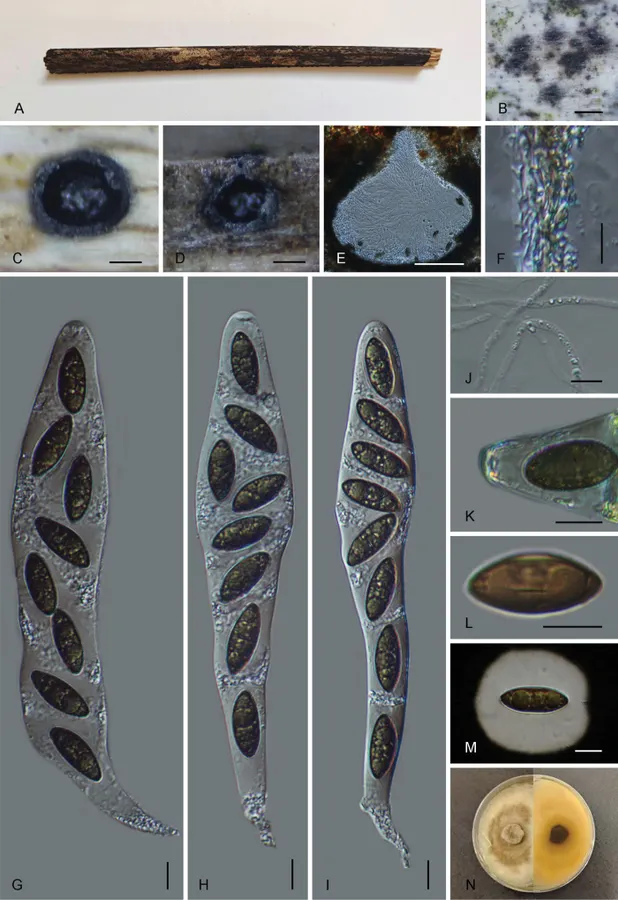
Saprobic on a dry palm branch. Sexual morph: Ascomata 440–680 µm wide, 470–540 µm high, immersed, solitary or gregarious, appearing as small black spot, in cross-section globose to subglobose with a flattened base. Ostioles centric, slightly papillate, black, slightly higher than the surface of the host. Peridium 12–27.4 µm thick, comprised of two layers; outer layer composed of thick-walled, dark-brown, cells of textura angularis; inner layer composed of thin-walled, hyaline, cells of textura angularis. Paraphyses 2–5 µm (x̄ = 3 µm, n = 30) wide, longer than the asci, numerous, filamentous, guttulate. Asci 185–260 × 15–35 µm (x̄ = 216 × 23 µm, n = 30) 8-spored, unitunicate, clavate-cylindrical, short-pedicellate, apically rounded, with non-amyloid apical apparatus. Ascospores 20–27.5 × 8.5–11.5 µm (x̄ = 25 × 10 µm, n = 30), overlapping unicellular, fusiform with rounded ends, dark brown, covered with a thick mucilaginous sheath measuring 4–14.5 µm (x̄ = 8.0 µm, n = 30), with a straight germ slit on the centre, ca. 1/4 of the length of the spore. Asexual morph: not found. Ascospores germinated on PDA within 24 hours. Colonies reaching 55 mm diam., after 4 weeks at 24–27 °C on PDA. Colony surface white towards edges, dirty brown at centre, with densely mycelium, cottony, circular, velvety, smooth-edged, centre raised; reverse pale brown.
Habitat dan peran ekologis
Saprobic on a dry palm branch. Sexual morph: Ascomata 440–680 µm wide, 470–540 µm high, immersed, solitary or gregarious, appearing as small black spot, in cross-section globose to subglobose with a flattened base. Ostioles centric, slightly papillate, black, slightly higher than the surface of the host. Peridium 12–27.4 µm thick, comprised of two layers; outer layer composed of thick-walled, dark-brown, cells of textura angularis; inner layer composed of thin-walled, hyaline, cells of textura angularis. Paraphyses 2–5 µm (x̄ = 3 µm, n = 30) wide, longer than the asci, numerous, filamentous, guttulate. Asci 185–260 × 15–35 µm (x̄ = 216 × 23 µm, n = 30) 8-spored, unitunicate, clavate-cylindrical, short-pedicellate, apically rounded, with non-amyloid apical apparatus. Ascospores 20–27.5 × 8.5–11.5 µm (x̄ = 25 × 10 µm, n = 30), overlapping unicellular, fusiform with rounded ends, dark brown, covered with a thick mucilaginous sheath measuring 4–14.5 µm (x̄ = 8.0 µm, n = 30), with a straight germ slit on the centre, ca. 1/4 of the length of the spore. Asexual morph: not found. Ascospores germinated on PDA within 24 hours. Colonies reaching 55 mm diam., after 4 weeks at 24–27 °C on PDA. Colony surface white towards edges, dirty brown at centre, with densely mycelium, cottony, circular, velvety, smooth-edged, centre raised; reverse pale brown.
- Habitat atau konteks temuan
- kultur yang didokumentasikan
- Substrat
- Informasi belum tersedia pada sumber rilis ini.
- Peran atau konteks
- Pengurai
Reproduksi
Saprobic on a dry palm branch. Sexual morph: Ascomata 440–680 µm wide, 470–540 µm high, immersed, solitary or gregarious, appearing as small black spot, in cross-section globose to subglobose with a flattened base. Ostioles centric, slightly papillate, black, slightly higher than the surface of the host. Peridium 12–27.4 µm thick, comprised of two layers; outer layer composed of thick-walled, dark-brown, cells of textura angularis; inner layer composed of thin-walled, hyaline, cells of textura angularis. Paraphyses 2–5 µm (x̄ = 3 µm, n = 30) wide, longer than the asci, numerous, filamentous, guttulate. Asci 185–260 × 15–35 µm (x̄ = 216 × 23 µm, n = 30) 8-spored, unitunicate, clavate-cylindrical, short-pedicellate, apically rounded, with non-amyloid apical apparatus.
Catatan identitas dan cakupan
- Nama diterima mengikuti Catalogue of Life Base2026-09-11; uraian mempertahankan konsep dan nama sumber aslinya.
- Preserve original treatment localities, hosts and substrate scope. Materials examined describe documented specimens, not the full global range.
- Impor dan terjemahan otomatis belum diperiksa editorial per profil. Struktur reproduktif yang disebutkan tidak membuktikan seluruh siklus hidup diketahui.
- Pengukuran pada uraian mengikuti spesimen, kultur, dan metode sumber; angka tidak diperluas ke semua populasi.
Catatan distribusi dalam narasi mengikuti sumbernya. Dokumentasi spesimen atau foto mengikuti catatan sumber. Bukti wilayah Indonesia dan penilaian konservasi tidak disimpulkan dari gambar.
Melihat dengan konteks
Melanographium citri (GMB4902). A. Material; B. Ascomata on the surface of host; C. Cross-section of ascoma; D, E. Longitudinal sections of ascoma; F. Peridium; G–I. Asci with ascospores; J. Paraphyses; K. Ascus apical apparatus (stained in Melzer’s reagent); L. Ascospore with germ slits; M. Ascospore in Indian ink; N. Culture on PDA. Scale bars: 0.2 mm (B–D); 100 µm (E); 10 µm (F–M).
- Jenis
- Pelat ilmiah
- Kredit
- Chang-Tao Lu, Yu-Lin Ren, Kamran Habib, Qin-Fang Zhang, Li-Li Liu, Ji-Chuan Kang, Xiang-Chun Shen, Nalin N. Wijayawardene, Salim S. Al-Rejaie, Chanhom Loinheuang, Qi-Rui Li, Qing-De Long, Abdallah M. Elgorban
- Lisensi
- CC BY 4.0
- Sumber media
- Buka entri sumber
Sumber profil
- [1] Two new species of Nigropunctata and the first report of sexual morph of Melanographium citri (Pallidoperidiaceae, Xylariales) from south-western China — Melanographium citri
- [2] Catalogue of Life Base2026-09-11 — Melanographium citri
- [3] Dokumentasi visual — Melanographium citri
Rujukan halaman ini
Fungi. Melanographium citri. Rilis data fungi-2026-10-12-expansion-2. https://fungi-atlas.mgadib.chatgpt.site/jamur/melanographium-citri/.
Status: impor sumber; pemeriksaan editorial per profil belum selesai. Untuk klaim biologis, gunakan rujukan pada bagian terkait dan periksa konteks sumber aslinya.