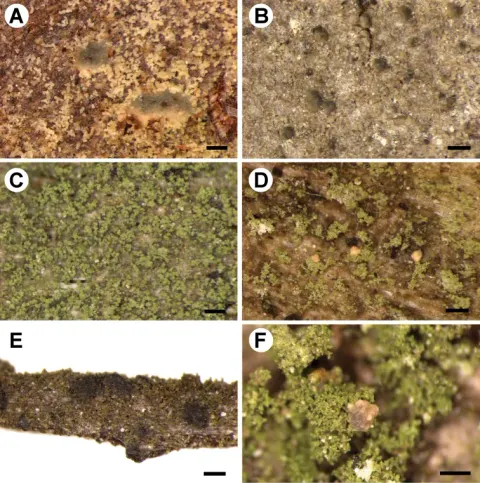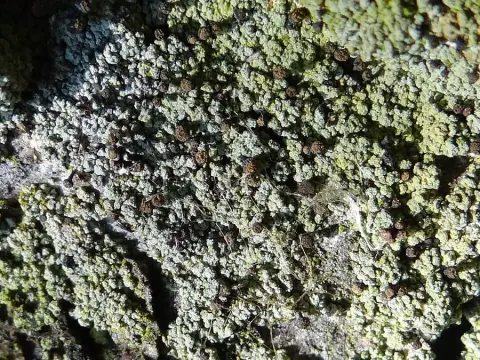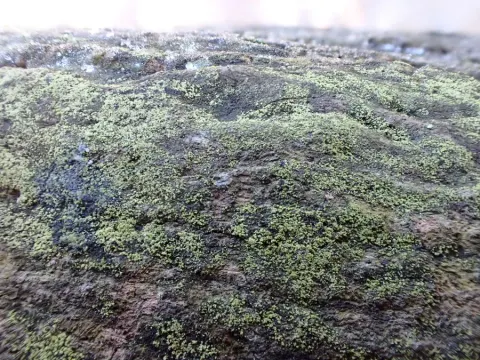
Ciri dan struktur
Thallus endoxylic or thin green-grey layer on top of substrate. Photobiont micareoid, 4–7 µm. Apothecia absent to numerous (mostly rare), immarginate, subglobose, often becoming tuberculate, black, matt, 0.1–0.3 mm in diam. Hymenium 25–30 µm tall, hyaline or tinged dull brown or purplish brown, K+ sordid green, HNO 3 + purple-red (Melaena-red), often with darker vertical streaks. Epihymenium irregularly pigmented brown to purplish-brown (Melaena-red), sometimes dark greenish, K+ olive green, HNO 3 + purple (Cinereorufa-green). Asci clavate, 22–30 × 10–12 µm. Ascospores ellipsoid to usually ovoid, simple, 6.5–12 × 2.5–4.0 µm. Paraphyses of two types: 1.) evenly distributed, branched, thin, c. 0.7–1 µm wide, 2.) scattered or in small fascicles, stout, 2–3 µm wide, coated by dark pigment. Hypothecium c. 70–120(–160) µm tall, dark brown with variable amount of purplish tone, K+ olive green, HNO 3 + purple-red (Melaena-red), hyphae coated with a dark brown pigment. Excipulum not evident. Mesopycnidia always present, usually numerous, black, sessile or more usually stalked and then 80–300 µm tall, 40–80 µm in diam., stalks simple or branched from the base bearing up to four pycnidia, walls brownish black to purplish black, sometimes olivaceous from the top, K+ dull green and HNO 3 + purple-red especially in the brown parts (Melaena-red). Mesoconidia ellipsoid or short cylindrical 3.5–4.5(–5) × 1.2–1.8 µm. Micro- or macropycnidia not seen. Crystalline granules not present in apothecia, pycnidia or thallus. Chemistry no substances detected by TLC (information based on Coppins 1983 and Czarnota 2007).
Habitat dan peran ekologis
Micarea nigella occurs mainly on lignum of conifer stumps or fallen trunks, sometimes spreading from wood to dead bryophytes. Based on sequenced specimens and the type material, the species is known from the Czech Republic, Denmark (holotype), Great Britain (paratypes), Finland and Sweden. In addition, M. nigella has previously been reported from boreal and temperate forests in north-western, central and eastern Europe (e.g. Czarnota 2007).
- Habitat atau konteks temuan
- hutan
- Substrat
- Informasi belum tersedia pada sumber rilis ini.
- Peran atau konteks
- Pembentuk liken
Reproduksi
Thallus endoxylic or thin green-grey layer on top of substrate. Photobiont micareoid, 4–7 µm. Apothecia absent to numerous (mostly rare), immarginate, subglobose, often becoming tuberculate, black, matt, 0.1–0.3 mm in diam. Hymenium 25–30 µm tall, hyaline or tinged dull brown or purplish brown, K+ sordid green, HNO 3 + purple-red (Melaena-red), often with darker vertical streaks. Epihymenium irregularly pigmented brown to purplish-brown (Melaena-red), sometimes dark greenish, K+ olive green, HNO 3 + purple (Cinereorufa-green). Asci clavate, 22–30 × 10–12 µm. Ascospores ellipsoid to usually ovoid, simple, 6.5–12 × 2.5–4.0 µm. Paraphyses of two types: 1.) evenly distributed, branched, thin, c. 0.7–1 µm wide, 2.) scattered or in small fascicles, stout, 2–3 µm wide, coated by dark pigment.
Catatan identitas dan cakupan
- Nama diterima mengikuti Catalogue of Life Base2026-09-11; uraian mempertahankan konsep dan nama sumber aslinya.
- Preserve original treatment localities, hosts and substrate scope. Materials examined describe documented specimens, not the full global range.
- Impor dan terjemahan otomatis belum diperiksa editorial per profil. Struktur reproduktif yang disebutkan tidak membuktikan seluruh siklus hidup diketahui.
- Pengukuran pada uraian mengikuti spesimen, kultur, dan metode sumber; angka tidak diperluas ke semua populasi.
Catatan distribusi dalam narasi mengikuti sumbernya. Dokumentasi spesimen atau foto mengikuti catatan sumber. Bukti wilayah Indonesia dan penilaian konservasi tidak disimpulkan dari gambar.
Melihat dengan konteks
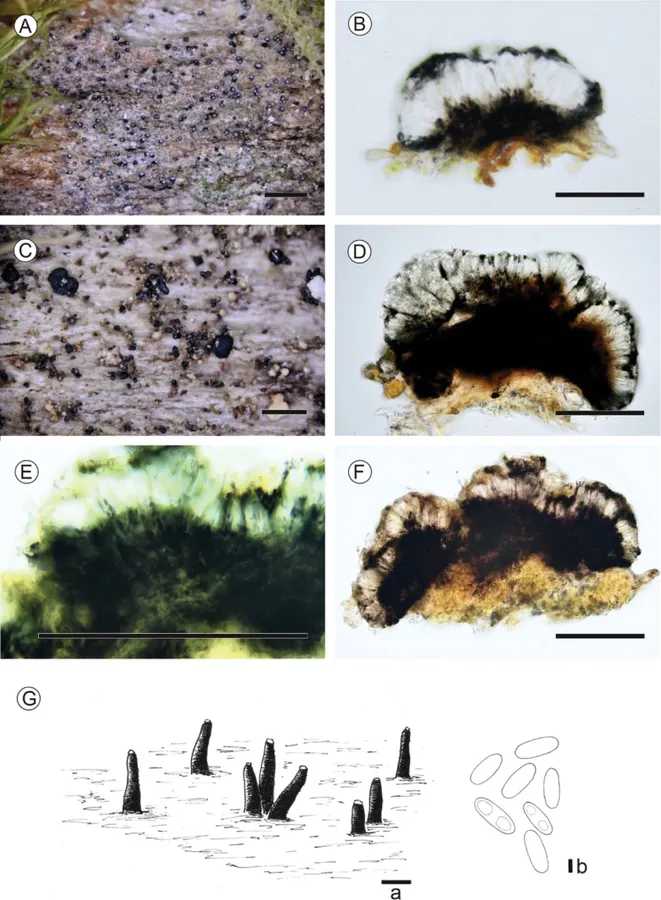
Morphological and anatomical features A, B Micarea eurasiatica sp. nov. (Thor 40053) A habit B apothecial section in water C, D Micarea melaeniza (Holotype) C habit, apothecia and pycnidia D apothecial section in water E–G Micarea nigella (Holotype) E apothecial section in K F apothecial section in water G drawing of M. nigella pycnidia on dead wood (Kantelinen 1974, H), Ga.) Mesopycnidia extruding mesoconidia, Gb.) Mesoconidia are cylindrical, ellipsoid, sometimes biguttulate. Photos and drawing Kantelinen. Scale bars: Habit 0.5 mm (A, C); Apothecial sections 100 µm (B, C, E, F); Drawing Ga 100 µm, Gb 1 µm.
- Jenis
- Pelat ilmiah
- Kredit
- Annina Kantelinen, Måns Svensson, Jiří Malíček, Jan Vondrák, Göran Thor, Zdeněk Palice, Stanislav Svoboda, Leena Myllys
- Lisensi
- CC BY 4.0
- Sumber media
- Buka entri sumber
Sumber profil
- [1] A phylogenetic study of Micarea melaeniza and similar-looking species (Pilocarpaceae) unveils hidden diversity and clarifies species boundaries and reproduction modes — Micarea nigella
- [2] Catalogue of Life Base2026-09-11 — Micarea nigella
- [3] Dokumentasi visual — Micarea nigella
Rujukan halaman ini
Fungi. Micarea nigella. Rilis data fungi-2026-10-12-expansion-2. https://fungi-atlas.mgadib.chatgpt.site/jamur/micarea-nigella/.
Status: impor sumber; pemeriksaan editorial per profil belum selesai. Untuk klaim biologis, gunakan rujukan pada bagian terkait dan periksa konteks sumber aslinya.