Ciri dan struktur
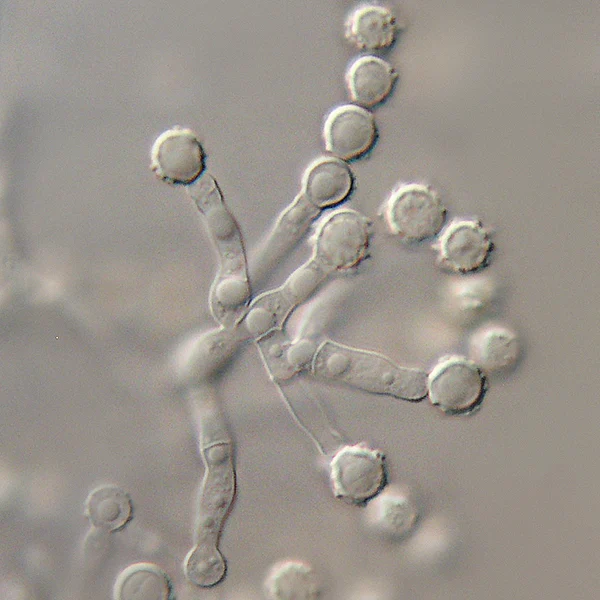
Microascus brevicaulis is a common mold. When cultured at a temperature of 25 °C on potato dextrose agar it forms white colonies which become powdery and/or granular as they mature. Under such conditions the fungus can grow rapidly, expanding as much as 4.5 - 5.5 cm within one week. The hyphae of M. brevicaulis are hyaline (transparent) and septate (separated into segments by cross-walls). The anamorph has conidia that are flattened on the base and tapered at the apex, resembling a boat keel in cross-section or a pontifical mitre. These, in turn, range from solitary to arranged in complex broom-like clusters on fertile hyphae known as conidiophores. The fungus is a typical perithecial member of Phylum Ascomycota, producing minute, enclosed fruiting bodies containing sexual spores (ascospores) in sacs known as asci. The ascospores of M. brevicaulis are kidney-shaped and reddish-brown in colour.
Habitat dan peran ekologis
This fungus usually occurs as a mold present in numerous different types of soil as well as various decaying types of organic matter. Microascus brevicaulis has a world-wide distribution, and occurs chiefly as a soil saprotroph. Besides the typical soil life of a decomposer, this fungus is also known to live within the American dog tick, Dermacentor variabilis. This relationship seems to be highly adapted but not as a classic host-parasite interaction. Studies have shown M. brevicaulis inhabits its host as an endosymbiont, and may provides protection against the insect-pathogenic fungus, Metarhizium anisopliae.
- Habitat atau konteks temuan
- Informasi belum tersedia pada sumber rilis ini.
- Substrat
- Informasi belum tersedia pada sumber rilis ini.
- Peran atau konteks
- Pengurai
Reproduksi
Microascus brevicaulis is a common mold. When cultured at a temperature of 25 °C on potato dextrose agar it forms white colonies which become powdery and/or granular as they mature. Under such conditions the fungus can grow rapidly, expanding as much as 4.5 - 5.5 cm within one week. The hyphae of M. brevicaulis are hyaline (transparent) and septate (separated into segments by cross-walls). The anamorph has conidia that are flattened on the base and tapered at the apex, resembling a boat keel in cross-section or a pontifical mitre. These, in turn, range from solitary to arranged in complex broom-like clusters on fertile hyphae known as conidiophores. The fungus is a typical perithecial member of Phylum Ascomycota, producing minute, enclosed fruiting bodies containing sexual spores (ascospores) in sacs known as asci.
Catatan identitas dan cakupan
- Nama diterima mengikuti Catalogue of Life Base2026-09-11; uraian mempertahankan konsep dan nama sumber aslinya.
- Original geographic, specimen and life-cycle scope retained; source import awaits individual editorial review.
- Impor dan terjemahan otomatis belum diperiksa editorial per profil. Struktur reproduktif yang disebutkan tidak membuktikan seluruh siklus hidup diketahui.
- Pengukuran pada uraian mengikuti spesimen, kultur, dan metode sumber; angka tidak diperluas ke semua populasi.
Catatan distribusi dalam narasi mengikuti sumbernya. Dokumentasi spesimen atau foto mengikuti catatan sumber. Bukti wilayah Indonesia dan penilaian konservasi tidak disimpulkan dari gambar.
Melihat dengan konteks
Mikrograf Microascus brevicaulis yang dicatat sumber sebagai Scopulariopsis brevicaulis, sinonim dalam profil ini. Foto: J Scott / Medmyco.
- Jenis
- Mikrograf
- Kredit
- J Scott (foto pribadi); Medmyco at English Wikipedia
- Lisensi
- CC0 1.0
- Sumber media
- Buka entri sumber
Sumber profil
- [1] Microascus brevicaulis — Wikipedia (en)
- [2] Catalogue of Life Base2026-09-11 — Microascus brevicaulis
- [3] Dokumentasi visual — Microascus brevicaulis
Rujukan halaman ini
Fungi. Microascus brevicaulis. Rilis data fungi-2026-10-12-expansion-2. https://fungi-atlas.mgadib.chatgpt.site/jamur/microascus-brevicaulis/.
Status: impor sumber; pemeriksaan editorial per profil belum selesai. Untuk klaim biologis, gunakan rujukan pada bagian terkait dan periksa konteks sumber aslinya.
