Ciri dan struktur
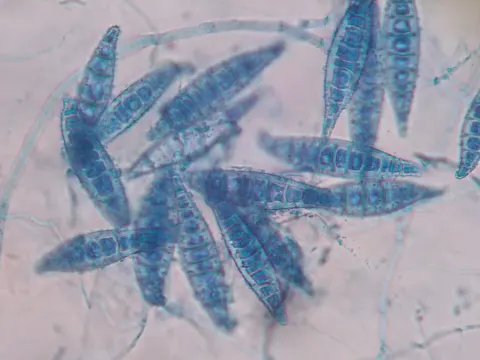
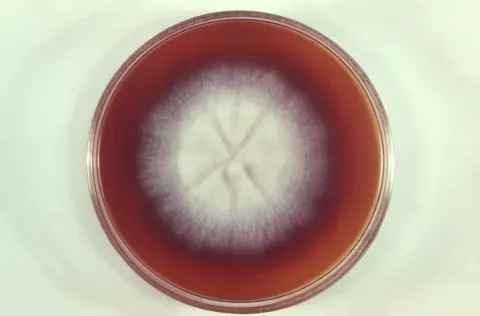
The colonies of M. gypseum are described as cottony or powdery, they grow rapidly with a colour range of white to buff, with a reserve that can range from pink, to red, to yellow (cinnamon); they may occasionally have overtones of violet. The powdery appearance of the colony is due to the abundant production of macroconidia on the older mycelium, while the edges of the colony are described as scalloped to ragged and can exhibit pleomorphism. Macroconidia of M. gypseum have a substantial range that can occur as short pedicels, terminal, solitary, spindle shaped, large, thick walled, that are smooth or roughened, borne directly on hyphae or on short branches. They are often very large (e.g., 40–150 x 8–15 μm), ellipsoid to fusiform, moderately thick, have verrucose and are 4–6 septate. The macroconidia also possess a rat-like tail at the edges of the conidia. The ascoma of the fungus is a globose, appendaged gymnothecium that is pale buff in colour and 500–1250 μm in diameter. The peridial hyphae are hyaline, pale buff, septate, and are branched with thinly but have densely verrucose walls. Microconidia are drop shaped, clavate, (1.7–3.5 x 3.3–8.3 μm), unicellular, smooth-walled or can be slightly roughened and are created laterally on the hyphae. The abundance of microconidia is characteristic of the fungus. The hyphae or appendages are of three kinds in the fungi, the first being straight, slender, smooth walled hyphae that can grow up to 250 μm long; they taper at 2.5–4.0 μm in diameter at the base but close to about 1.5-2 μm. The second are slender, smooth-walled, septate, spiral hyphae that are rarely branched, which have a base diameter of 2.5–3.5 μm that taper up to 1.5-2 μm in diameter.
Habitat dan peran ekologis
Spesies ini geofil, banyak di tanah dan dapat terisolasi di seluruh dunia; ini tersebar di seluruh dunia. Namun, hal ini jarang terjadi di tempat-tempat seperti Amerika Serikat, Inggris, dan Germany but umum di Amerika Selatan. Hal ini didefinisikan untuk menjadi baik kosmopolitan atau terbatas pada wilayah grafis tertentu. Jamur ini dapat ditemukan di tanah rumah kaca dan pabrik amunisi di daerah ini. Spesies itu sendiri biasanya menularkan manusia yang terkait erat dengan daerah-daerah ini karena pekerjaan pertanian. Di daerah-daerah ini, kompleks M. gypseum lebih memilih daerah dengan kelembaban tanah yang lebih tinggi. Correlations between infeksi dan jenis tanah menunjukkan bahwa sebagian besar tanah yang lebih baik dari jenis tanah liat atau tanah liat-pasir lebih disukai, terutama yang dibuahi dengan pupuk keratinus. Additionally the jamur lebih memilih tanah dengan pH 7-7.5. Various soils dalam korelasi dengan jumlah infeksi menunjukkan bahwa jamur lebih memilih tanah chernozemik (74%), yang terjadi isolasi positif. Peran infeksi jamur dipengaruhi oleh iklim dan karakteristik geografis yang mendukung kehidupan dermatophyte seperti yang ditegakkan oleh rata-rata tingkat curah hujan dan suhu udara rata-rata.
- Habitat atau konteks temuan
- Informasi belum tersedia pada sumber rilis ini.
- Substrat
- tanah
- Peran atau konteks
- Belum dikategorikan pada rilis ini.
Reproduksi
The colonies of M. gypseum are described as cottony or powdery, they grow rapidly with a colour range of white to buff, with a reserve that can range from pink, to red, to yellow (cinnamon); they may occasionally have overtones of violet. The powdery appearance of the colony is due to the abundant production of macroconidia on the older mycelium, while the edges of the colony are described as scalloped to ragged and can exhibit pleomorphism. Macroconidia of M. gypseum have a substantial range that can occur as short pedicels, terminal, solitary, spindle shaped, large, thick walled, that are smooth or roughened, borne directly on hyphae or on short branches. They are often very large (e.g., 40–150 x 8–15 μm), ellipsoid to fusiform, moderately thick, have verrucose and are 4–6 septate.
Catatan identitas dan cakupan
- Nama diterima mengikuti Catalogue of Life Base2026-09-11; uraian mempertahankan konsep dan nama sumber aslinya.
- Original geographic, specimen and life-cycle scope retained; source import awaits individual editorial review.
- Impor dan terjemahan otomatis belum diperiksa editorial per profil. Struktur reproduktif yang disebutkan tidak membuktikan seluruh siklus hidup diketahui.
- Pengukuran pada uraian mengikuti spesimen, kultur, dan metode sumber; angka tidak diperluas ke semua populasi.
Catatan distribusi dalam narasi mengikuti sumbernya. Dokumentasi spesimen atau foto mengikuti catatan sumber. Bukti wilayah Indonesia dan penilaian konservasi tidak disimpulkan dari gambar.
Melihat dengan konteks
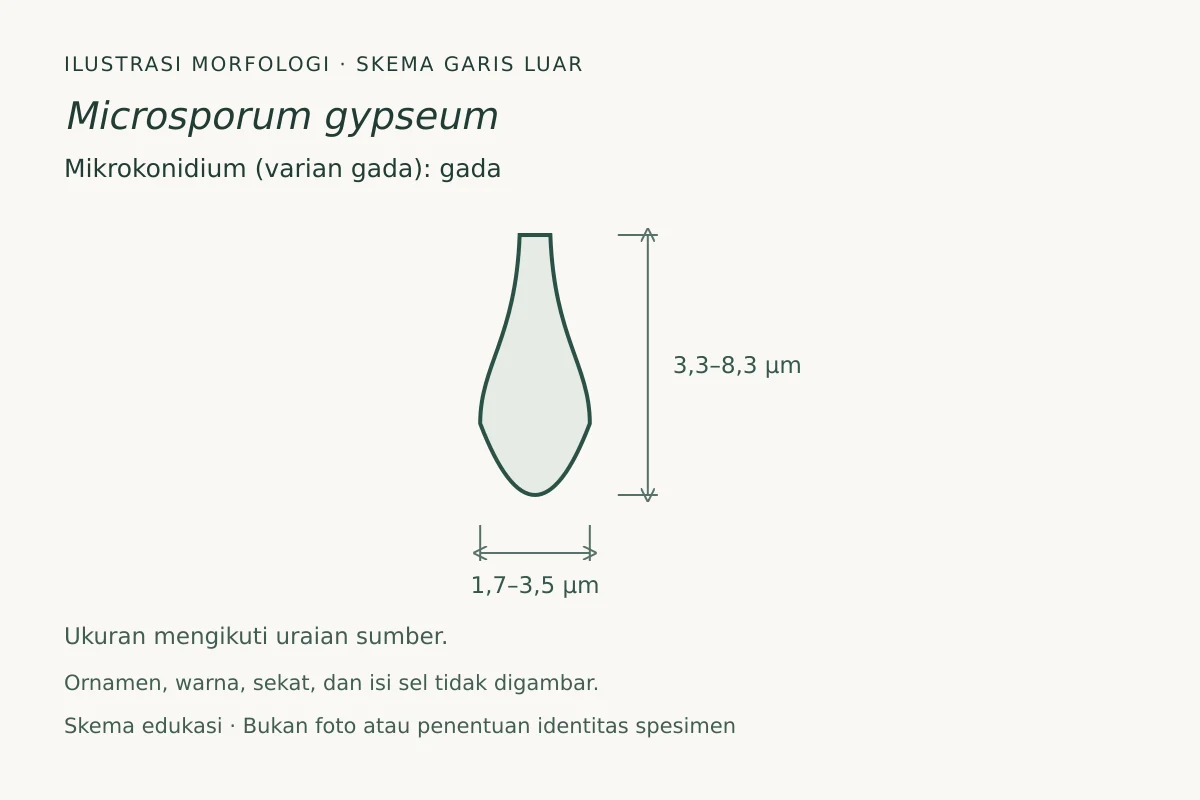
Ilustrasi skematis garis luar mikrokonidium (varian gada) Microsporum gypseum, berdasarkan uraian sumber; ukuran yang dilaporkan 1,7–3,5 × 3,3–8,3 µm dalam urutan sumber. Proporsi disederhanakan, bukan salinan satu spesimen. Ornamen permukaan, warna, sekat, dan isi sel tidak direkonstruksi. Varian mikrokonidium berbentuk gada. Sumber menuliskan 1,7–3,5 × 3,3–8,3 µm tanpa menamai sumbu; urutannya dipertahankan. Makrokonidium berekor tidak digunakan. Ornamen, warna, sekat, dan isi sel tidak digambar. Skema edukasi, bukan alat identifikasi.
- Jenis
- Ilustrasi skematis
- Kredit
- Fungi, ilustrasi orisinal (2026); fakta morfologi berdasarkan Wikipedia contributors
- Lisensi
- CC BY-SA 4.0
- Sumber media
- Buka entri sumber
Sumber profil
Rujukan halaman ini
Fungi. Microsporum gypseum. Rilis data fungi-2026-10-12-expansion-2. https://fungi-atlas.mgadib.chatgpt.site/jamur/microsporum-gypseum/.
Status: impor sumber; pemeriksaan editorial per profil belum selesai. Untuk klaim biologis, gunakan rujukan pada bagian terkait dan periksa konteks sumber aslinya.