01 / Morfologi

Ciri dan struktur

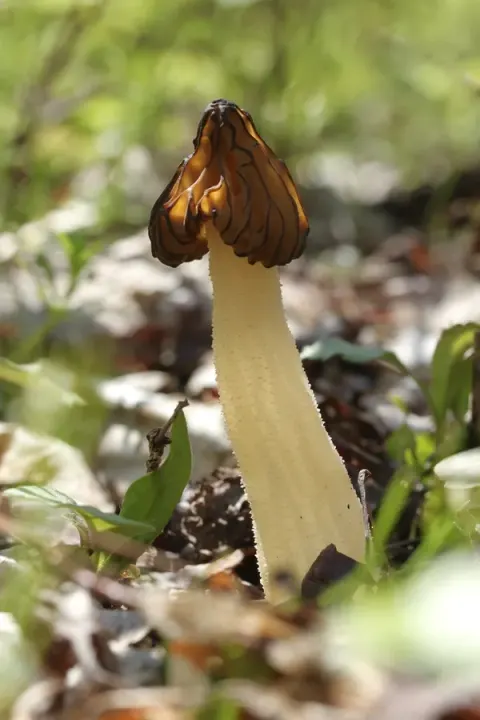
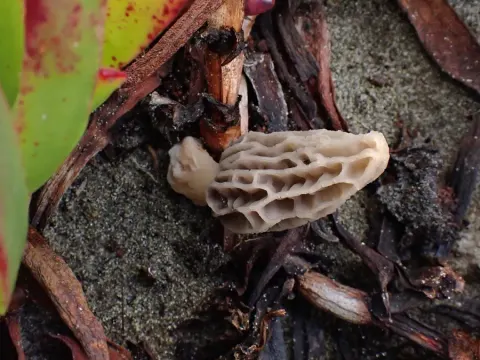
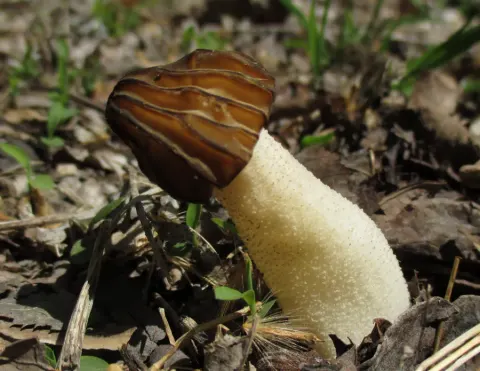
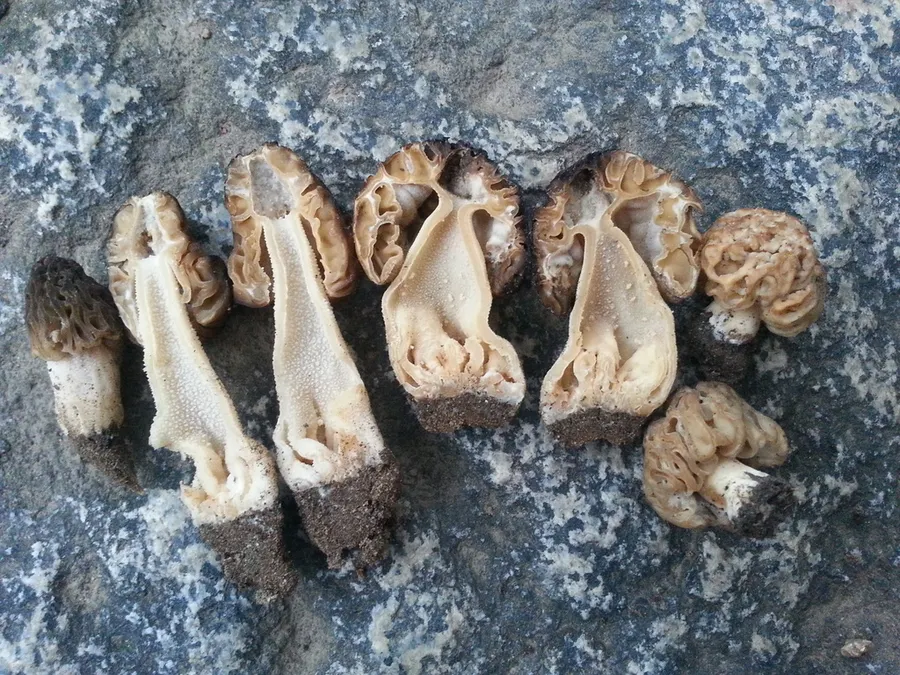
The fruit bodies are 4 – 15 cm high with a conical cap that is 2 – 5 cm tall and 2 – 5 cm wide at the widest point. The cap surface has pits and ridges, formed by the intersection of 12–20 primary vertical ridges and infrequent shorter, secondary vertical ridges and transecting horizontal ridges. The cap is attached in a skirt-like manner to the stipe, roughly halfway from the top, with a sinus 1 – 2.5 cm deep. The ridges are smooth and colored yellowish brown to honey brown when young, but darken in age to brown, dark brown or black. When young the ridges are up to 1 mm wide and flat with sharp edges but usually become rounded, sharp or eroded in age. The pits are smooth and vertically elongated. Initially whitish to pale brown when immature, they become brownish to yellowish or grayish brown at maturity. The fragile stipe measures 2.5 – 11 cm tall by 1 – 5 cm thick and is roughly the same width throughout its length, or tapered towards the top. It is often hidden by the cap when young but becomes longer as it matures, often developing shallow longitudinal furrows. In warm, wet conditions the stipe sometimes becomes inflated, especially near the base. White to whitish or watery brownish in color, its texture is occasionally nearly smooth but more commonly covered with mealy whitish granules that sometimes darken to brown. Orson K. Miller likened the stipe texture to that of a cow tongue. The fragile, whitish to watery tan flesh is 1–2 mm thick in the hollow cap, and sometimes forms chambers or layers near the base. The whitish to brownish sterile inner surface of the cap is covered in mealy granules.

Sebagian uraian ditampilkan dalam bahasa sumber; terjemahannya belum tersedia atau belum lolos pemeriksaan.

Rujukan: [1]

Pengukuran mengikuti objek, spesimen atau kultur, dan metode yang disebutkan sumber. Baca uraian asli untuk konteks lengkap.

02 / Kehidupan

Habitat dan peran ekologis

Like many morel species, the ecological mode of Morchella populiphila is not known with certainty, but it is suspected of being both saprobic (obtaining its nourishment from nonliving or decaying organic matter) and mycorrhizal (symbiotic with trees) at different stages in its life cycle. Fruit bodies grow singly, scattered, or in groups. It is found in Oregon to Nevada and northern California, where it grows on dried-out riverbeds. Fruiting, which occurs in the spring, tends to occur shortly after the emergence of Verpa mushrooms, and before the appearance of other morels. Morchella populiphila has been found in Europe, but is suspected to have been introduced with trees from North America. In 2017, the species was reported from eastern Turkey (Van Province), based on material collected in the Çatak district under Populus at 1684 m elevation; this was presented as the first record of M. populiphila for Turkey.

Sebagian uraian ditampilkan dalam bahasa sumber; terjemahannya belum tersedia atau belum lolos pemeriksaan.

Rujukan: [1]

Habitat atau konteks temuan
Informasi belum tersedia pada sumber rilis ini.
Substrat
Informasi belum tersedia pada sumber rilis ini.
Peran atau konteks
Belum dikategorikan pada rilis ini.
Temukan hubungan serupa
03 / Siklus hidup

Reproduksi

In deposit, the spores are bright yellowish orange. Ascospores are smooth, elliptical, and typically measure 20–25 by 12–16 μm. Asci (spore-bearing cells) are eight-spored, cylindrical, hyaline (translucent), and measure 225–325 by 15–22.5 μm. Paraphyses are septate, and cylindrical with tips that are rounded to club-shaped, and measure 150–275 by 7–15 μm. Hyphal cells on sterile ridges are septate, measuring 100–175 by 10–25 μm. They are tightly packed in an even layer. The terminal hyphae are club-shaped to somewhat rectangular with a flattened to broadly rounded tip.

Sebagian uraian ditampilkan dalam bahasa sumber; terjemahannya belum tersedia atau belum lolos pemeriksaan.

Rujukan: [1]

04 / Batas informasi

Catatan identitas dan cakupan

  • Nama diterima mengikuti Catalogue of Life Base2026-09-11; uraian mempertahankan konsep dan nama sumber aslinya.
  • Original geographic, specimen and life-cycle scope retained; source import awaits individual editorial review.
  • Impor dan terjemahan otomatis belum diperiksa editorial per profil. Struktur reproduktif yang disebutkan tidak membuktikan seluruh siklus hidup diketahui.
  • Pengukuran pada uraian mengikuti spesimen, kultur, dan metode sumber; angka tidak diperluas ke semua populasi.

Catatan distribusi dalam narasi mengikuti sumbernya. Dokumentasi spesimen atau foto mengikuti catatan sumber. Bukti wilayah Indonesia dan penilaian konservasi tidak disimpulkan dari gambar.

05 / Dokumentasi

Melihat dengan konteks

Dokumentasi Morchella populiphila menurut asosiasi foto pada record takson iNaturalist. Kredit: Thea Chesney. Identitas mengikuti sumber; bukan penentuan spesimen independen.

Jenis
Fotografi
Kredit
(c) Thea Chesney, some rights reserved (CC BY), uploaded by Thea Chesney
Lisensi
CC BY 4.0
Sumber media
Buka entri sumber

Gambar menunjukkan objek menurut identifikasi sumber, bukan verifikasi independen spesimen oleh Fungi. Tidak ada skala baru yang ditambahkan.

06 / Rujukan

Sumber profil

  1. [1] Morchella populiphila — Wikipedia (en)Bagian sumber: Frozen revision 1376503498
    Tanggal penghimpunan sumber: 2026-10-12
    Teks sumber: CC BY-SA4.0 · Wikipedia contributors
  2. [2] Catalogue of Life Base2026-09-11 — Morchella populiphilaBagian sumber: ColDP NameUsage.tsv ID 44CQZ; accepted species; source 2073
    Tanggal penghimpunan sumber: 2026-10-12
  3. [3] Dokumentasi visual — Morchella populiphilaBagian sumber: Individual media record; identification follows the source, not independent determination
    Tanggal penghimpunan sumber: 2026-10-12
    Media sumber: CC BY 4.0 · (c) Thea Chesney, some rights reserved (CC BY), uploaded by Thea Chesney

Adaptasi teks: CC BY-SA 4.0. Wikipedia contributors — Morchella populiphila — Wikipedia (en)

Uraian asli dan riwayat sumber

Riwayat atau halaman sumber

Ringkasan sumber

Morchella populiphila is a species of morel fungus (family Morchellaceae) native to northwestern North America. Described as new to science in 2012, its specific epithet refers to its association with black cottonwood (Populus trichocarpa). The morel used to be referred to as Morchella semilibera in western North American field guides until molecular analysis established that to be a strictly European species. M. populiphila occurs in California, Nevada and Oregon. Its fruit bodies grow up to 15 cm tall with a ridged and pitted conical cap that attaches about halfway down the stipe.

Revisi sumber

Morfologi sumber

The fruit bodies are 4 – 15 cm high with a conical cap that is 2 – 5 cm tall and 2 – 5 cm wide at the widest point. The cap surface has pits and ridges, formed by the intersection of 12–20 primary vertical ridges and infrequent shorter, secondary vertical ridges and transecting horizontal ridges. The cap is attached in a skirt-like manner to the stipe, roughly halfway from the top, with a sinus 1 – 2.5 cm deep. The ridges are smooth and colored yellowish brown to honey brown when young, but darken in age to brown, dark brown or black. When young the ridges are up to 1 mm wide and flat with sharp edges but usually become rounded, sharp or eroded in age. The pits are smooth and vertically elongated. Initially whitish to pale brown when immature, they become brownish to yellowish or grayish brown at maturity. The fragile stipe measures 2.5 – 11 cm tall by 1 – 5 cm thick and is roughly the same width throughout its length, or tapered towards the top. It is often hidden by the cap when young but becomes longer as it matures, often developing shallow longitudinal furrows. In warm, wet conditions the stipe sometimes becomes inflated, especially near the base. White to whitish or watery brownish in color, its texture is occasionally nearly smooth but more commonly covered with mealy whitish granules that sometimes darken to brown. Orson K. Miller likened the stipe texture to that of a cow tongue. The fragile, whitish to watery tan flesh is 1–2 mm thick in the hollow cap, and sometimes forms chambers or layers near the base. The whitish to brownish sterile inner surface of the cap is covered in mealy granules.

Revisi sumber

Ekologi sumber

Like many morel species, the ecological mode of Morchella populiphila is not known with certainty, but it is suspected of being both saprobic (obtaining its nourishment from nonliving or decaying organic matter) and mycorrhizal (symbiotic with trees) at different stages in its life cycle. Fruit bodies grow singly, scattered, or in groups. It is found in Oregon to Nevada and northern California, where it grows on dried-out riverbeds. Fruiting, which occurs in the spring, tends to occur shortly after the emergence of Verpa mushrooms, and before the appearance of other morels. Morchella populiphila has been found in Europe, but is suspected to have been introduced with trees from North America. In 2017, the species was reported from eastern Turkey (Van Province), based on material collected in the Çatak district under Populus at 1684 m elevation; this was presented as the first record of M. populiphila for Turkey.

Revisi sumber

Struktur reproduksi sumber

In deposit, the spores are bright yellowish orange. Ascospores are smooth, elliptical, and typically measure 20–25 by 12–16 μm. Asci (spore-bearing cells) are eight-spored, cylindrical, hyaline (translucent), and measure 225–325 by 15–22.5 μm. Paraphyses are septate, and cylindrical with tips that are rounded to club-shaped, and measure 150–275 by 7–15 μm. Hyphal cells on sterile ridges are septate, measuring 100–175 by 10–25 μm. They are tightly packed in an even layer. The terminal hyphae are club-shaped to somewhat rectangular with a flattened to broadly rounded tip.

Revisi sumber

Rujukan halaman ini

Fungi. Morchella populiphila. Rilis data fungi-2026-10-12-expansion-2. https://fungi-atlas.mgadib.chatgpt.site/jamur/morchella-populiphila/.

Status: impor sumber; pemeriksaan editorial per profil belum selesai. Untuk klaim biologis, gunakan rujukan pada bagian terkait dan periksa konteks sumber aslinya.