Ciri dan struktur
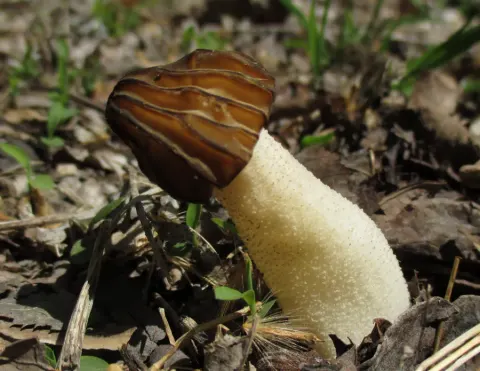
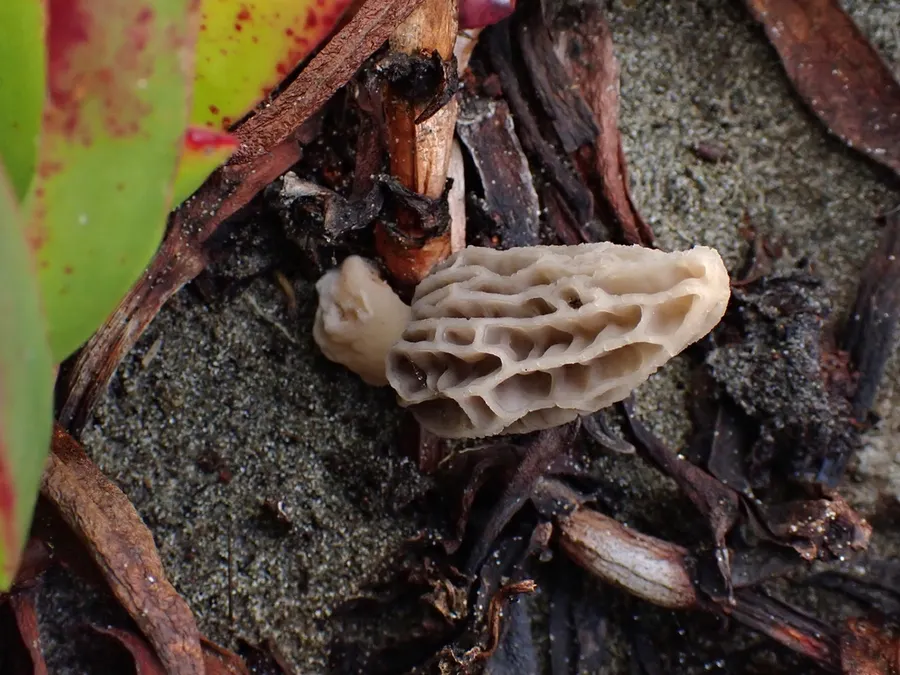
Fruit bodies of M. rufobrunnea can reach 6 – 21 cm tall, although most are typically found in a narrower range, 9 – 15.5 cm. The conical to roughly cylindrical hymenophore (cap) is typically 6 – 12 cm high by 2 – 6 cm wide. Its surface is covered with longitudinal anastomosed ridges and crosswise veins that form broad, angular, elongated pits. Young fruit bodies are typically dark grey with sharply contrasting beige or buff ridges, while mature specimens fade to ochraceous-buff. The cylindrical stipe is often strongly wrinkled, enlarged at the base and measures 30 – 70 cm by 1 – 2.5 cm thick. It is typically covered with a dark brown to greyish pruinescence, often fading at maturity, a useful character to discriminate it from similar species, such as M. tridentina (=Morchella frustrata), or M. sceptriformis. The stipe and hymenophore often exhibit ochraceous, orange or reddish stains, although this feature is neither constant nor exclusive to M. rufobrunnea and can be seen in a number of Morchella species, such as M. anatolica, M. esculenta, M. fluvialis, M. guatemalensis, M. palazonii, and M. tridentina. In deposit, the spores are pale orange to yellowish orange. Ascospores are egg-shaped, measuring 20–24 by 14–16 μm when mature, but smaller (14.5–19 by 9–10 μm) in immature fruit bodies. They are thin-walled, hyaline (translucent), and inamyloid. Although in normal light microscopy they appear smooth, they are longitudinally grooved when viewed in the appropriate staining medium (like heated lactophenol cotton blue) or under a scanning electron microscope. The cylindrical asci (spore-bearing cells) are 300–360 by 16–20 μm with walls up to 1.5 μm thick.
Habitat dan peran ekologis
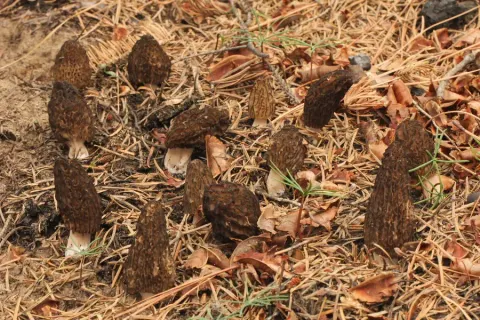
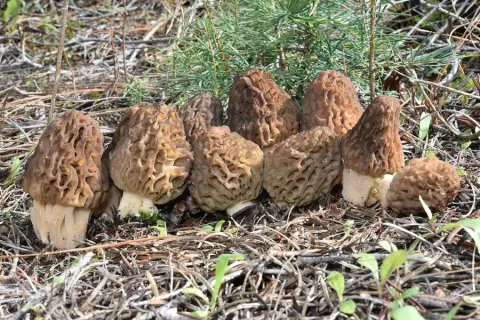
Spesies yang sebagian besar bersifat sapropit, Morchella rufobrunnea tubuh buah tumbuh bersendirian atau dalam kelompok di tanah yang terganggu atau kayu yang digunakan dalam penataan lansekap. Large numbers dapat muncul setahun setelah kayu mulch telah menyebar di tanah. Typical disturbed habitatnya meliputi lubang api, dekat tumpukan kompos, jalan-jalan pemanen kayu, dan ruang bawah tanah kotor. Fruiting usually terjadi di musim semi, meskipun tubuh buah dapat ditemukan di habitat ini sebagian besar tahun. Di American continent, Morchella rufobrunnea berkisar dari Mexico through California and Oregon. Diperkirakan telah diperkenalkan ke pusat Michigan from California and adalah salah satu dari tujuh Morchella species yang telah tercatat di Meksiko. Dalam 2009, Israeli researchers menggunakan genetika molekul untuk mengkonfirmasi identitas spesies di Israel utara, di mana ditemukan tumbuh di tanah yang terganggu dengan tanah tanah tanah di dekat jalur yang baru saja diratakan di tepi hutan. Ini adalah penampilan pertama yang didokumentasikan jamur di luar American continent. Unlike North American populations that typically fruit for only a few weeks in spring, the Israeli populations have a long-season ecotype, fruiting from early November to late May (winter and spring).
- Habitat atau konteks temuan
- Informasi belum tersedia pada sumber rilis ini.
- Substrat
- tanah
- Peran atau konteks
- Belum dikategorikan pada rilis ini.
Reproduksi
In deposit, the spores are pale orange to yellowish orange. Ascospores are egg-shaped, measuring 20–24 by 14–16 μm when mature, but smaller (14.5–19 by 9–10 μm) in immature fruit bodies. They are thin-walled, hyaline (translucent), and inamyloid. Although in normal light microscopy they appear smooth, they are longitudinally grooved when viewed in the appropriate staining medium (like heated lactophenol cotton blue) or under a scanning electron microscope. The cylindrical asci (spore-bearing cells) are 300–360 by 16–20 μm with walls up to 1.5 μm thick. Paraphyses measure 90–184 by 10–18.5 μm (6–9 μm thick if immature); they are hyaline, have 1–2 (–3) septa in the lower half and slightly enlarged, subcapitate tips.
Catatan identitas dan cakupan
- Nama diterima mengikuti Catalogue of Life Base2026-09-11; uraian mempertahankan konsep dan nama sumber aslinya.
- Original geographic, specimen and life-cycle scope retained; source import awaits individual editorial review.
- Impor dan terjemahan otomatis belum diperiksa editorial per profil. Struktur reproduktif yang disebutkan tidak membuktikan seluruh siklus hidup diketahui.
- Pengukuran pada uraian mengikuti spesimen, kultur, dan metode sumber; angka tidak diperluas ke semua populasi.
Catatan distribusi dalam narasi mengikuti sumbernya. Dokumentasi spesimen atau foto mengikuti catatan sumber. Bukti wilayah Indonesia dan penilaian konservasi tidak disimpulkan dari gambar.
Melihat dengan konteks
Dokumentasi Morchella rufobrunnea menurut asosiasi foto pada record takson iNaturalist. Kredit: Mandy Hackney. Identitas mengikuti sumber; bukan penentuan spesimen independen.
- Jenis
- Fotografi
- Kredit
- (c) Mandy Hackney, some rights reserved (CC BY), uploaded by Mandy Hackney
- Lisensi
- CC BY 4.0
- Sumber media
- Buka entri sumber
Dokumentasi tambahan
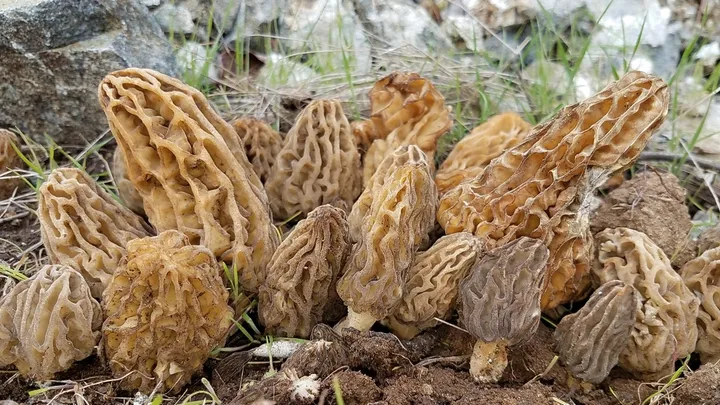
Foto yang diasosiasikan dengan Morchella rufobrunnea pada iNaturalist. Identifikasi mengikuti sumber; bukan penentuan spesimen independen.
Kredit dan penggunaan
(c) Alan Rockefeller, some rights reserved (CC BY), uploaded by Alan Rockefeller
Ukuran dan format gambar disesuaikan tanpa pemotongan, retus, atau penambahan skala. Lisensi sumber dipertahankan.
Sumber profil
- [1] Morchella rufobrunnea — Wikipedia (en)
- [2] Catalogue of Life Base2026-09-11 — Morchella rufobrunnea
- [3] Dokumentasi visual — Morchella rufobrunnea
- [4] Dokumentasi visual — Morchella rufobrunnea
Rujukan halaman ini
Fungi. Morchella rufobrunnea. Rilis data fungi-2026-10-12-expansion-2. https://fungi-atlas.mgadib.chatgpt.site/jamur/morchella-rufobrunnea/.
Status: impor sumber; pemeriksaan editorial per profil belum selesai. Untuk klaim biologis, gunakan rujukan pada bagian terkait dan periksa konteks sumber aslinya.