01 / Morfologi

Ciri dan struktur

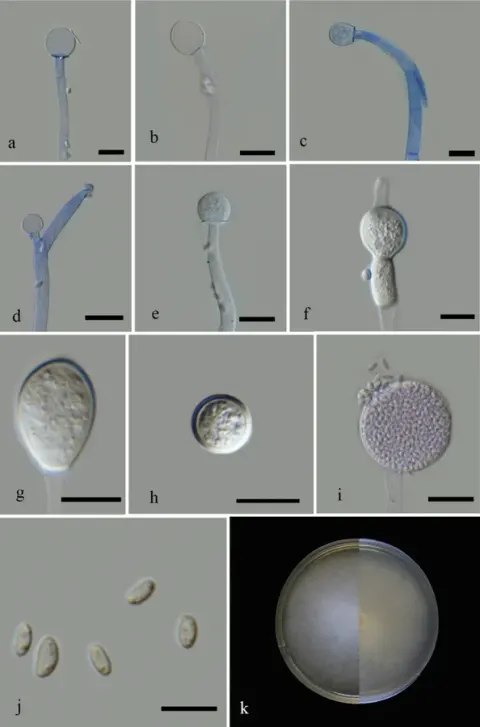
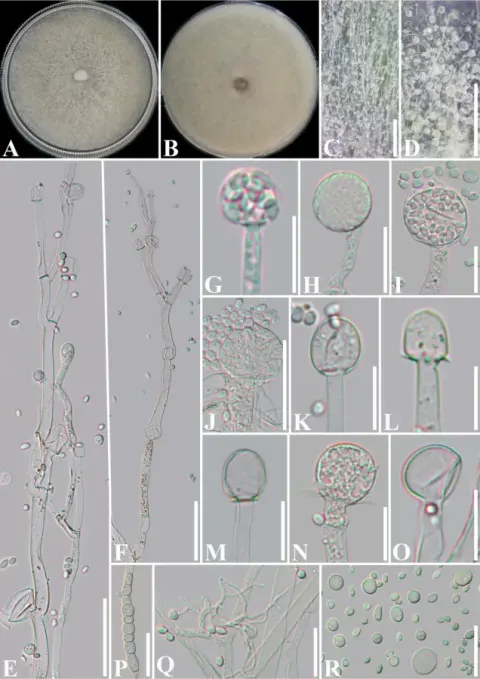
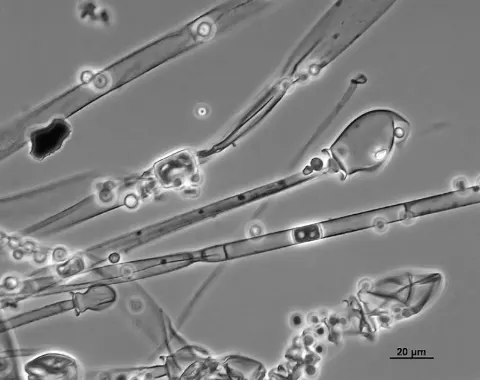
Mucor circinelloides reproduce both asexually and sexually. The asexual sporangiophores are found as two types: elongate and sympodially branched. The elongate sporangiophores have larger sporangia, which are white at first and progressively turn greenish brown in colour. They assume a globose shape and are 40–80 μm in size; characterized as "bobbing heads". Sporangiophores are mostly sympodially branched with small sporangia (25 μm); branches are and sometimes circinate. The diameter of the sporangia range from 20 to 80 μm. Sporangia have slightly encrusted walls. In larger sporangia, the membranes are deliquescent, whereas they are persistent in the smaller ones and rupture at maturity. Smaller sporangia also have smooth persistent walls. Sporangiophores are ellipsoid (6–7 μm in diameter) or subglobose (4–6 μm in diameter). Numerous chlamydospores are also produced. Colonies are fast growing and go up to 2 cm in height. On Czapek Yeast Autolysate (CYA) plates, the colony growth is low and sparse, most often spreading across the entire Petri dish. These colonies of 60 mm diameter or more appear to be pale grey or yellow in colour, with the reverse being uncoloured. Colonies also fill up the entire Petri dish of malt extract agar, producing colony colours similar to those observed on CYA. Mucor circinelloides can assume a yeast-like growth form. It has been isolated in this yeast form from human urine and normal stool specimen. It has also been recovered as a yeast from frogs.

Sebagian uraian ditampilkan dalam bahasa sumber; terjemahannya belum tersedia atau belum lolos pemeriksaan.

Rujukan: [1]

Pengukuran mengikuti objek, spesimen atau kultur, dan metode yang disebutkan sumber. Baca uraian asli untuk konteks lengkap.

02 / Kehidupan

Habitat dan peran ekologis

At least 20 species belonging to the genus Mucor are found to be extracted from food. M. circinelloides is one of the five most significant fungus out of these 20 along with M. hiemalis, M. piriformis, M. plumbeus and M. racemosus. It has been reported to spoil cheese and yams as well as diseases of mango. This fungus has also been isolated from various foods such as meat, hazelnuts, walnuts, maize, mung beans, soybeans and barley. Fungi in the order Mucorales class have not been investigated in detail for their ability to produce mycotoxins; Cytotoxicity and mycotoxin-production was analysed and tested for using the cytotoxicity test (MTT assay) and LC/MS/MS-based multimycotoxin method respectively for three fungal species, including M. circinelloides. Mucor circinelloides was found to be able to produce 3-nitropropionic acid as well as have low cytotoxicity. Conventionally, M. circinelloides is considered not to produce mycotoxins.

Sebagian uraian ditampilkan dalam bahasa sumber; terjemahannya belum tersedia atau belum lolos pemeriksaan.

Rujukan: [1]

Habitat atau konteks temuan
Informasi belum tersedia pada sumber rilis ini.
Substrat
Informasi belum tersedia pada sumber rilis ini.
Peran atau konteks
Belum dikategorikan pada rilis ini.
Temukan hubungan serupa
03 / Siklus hidup

Reproduksi

Mucor circinelloides reproduce both asexually and sexually. The asexual sporangiophores are found as two types: elongate and sympodially branched. The elongate sporangiophores have larger sporangia, which are white at first and progressively turn greenish brown in colour. They assume a globose shape and are 40–80 μm in size; characterized as "bobbing heads". Sporangiophores are mostly sympodially branched with small sporangia (25 μm); branches are and sometimes circinate. The diameter of the sporangia range from 20 to 80 μm. Sporangia have slightly encrusted walls. In larger sporangia, the membranes are deliquescent, whereas they are persistent in the smaller ones and rupture at maturity. Smaller sporangia also have smooth persistent walls.

Sebagian uraian ditampilkan dalam bahasa sumber; terjemahannya belum tersedia atau belum lolos pemeriksaan.

Rujukan: [1]

Sinonim menurut acuan taksonomi rilis: Calyptromyces circinelloides; Circinella tenella; Circinomucor circinelloides; Circinomucor janssenii; Mucor alternans; Mucor ambiguus; Mucor circinelloides f. janssenii; Mucor dubius; Mucor griseolilacinus; Mucor jansseni; Mucor jansseni var. indicus; Mucor jauchae; Mucor javanicus; Mucor kurssanovii; Mucor mandshuricus; Mucor prainii; Mucor ramificus; Mucor stagnalis; Mucor tenellus; Mucor velutinosus
04 / Batas informasi

Catatan identitas dan cakupan

  • Nama diterima mengikuti Catalogue of Life Base2026-09-11; uraian mempertahankan konsep dan nama sumber aslinya.
  • Original geographic, specimen and life-cycle scope retained; source import awaits individual editorial review.
  • Impor dan terjemahan otomatis belum diperiksa editorial per profil. Struktur reproduktif yang disebutkan tidak membuktikan seluruh siklus hidup diketahui.
  • Pengukuran pada uraian mengikuti spesimen, kultur, dan metode sumber; angka tidak diperluas ke semua populasi.

Catatan distribusi dalam narasi mengikuti sumbernya. Dokumentasi spesimen atau foto mengikuti catatan sumber. Bukti wilayah Indonesia dan penilaian konservasi tidak disimpulkan dari gambar.

05 / Dokumentasi

Melihat dengan konteks

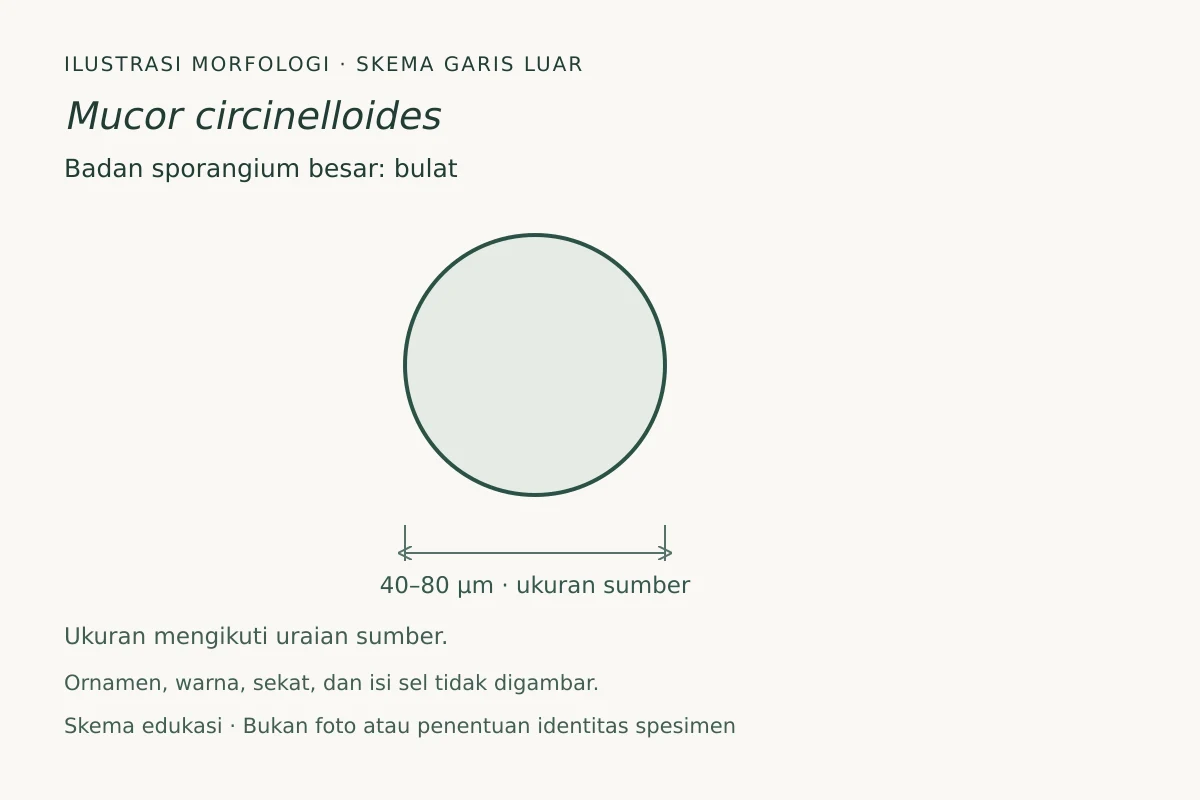
Ilustrasi skematis garis luar badan sporangium besar Mucor circinelloides, berdasarkan uraian sumber; ukuran yang dilaporkan 40–80 µm. Proporsi disederhanakan, bukan salinan satu spesimen. Ornamen permukaan, warna, sekat, dan isi sel tidak direkonstruksi. Badan sporangium besar berbentuk bola, ukuran yang dilaporkan 40–80 µm. Tangkai dan spora di dalamnya tidak digambar; ukuran sporangium kecil tidak dipindahkan. Ornamen, warna, sekat, dan isi sel tidak digambar. Skema edukasi, bukan alat identifikasi.

Jenis
Ilustrasi skematis
Kredit
Fungi, ilustrasi orisinal (2026); fakta morfologi berdasarkan Wikipedia contributors
Sumber media
Buka entri sumber

Gambar menunjukkan objek menurut identifikasi sumber, bukan verifikasi independen spesimen oleh Fungi. Tidak ada skala baru yang ditambahkan.

06 / Rujukan

Sumber profil

  1. [1] Mucor circinelloides — Wikipedia (en)Bagian sumber: Frozen revision 1306634607
    Tanggal penghimpunan sumber: 2026-10-12
    Media sumber: CC BY-SA4.0 · Wikipedia contributors
  2. [2] Catalogue of Life Base2026-09-11 — Mucor circinelloidesBagian sumber: ColDP NameUsage.tsv ID 44H4Q; accepted species; source 2073
    Tanggal penghimpunan sumber: 2026-10-12

Adaptasi teks: CC BY-SA 4.0. Wikipedia contributors — Mucor circinelloides — Wikipedia (en)

Uraian asli dan riwayat sumber

Riwayat atau halaman sumber

Ringkasan sumber

Mucor circinelloides reproduce both asexually and sexually. The asexual sporangiophores are found as two types: elongate and sympodially branched. The elongate sporangiophores have larger sporangia, which are white at first and progressively turn greenish brown in colour. They assume a globose shape and are 40–80 μm in size; characterized as "bobbing heads". Sporangiophores are mostly sympodially branched with small sporangia (25 μm); branches are and sometimes circinate. The diameter of the sporangia range from 20 to 80 μm.

Revisi sumber

Morfologi sumber

Mucor circinelloides reproduce both asexually and sexually. The asexual sporangiophores are found as two types: elongate and sympodially branched. The elongate sporangiophores have larger sporangia, which are white at first and progressively turn greenish brown in colour. They assume a globose shape and are 40–80 μm in size; characterized as "bobbing heads". Sporangiophores are mostly sympodially branched with small sporangia (25 μm); branches are and sometimes circinate. The diameter of the sporangia range from 20 to 80 μm. Sporangia have slightly encrusted walls. In larger sporangia, the membranes are deliquescent, whereas they are persistent in the smaller ones and rupture at maturity. Smaller sporangia also have smooth persistent walls. Sporangiophores are ellipsoid (6–7 μm in diameter) or subglobose (4–6 μm in diameter). Numerous chlamydospores are also produced. Colonies are fast growing and go up to 2 cm in height. On Czapek Yeast Autolysate (CYA) plates, the colony growth is low and sparse, most often spreading across the entire Petri dish. These colonies of 60 mm diameter or more appear to be pale grey or yellow in colour, with the reverse being uncoloured. Colonies also fill up the entire Petri dish of malt extract agar, producing colony colours similar to those observed on CYA. Mucor circinelloides can assume a yeast-like growth form. It has been isolated in this yeast form from human urine and normal stool specimen. It has also been recovered as a yeast from frogs.

Revisi sumber

Ekologi sumber

At least 20 species belonging to the genus Mucor are found to be extracted from food. M. circinelloides is one of the five most significant fungus out of these 20 along with M. hiemalis, M. piriformis, M. plumbeus and M. racemosus. It has been reported to spoil cheese and yams as well as diseases of mango. This fungus has also been isolated from various foods such as meat, hazelnuts, walnuts, maize, mung beans, soybeans and barley. Fungi in the order Mucorales class have not been investigated in detail for their ability to produce mycotoxins; Cytotoxicity and mycotoxin-production was analysed and tested for using the cytotoxicity test (MTT assay) and LC/MS/MS-based multimycotoxin method respectively for three fungal species, including M. circinelloides. Mucor circinelloides was found to be able to produce 3-nitropropionic acid as well as have low cytotoxicity. Conventionally, M. circinelloides is considered not to produce mycotoxins.

Revisi sumber

Struktur reproduksi sumber

Mucor circinelloides reproduce both asexually and sexually. The asexual sporangiophores are found as two types: elongate and sympodially branched. The elongate sporangiophores have larger sporangia, which are white at first and progressively turn greenish brown in colour. They assume a globose shape and are 40–80 μm in size; characterized as "bobbing heads". Sporangiophores are mostly sympodially branched with small sporangia (25 μm); branches are and sometimes circinate. The diameter of the sporangia range from 20 to 80 μm. Sporangia have slightly encrusted walls. In larger sporangia, the membranes are deliquescent, whereas they are persistent in the smaller ones and rupture at maturity. Smaller sporangia also have smooth persistent walls.

Revisi sumber

Rujukan halaman ini

Fungi. Mucor circinelloides. Rilis data fungi-2026-10-12-expansion-2. https://fungi-atlas.mgadib.chatgpt.site/jamur/mucor-circinelloides/.

Status: impor sumber; pemeriksaan editorial per profil belum selesai. Untuk klaim biologis, gunakan rujukan pada bagian terkait dan periksa konteks sumber aslinya.