01 / Morfologi

Ciri dan struktur

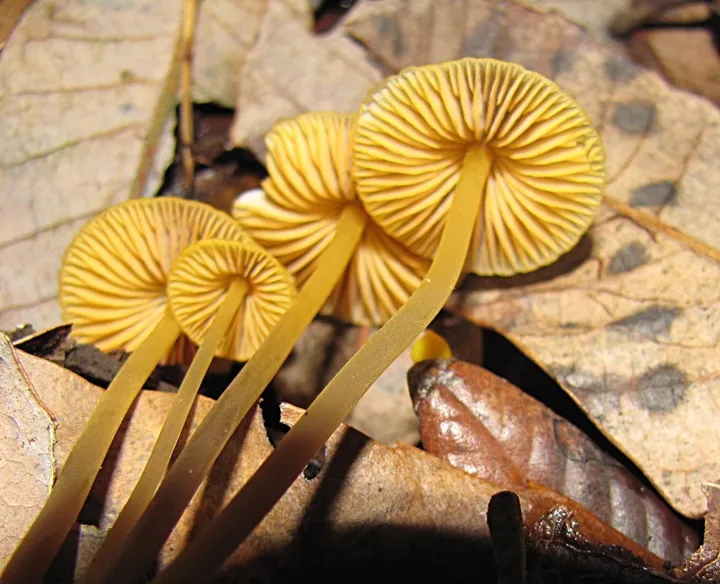
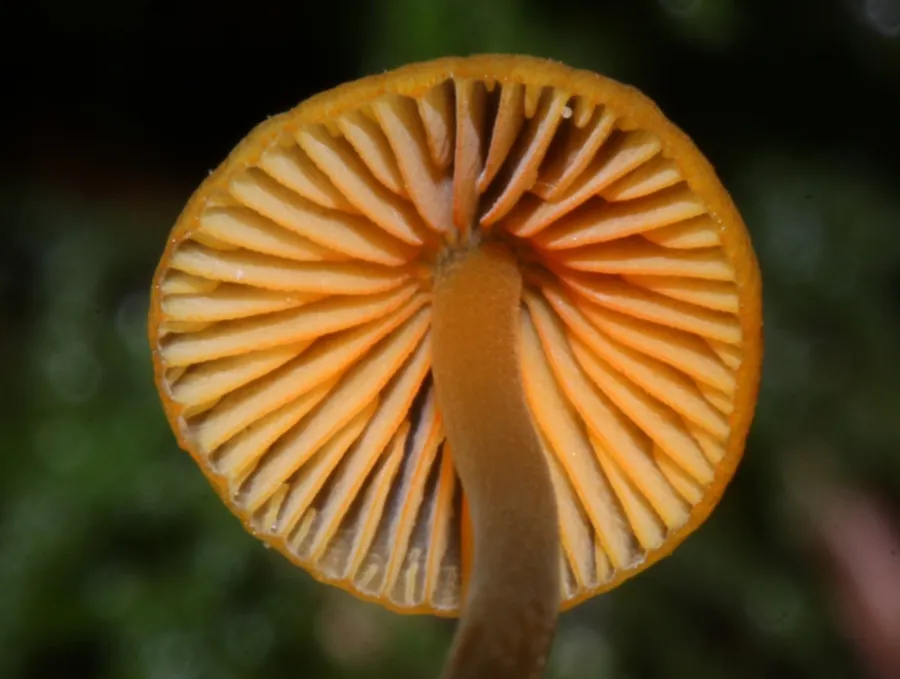
The cap of M. aurantiomarginata ranges in shape from obtusely conic to bell-shaped, and becomes flat in maturity, reaching diameters of 0.8 – 2.0 cm. The cap color is variable, ranging from dark olive fuscous (dark brownish-gray) to yellowish-olive in the center, while the margin is orangish. Alexander H. Smith, in his 1947 monograph of North American Mycena species, stated that the caps are not hygrophanous (changing color depending on the level of hydration), while Mycena specialist Arne Aronsen says they are. The overall color fades as the mushroom ages. The surface is moist, and young individuals are covered with fine whitish powder, but this soon sloughs off to leave a polished surface that develops radial grooves in maturity. The flesh is thin (about 1 mm thick in the center of the cap) and flexible. Gills are adnate with a decurrent tooth (where the gills curve up to join the stipe but then, close to the stipe, the margin turns down again), and initially narrow but broaden when old. They are pallid to grayish-olive with bright orange edges. Smith noted that the edge color may spread to the gill faces in some specimens, because the pigment, rather than being encrusted on the walls of the cystidia, is found in the cytosol and therefore more readily diffusible. The gills are spaced close together, with between 16 and 26 gills reaching the stipe, and there are up to three tiers of interspersed lamellulae (short gills that do not extend fully from the cap edge to the stipe). The cylindrical stipe is 3 – 6 cm long by 0.1 – 0.2 cm thick, hollow, and stiff but flexible; it is somewhat thicker at the base.

Sebagian uraian ditampilkan dalam bahasa sumber; terjemahannya belum tersedia atau belum lolos pemeriksaan.

Rujukan: [1]

Pengukuran mengikuti objek, spesimen atau kultur, dan metode yang disebutkan sumber. Baca uraian asli untuk konteks lengkap.

02 / Kehidupan

Habitat dan peran ekologis

Mycena aurantiomarginata adalah jamur saprobik, yang memperoleh nutrisi dari bahan organik yang membusuk yang ditemukan di lantai hutan, seperti karpet jarum. Fruit bodies of the fungus grow scattered, in groups, or in tufts under conifers (usually spruce and fir), and are often found on moss. Di Amerika Utara, ia ditemukan di California, Washington, Oregon, dan British Columbia, dan spesies ini tersebar luas di Eropa barat dan utara. In Central America, the mushroom has been collected on the summit of Cerro de la Muerte in the Cordillera de Talamanca, Costa Rica, on leaf litter of Comarostaphylis arbutoides (a highly branched evergreen shrub or tree in the heath family). Di 2010, dilaporkan dari Hokkaido in Jepang utara, di mana ditemukan tumbuh di atas sampah hutan Picea glehnii pada awal musim dingin. Hal ini juga telah direkam dari Afrika Utara.

Sebagian uraian ditampilkan dalam bahasa sumber; terjemahannya belum tersedia atau belum lolos pemeriksaan.

Rujukan: [1]

Habitat atau konteks temuan
hutan
Substrat
Informasi belum tersedia pada sumber rilis ini.
Peran atau konteks
Pengurai
Temukan hubungan serupa
03 / Siklus hidup

Reproduksi

The spores are elliptic, smooth, and amyloid, with dimensions of 7–9 by 4–5 μm. The basidia (spore-bearing cells of the hymenium) are club-shaped, four-spored, and measure 25–32 by 5.5–7 μm. Pleurocystidia and cheilocystidia (cystidia on the gill faces and edges, respectively) are abundant and similar in morphology: club-shaped to somewhat capitate (with a head), the tops sparsely to densely covered with small spines (said to resemble a mace), filled with a bright orange pigment, and measuring 28–36 by 7–12 μm. The flesh of the cap is covered with a cuticle, on the surface of which are found scattered cystidia similar to those on the gills. Directly beneath the cuticle is a layer of enlarged cells, and beneath this are filamentous hyphae.

Sebagian uraian ditampilkan dalam bahasa sumber; terjemahannya belum tersedia atau belum lolos pemeriksaan.

Rujukan: [1]

Sinonim menurut acuan taksonomi rilis: Agaricus aurantiomarginatus; Agaricus elegans; Mycena aurantiomarginata f. elegans; Mycena elegans; Mycena elegans var. aurantiomarginata
04 / Batas informasi

Catatan identitas dan cakupan

  • Nama diterima mengikuti Catalogue of Life Base2026-09-11; uraian mempertahankan konsep dan nama sumber aslinya.
  • Original geographic, specimen and life-cycle scope retained; source import awaits individual editorial review.
  • Impor dan terjemahan otomatis belum diperiksa editorial per profil. Struktur reproduktif yang disebutkan tidak membuktikan seluruh siklus hidup diketahui.
  • Pengukuran pada uraian mengikuti spesimen, kultur, dan metode sumber; angka tidak diperluas ke semua populasi.

Catatan distribusi dalam narasi mengikuti sumbernya. Dokumentasi spesimen atau foto mengikuti catatan sumber. Bukti wilayah Indonesia dan penilaian konservasi tidak disimpulkan dari gambar.

05 / Dokumentasi

Melihat dengan konteks

Dokumentasi Mycena aurantiomarginata menurut asosiasi foto pada record takson iNaturalist. Kredit: Alan Rockefeller. Identitas mengikuti sumber; bukan penentuan spesimen independen.

Jenis
Fotografi
Kredit
(c) Alan Rockefeller, some rights reserved (CC BY), uploaded by Alan Rockefeller
Lisensi
CC BY 4.0
Sumber media
Buka entri sumber

Gambar menunjukkan objek menurut identifikasi sumber, bukan verifikasi independen spesimen oleh Fungi. Tidak ada skala baru yang ditambahkan.

Dokumentasi tambahan

06 / Rujukan

Sumber profil

  1. [1] Mycena aurantiomarginata — Wikipedia (en)Bagian sumber: Frozen revision 1371286213
    Tanggal penghimpunan sumber: 2026-10-12
    Teks sumber: CC BY-SA4.0 · Wikipedia contributors
  2. [2] Catalogue of Life Base2026-09-11 — Mycena aurantiomarginataBagian sumber: ColDP NameUsage.tsv ID 44SRN; accepted species; source 2073
    Tanggal penghimpunan sumber: 2026-10-12
  3. [3] Dokumentasi visual — Mycena aurantiomarginataBagian sumber: Identitas mengikuti sumber dokumentasi; bukan penentuan spesimen independen.
    Tanggal penghimpunan sumber: 2026-10-17
    Media sumber: CC BY 4.0 · (c) Alan Rockefeller, some rights reserved (CC BY), uploaded by Alan Rockefeller
  4. [4] Dokumentasi visual — Mycena aurantiomarginataBagian sumber: Identitas mengikuti sumber dokumentasi; bukan penentuan spesimen independen.
    Tanggal penghimpunan sumber: 2026-10-17
    Teks sumber: CC BY-SA 4.0 · (c) Alan Rockefeller, some rights reserved (CC BY-SA)

Adaptasi teks: CC BY-SA 4.0. Wikipedia contributors — Mycena aurantiomarginata — Wikipedia (en)

Uraian asli dan riwayat sumber

Riwayat atau halaman sumber

Ringkasan sumber

Mycena aurantiomarginata, commonly known as the golden-edge bonnet, is a species of agaric fungus in the family Mycenaceae. First formally described in 1803, it was given its current name in 1872. Widely distributed, it is common in Europe and North America, and has also been collected in North Africa, Central America, and Japan. The fungus is saprobic, and produces fruit bodies (mushrooms) that grow on the floor of coniferous forests. The mushrooms have a bell-shaped to conical cap up to 2 cm in diameter, set atop a slender stipe up to 6 cm long with yellow to orange hairs at the base.

Revisi sumber

Morfologi sumber

The cap of M. aurantiomarginata ranges in shape from obtusely conic to bell-shaped, and becomes flat in maturity, reaching diameters of 0.8 – 2.0 cm. The cap color is variable, ranging from dark olive fuscous (dark brownish-gray) to yellowish-olive in the center, while the margin is orangish. Alexander H. Smith, in his 1947 monograph of North American Mycena species, stated that the caps are not hygrophanous (changing color depending on the level of hydration), while Mycena specialist Arne Aronsen says they are. The overall color fades as the mushroom ages. The surface is moist, and young individuals are covered with fine whitish powder, but this soon sloughs off to leave a polished surface that develops radial grooves in maturity. The flesh is thin (about 1 mm thick in the center of the cap) and flexible. Gills are adnate with a decurrent tooth (where the gills curve up to join the stipe but then, close to the stipe, the margin turns down again), and initially narrow but broaden when old. They are pallid to grayish-olive with bright orange edges. Smith noted that the edge color may spread to the gill faces in some specimens, because the pigment, rather than being encrusted on the walls of the cystidia, is found in the cytosol and therefore more readily diffusible. The gills are spaced close together, with between 16 and 26 gills reaching the stipe, and there are up to three tiers of interspersed lamellulae (short gills that do not extend fully from the cap edge to the stipe). The cylindrical stipe is 3 – 6 cm long by 0.1 – 0.2 cm thick, hollow, and stiff but flexible; it is somewhat thicker at the base.

Revisi sumber

Ekologi sumber

Mycena aurantiomarginata is a saprobic fungus, deriving nutrients from decomposing organic matter found on the forest floor, such as needle carpets. Fruit bodies of the fungus grow scattered, in groups, or in tufts under conifers (usually spruce and fir), and are often found on moss. In North America, it is found in California, Washington, Oregon, and British Columbia, and the species is widely distributed in western and northern Europe. In Central America, the mushroom has been collected on the summit of Cerro de la Muerte in the Cordillera de Talamanca, Costa Rica, on leaf litter of Comarostaphylis arbutoides (a highly branched evergreen shrub or tree in the heath family). In 2010, it was reported from Hokkaido in northern Japan, where it was found growing on Picea glehnii forest litter in early winter. It has also been recorded from North Africa.

Revisi sumber

Struktur reproduksi sumber

The spores are elliptic, smooth, and amyloid, with dimensions of 7–9 by 4–5 μm. The basidia (spore-bearing cells of the hymenium) are club-shaped, four-spored, and measure 25–32 by 5.5–7 μm. Pleurocystidia and cheilocystidia (cystidia on the gill faces and edges, respectively) are abundant and similar in morphology: club-shaped to somewhat capitate (with a head), the tops sparsely to densely covered with small spines (said to resemble a mace), filled with a bright orange pigment, and measuring 28–36 by 7–12 μm. The flesh of the cap is covered with a cuticle, on the surface of which are found scattered cystidia similar to those on the gills. Directly beneath the cuticle is a layer of enlarged cells, and beneath this are filamentous hyphae.

Revisi sumber

Rujukan halaman ini

Fungi. Mycena aurantiomarginata. Rilis data fungi-2026-10-12-expansion-2. https://fungi-atlas.mgadib.chatgpt.site/jamur/mycena-aurantiomarginata/.

Status: impor sumber; pemeriksaan editorial per profil belum selesai. Untuk klaim biologis, gunakan rujukan pada bagian terkait dan periksa konteks sumber aslinya.