01 / Morfologi

Ciri dan struktur

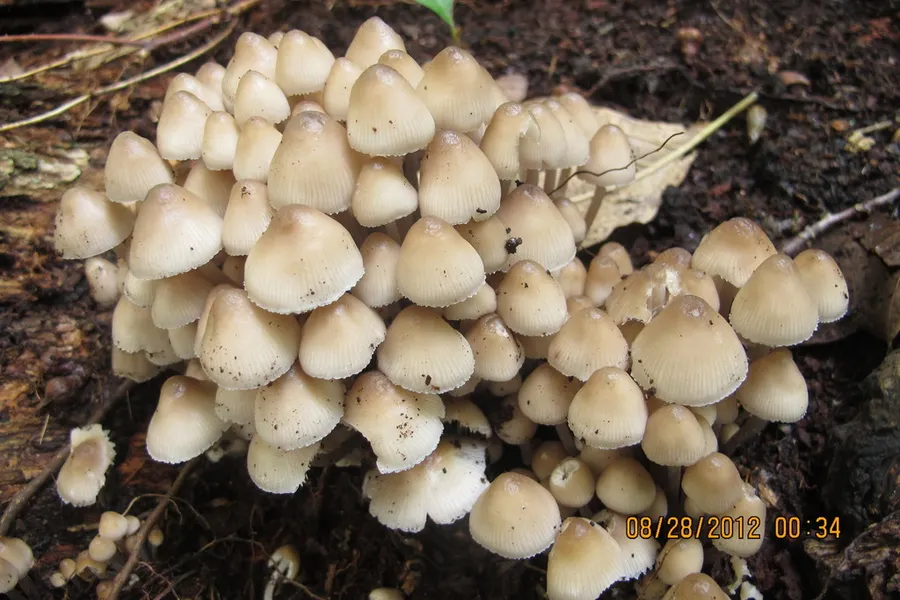
The cap is light reddish-brown, with a diameter typically ranging from 1 to 4.5 cm. Initially conic to bell-shaped to convex, it flattens during maturity, developing visible surface grooves corresponding to the gills underneath the cap. The margin of the cap has minute but distinct scallops. The surface is moist and smooth, and hygrophanous. The cap frequently develops splits in the margin, or cracks in the disc (the central part of the cap). The flesh of the cap is thick in the center but thin elsewhere, grayish to whitish, fragile, and with a slightly mealy odor and taste. The gills have a decurrent attachment to the stem (that is, running down the length of the stem) and are a pale brownish color with tinges of red. They are broad (between 3 and 6 mm), and have a close to subdistant spacing, with about 26–35 gills reaching the stem. The fragile stem is 3 to 9 cm long by 0.15 to 0.4 cm thick and yellow to yellow-brown, becoming reddish-brown to orange-brown in the bottom half in maturity. The lower portion of young stems is covered with white flecks. Roughly equal in thickness at the top and bottom, the base of the stem is covered by a yellowish mycelium that can be up to a third of the length of the stem. The edibility of the mushroom is "doubtful" and consumption "best avoided", although it is considered nonpoisonous. The spores are 7–9 by 5–6.5 μm, broadly ellipsoid, smooth, and strongly amyloid (it turns black when treated with Melzer's reagent). The basidia (spore-bearing cells) are four-spored. The pleurocystidia (cystidia on the gill face) are not differentiated. The cheilocystidia (cystidia on the gill edge) are embedded in the gill edge and very inconspicuous, club-shaped, 26–36 by 5–10 μm, and have tips that are covered with contorted projections that can be slender or thick.

Sebagian uraian ditampilkan dalam bahasa sumber; terjemahannya belum tersedia atau belum lolos pemeriksaan.

Rujukan: [1]

Pengukuran mengikuti objek, spesimen atau kultur, dan metode yang disebutkan sumber. Baca uraian asli untuk konteks lengkap.

02 / Kehidupan

Habitat dan peran ekologis

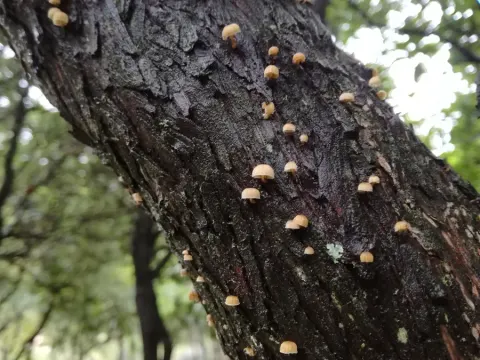
Mycena inclinata adalah jamur saprobik, yang memperoleh nutrisi dari bahan organik yang terurai yang ditemukan dalam sampah tanaman seperti daun, cabang, kulit dan cabang. Hal ini dicapai dengan menghasilkan enzim yang mampu memecah tiga komponen biokimia utama dinding sel tumbuhan yang ditemukan dalam sampah: selulosa, hemicellulosa dan lignin. The fruit bodies of Mycena inclinata grow in dense groups or clusters on decaying hardwood logs and stumps (especially oak and chestnut) during the spring and autumn. Jamur membentuk mycelium putih, wol di permukaan daun oak yang membusuk. Kadang-kadang, bisa ditemukan tumbuh di pohon hidup. Di Amerika Utara timur, banyak ditemukan di daerah yang berbatasan dengan Nova Scotia, Ontario, Manitoba, Missouri, North Carolina, dan New York. Ia telah ditemukan di Oregon, tetapi spesies ini tampaknya umumnya langka di sepanjang Pantai Pasifik. Daerah jamur ini juga mencakup Eropa, Kepulauan Canary, Afrika Utara, Siberia Timur, Jepang, Malesia, Turki, dan Selandia Baru.

Sebagian uraian ditampilkan dalam bahasa sumber; terjemahannya belum tersedia atau belum lolos pemeriksaan.

Rujukan: [1]

Habitat atau konteks temuan
Informasi belum tersedia pada sumber rilis ini.
Substrat
Informasi belum tersedia pada sumber rilis ini.
Peran atau konteks
Pengurai
Temukan hubungan serupa
03 / Siklus hidup

Reproduksi

The spores are 7–9 by 5–6.5 μm, broadly ellipsoid, smooth, and strongly amyloid (it turns black when treated with Melzer's reagent). The basidia (spore-bearing cells) are four-spored. The pleurocystidia (cystidia on the gill face) are not differentiated. The cheilocystidia (cystidia on the gill edge) are embedded in the gill edge and very inconspicuous, club-shaped, 26–36 by 5–10 μm, and have tips that are covered with contorted projections that can be slender or thick. The flesh of the gills is homogeneous, and pale yellowish to dirty brown when stained in iodine. The flesh of the cap has a distinct pellicle, a well-differentiated hypoderm (a region of tissue immediately under the pellicle), and a filamentous tramal body (gill tissue); it is pale yellowish to sordid brownish in iodine stain.

Sebagian uraian ditampilkan dalam bahasa sumber; terjemahannya belum tersedia atau belum lolos pemeriksaan.

Rujukan: [1]

Sinonim menurut acuan taksonomi rilis: Agaricus galericulatus var. calopus; Agaricus inclinatus; Mycena alcalina var. luteopes; Mycena calopus; Mycena galericulata var. calopus; Mycena inclinata f. albopilea; Mycena inclinata var. exstria; Mycena inclinata var. kinabaluensis; Mycena inclinata var. subglobospora
04 / Batas informasi

Catatan identitas dan cakupan

  • Nama diterima mengikuti Catalogue of Life Base2026-09-11; uraian mempertahankan konsep dan nama sumber aslinya.
  • Original geographic, specimen and life-cycle scope retained; source import awaits individual editorial review.
  • Impor dan terjemahan otomatis belum diperiksa editorial per profil. Struktur reproduktif yang disebutkan tidak membuktikan seluruh siklus hidup diketahui.
  • Pengukuran pada uraian mengikuti spesimen, kultur, dan metode sumber; angka tidak diperluas ke semua populasi.

Catatan distribusi dalam narasi mengikuti sumbernya. Dokumentasi spesimen atau foto mengikuti catatan sumber. Bukti wilayah Indonesia dan penilaian konservasi tidak disimpulkan dari gambar.

05 / Dokumentasi

Melihat dengan konteks

Dokumentasi Mycena inclinata menurut asosiasi foto pada record takson iNaturalist. Kredit: mycowalt. Identitas mengikuti sumber; bukan penentuan spesimen independen.

Jenis
Fotografi
Kredit
(c) mycowalt, some rights reserved (CC BY-SA), uploaded by mycowalt
Sumber media
Buka entri sumber

Gambar menunjukkan objek menurut identifikasi sumber, bukan verifikasi independen spesimen oleh Fungi. Tidak ada skala baru yang ditambahkan.

06 / Rujukan

Sumber profil

  1. [1] Mycena inclinata — Wikipedia (en)Bagian sumber: Frozen revision 1194754862
    Tanggal penghimpunan sumber: 2026-10-12
    Teks sumber: CC BY-SA4.0 · Wikipedia contributors
  2. [2] Catalogue of Life Base2026-09-11 — Mycena inclinataBagian sumber: ColDP NameUsage.tsv ID 44T9V; accepted species; source 2073
    Tanggal penghimpunan sumber: 2026-10-12
  3. [3] Dokumentasi visual — Mycena inclinataBagian sumber: Individual media record; identification follows the source, not independent determination
    Tanggal penghimpunan sumber: 2026-10-12
    Media sumber: CC BY-SA 4.0 · (c) mycowalt, some rights reserved (CC BY-SA), uploaded by mycowalt

Adaptasi teks: CC BY-SA 4.0. Wikipedia contributors — Mycena inclinata — Wikipedia (en)

Uraian asli dan riwayat sumber

Riwayat atau halaman sumber

Ringkasan sumber

Mycena inclinata, commonly known as the clustered bonnet or the oak-stump bonnet cap, is a species of mushroom in the family Mycenaceae. The doubtfully edible mushroom has a reddish-brown bell-shaped cap up to 4.5 cm in diameter. The thin stem is up to 9 cm tall, whitish to yellow-brown at the top but progressively becoming reddish-brown towards the base in maturity, where they are covered by a yellowish mycelium that can be up to a third of the length of the stem. The gills are pale brown to pinkish, and the spore print is white.

Revisi sumber

Morfologi sumber

The cap is light reddish-brown, with a diameter typically ranging from 1 to 4.5 cm. Initially conic to bell-shaped to convex, it flattens during maturity, developing visible surface grooves corresponding to the gills underneath the cap. The margin of the cap has minute but distinct scallops. The surface is moist and smooth, and hygrophanous. The cap frequently develops splits in the margin, or cracks in the disc (the central part of the cap). The flesh of the cap is thick in the center but thin elsewhere, grayish to whitish, fragile, and with a slightly mealy odor and taste. The gills have a decurrent attachment to the stem (that is, running down the length of the stem) and are a pale brownish color with tinges of red. They are broad (between 3 and 6 mm), and have a close to subdistant spacing, with about 26–35 gills reaching the stem. The fragile stem is 3 to 9 cm long by 0.15 to 0.4 cm thick and yellow to yellow-brown, becoming reddish-brown to orange-brown in the bottom half in maturity. The lower portion of young stems is covered with white flecks. Roughly equal in thickness at the top and bottom, the base of the stem is covered by a yellowish mycelium that can be up to a third of the length of the stem. The edibility of the mushroom is "doubtful" and consumption "best avoided", although it is considered nonpoisonous. The spores are 7–9 by 5–6.5 μm, broadly ellipsoid, smooth, and strongly amyloid (it turns black when treated with Melzer's reagent). The basidia (spore-bearing cells) are four-spored. The pleurocystidia (cystidia on the gill face) are not differentiated. The cheilocystidia (cystidia on the gill edge) are embedded in the gill edge and very inconspicuous, club-shaped, 26–36 by 5–10 μm, and have tips that are covered with contorted projections that can be slender or thick.

Revisi sumber

Ekologi sumber

Mycena inclinata is a saprobic fungus, deriving its nutrients from decomposing organic matter found in plant litter such as leaves, twigs, bark and branches. It accomplishes this by producing enzymes capable of breaking down the three major biochemical components of plant cell walls found in litter: cellulose, hemicellulose and lignin. The fruit bodies of Mycena inclinata grow in dense groups or clusters on decaying hardwood logs and stumps (especially oak and chestnut) during the spring and autumn. The fungus forms a white, woolly mycelium on the surface of decomposing oak leaves. Occasionally, it can be found growing on a living tree. In eastern North America, it is abundant in the area bounded by Nova Scotia, Ontario, Manitoba, Missouri, North Carolina, and New York. It has been found in Oregon, but the species appears to be generally rare along the Pacific Coast. The range of the fungus also includes Europe, the Canary Islands, North Africa, East Siberia, Japan, Malesia, Turkey, and New Zealand.

Revisi sumber

Struktur reproduksi sumber

The spores are 7–9 by 5–6.5 μm, broadly ellipsoid, smooth, and strongly amyloid (it turns black when treated with Melzer's reagent). The basidia (spore-bearing cells) are four-spored. The pleurocystidia (cystidia on the gill face) are not differentiated. The cheilocystidia (cystidia on the gill edge) are embedded in the gill edge and very inconspicuous, club-shaped, 26–36 by 5–10 μm, and have tips that are covered with contorted projections that can be slender or thick. The flesh of the gills is homogeneous, and pale yellowish to dirty brown when stained in iodine. The flesh of the cap has a distinct pellicle, a well-differentiated hypoderm (a region of tissue immediately under the pellicle), and a filamentous tramal body (gill tissue); it is pale yellowish to sordid brownish in iodine stain.

Revisi sumber

Rujukan halaman ini

Fungi. Mycena inclinata. Rilis data fungi-2026-10-12-expansion-2. https://fungi-atlas.mgadib.chatgpt.site/jamur/mycena-inclinata/.

Status: impor sumber; pemeriksaan editorial per profil belum selesai. Untuk klaim biologis, gunakan rujukan pada bagian terkait dan periksa konteks sumber aslinya.