01 / Morfologi

Ciri dan struktur

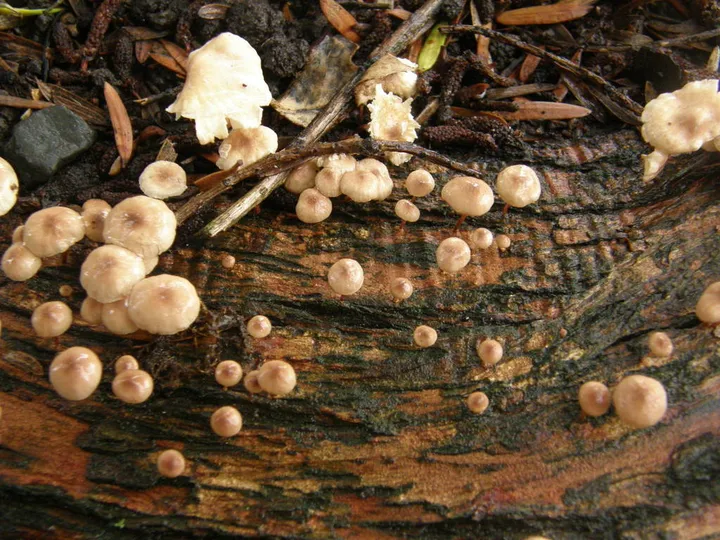
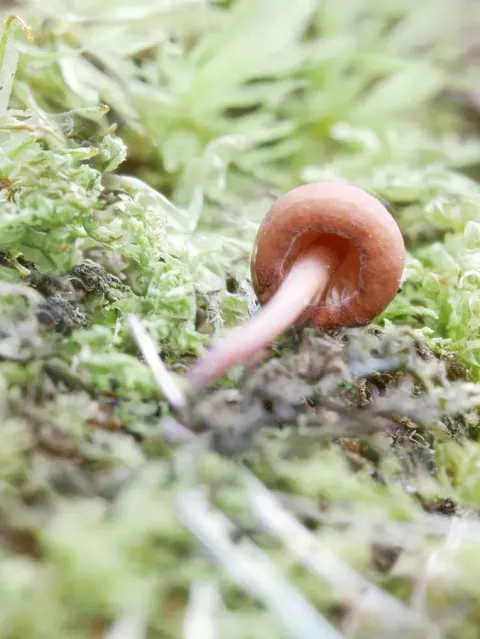
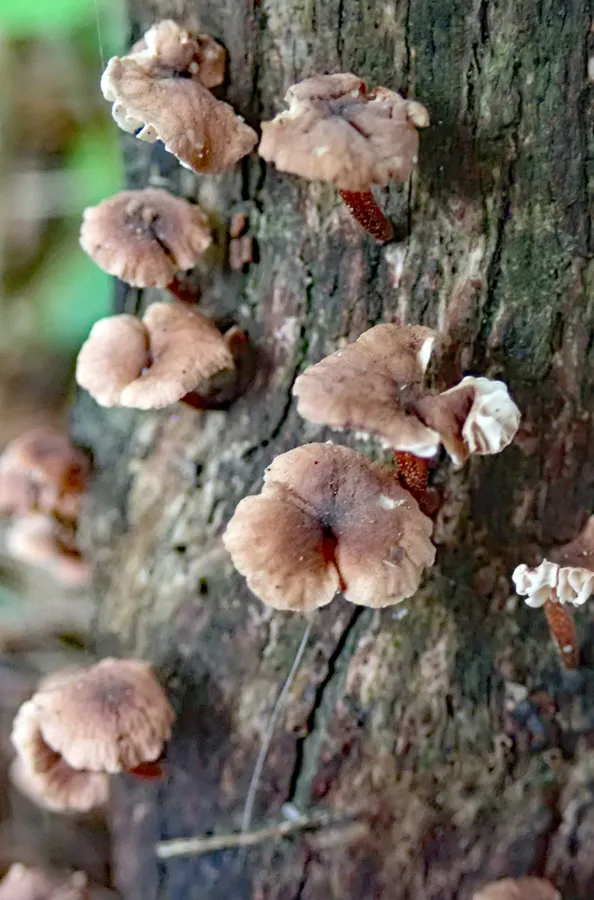
Pileus 5-20 mm diam, hemispherical to convex when young, expanding in age to plano-convex with a slightly depressed disc, with or without an indistinct obtuse umbo, subplicate towards the margin; surface dull, dry, minutely granular-punctate especially over the disc; pale beige-brown with reddish brown tones when young, disc remaining so in age, becoming paler towards the margin. Texture tough, membranaceous context thin, buff to pale concolorous with pileus surface.- Lamellae adnate to slightly subdecurrent, subdistant (912) with 2-series of lamellulae, up to 1.5 mm wide, often anastomosing, off-white to pale cream or pale beige; edges fimbriate, concolorous.- Stipe 6-15 x 0.5-1.0 mm, central or seldom eccentric, cylindrical, equal or slightly attenuated towards the base, apex granulose, base glabrous, tough, solid, insititious, apex orangish brown to dark reddish brown, almost black near the base; rhizomorphs absent.- Odor and taste strong, like garlic. Basidiospores 7-8(-10) x 4.0-4.5(-5.0) µm, ellipsoid, smooth, thin-walled, hyaline, inamyloid.- Basidia 20-40 x 5-6 µm, cylindrical to subclavate, 4-spored, clamped.- Cheilocystidia 15-30x6-10 µm, polymorphic, subcylindrical, clavate or irregular in outline, hyaline, thin-walled to slightly thick-walled (up to 0.5 µm); apical diverticula 1-7 x 1-2 µm, irregular in outline, often nodulose or forked, hyaline.- Pleurocystidia absent.Pileipellis a loosely organized, hymeniform layer of clavate to irregularly shaped cells, 20-50 x 7-15 µm, some with broad lobes or outgrowths, some irregularly roughened, thin-walled to thick-walled (up to 1.0 µm), yellowish brown, inamyloid; cells on disc more tightly organized.- Pileus tramal hyphae thin-walled to thick-walled, subgelatinous, inamyloid.- Stipe tissue monomitic; cortical hyphae cylindrical, thick-walled, roughened, yellowish brown, inamyloid.-Caulocystidia absent.-Clamp connections present.

Sebagian uraian ditampilkan dalam bahasa sumber; terjemahannya belum tersedia atau belum lolos pemeriksaan.

Rujukan: [1]

Pengukuran mengikuti objek, spesimen atau kultur, dan metode yang disebutkan sumber. Baca uraian asli untuk konteks lengkap.

02 / Kehidupan

Habitat dan peran ekologis

Habit, habitat and distribution.- Solitary, in groups on rotting bark of twigs or logs of myrtaceous trees (Leptospermum sp. or Metrosideros umbellata). Host substrate for type unknown.

Sebagian uraian ditampilkan dalam bahasa sumber; terjemahannya belum tersedia atau belum lolos pemeriksaan.

Rujukan: [1]

Habitat atau konteks temuan
Informasi belum tersedia pada sumber rilis ini.
Substrat
Informasi belum tersedia pada sumber rilis ini.
Peran atau konteks
Belum dikategorikan pada rilis ini.
Temukan hubungan serupa
03 / Siklus hidup

Reproduksi

Pileus 5-20 mm diam, hemispherical to convex when young, expanding in age to plano-convex with a slightly depressed disc, with or without an indistinct obtuse umbo, subplicate towards the margin; surface dull, dry, minutely granular-punctate especially over the disc; pale beige-brown with reddish brown tones when young, disc remaining so in age, becoming paler towards the margin. Texture tough, membranaceous context thin, buff to pale concolorous with pileus surface.- Lamellae adnate to slightly subdecurrent, subdistant (912) with 2-series of lamellulae, up to 1.5 mm wide, often anastomosing, off-white to pale cream or pale beige; edges fimbriate, concolorous.- Stipe 6-15 x 0.5-1.0 mm, central or seldom eccentric, cylindrical, equal or slightly attenuated towards the base, apex granulose, base glabrous, tough, solid, insititious, apex orangish brown to dark reddish brown, almost black near the base; rhizomorphs absent.- Odor and taste strong, like garlic.

Sebagian uraian ditampilkan dalam bahasa sumber; terjemahannya belum tersedia atau belum lolos pemeriksaan.

Rujukan: [1]

Sinonim menurut acuan taksonomi rilis: Marasmius curraniae
04 / Batas informasi

Catatan identitas dan cakupan

  • Nama diterima mengikuti Catalogue of Life Base2026-09-11; uraian mempertahankan konsep dan nama sumber aslinya.
  • Historical description as cited by BiotaNZ. Preserve explicit New Zealand/locality, host and specimen qualifiers. Distribution is the cited source scope, not a current global range.
  • Impor dan terjemahan otomatis belum diperiksa editorial per profil. Struktur reproduktif yang disebutkan tidak membuktikan seluruh siklus hidup diketahui.
  • Pengukuran pada uraian mengikuti spesimen, kultur, dan metode sumber; angka tidak diperluas ke semua populasi.

Catatan distribusi dalam narasi mengikuti sumbernya. Dokumentasi spesimen atau foto mengikuti catatan sumber. Bukti wilayah Indonesia dan penilaian konservasi tidak disimpulkan dari gambar.

05 / Dokumentasi

Melihat dengan konteks

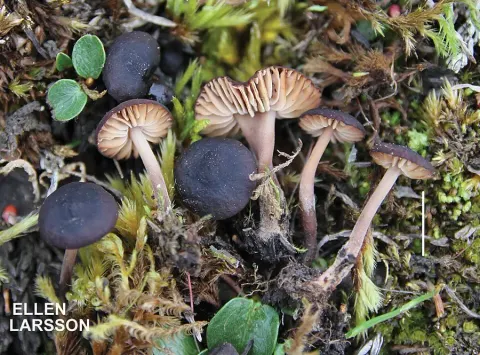
Dokumentasi Mycetinis curraniae menurut asosiasi foto pada record takson iNaturalist. Kredit: Peter de Lange. Identitas mengikuti sumber; bukan penentuan spesimen independen.

Jenis
Fotografi
Kredit
no rights reserved, uploaded by Peter de Lange
Lisensi
CC0 1.0
Sumber media
Buka entri sumber

Gambar menunjukkan objek menurut identifikasi sumber, bukan verifikasi independen spesimen oleh Fungi. Tidak ada skala baru yang ditambahkan.

Dokumentasi tambahan

06 / Rujukan

Sumber profil

  1. [1] Desjardin, D.E.; Horak, E. 1997: Marasmius and Gloiocephala in the South Pacific Region: Papua New Guinea, New Caledonia, and New Zealand taxa. Bibliotheca Mycologica. 168. — Marasmius curraniaeBagian sumber: biota:1cb0e8fe-36b9-11d5-9548-00d0592d548c:1cb19241-36b9-11d5-9548-00d0592d548c
    Tanggal penghimpunan sumber: 2026-10-12
    Teks sumber: CC BY 4.0 · Desjardin, D.E.; Horak, E. 1997: Marasmius and Gloiocephala in the South Pacific Region: Papua New Guinea, New Caledonia, and New Zealand taxa. Bibliotheca Mycologica. 168.
  2. [2] Catalogue of Life Base2026-09-11 — Mycetinis curraniaeBagian sumber: ColDP NameUsage.tsv ID 744D4; accepted species; source 2073
    Tanggal penghimpunan sumber: 2026-10-12
  3. [3] Dokumentasi visual — Mycetinis curraniaeBagian sumber: Identitas mengikuti sumber dokumentasi; bukan penentuan spesimen independen.
    Tanggal penghimpunan sumber: 2026-10-17
    Media sumber: CC0 1.0 · no rights reserved, uploaded by Peter de Lange
  4. [4] Dokumentasi visual — Mycetinis curraniaeBagian sumber: Identitas mengikuti sumber dokumentasi; bukan penentuan spesimen independen.
    Tanggal penghimpunan sumber: 2026-10-17
    Teks sumber: CC BY-SA 4.0 · (c) David Whyte, some rights reserved (CC BY-SA), uploaded by David Whyte

Adaptasi teks: CC BY 4.0. Desjardin, D.E.; Horak, E. 1997: Marasmius and Gloiocephala in the South Pacific Region: Papua New Guinea, New Caledonia, and New Zealand taxa. Bibliotheca Mycologica. 168. — Desjardin, D.E.; Horak, E. 1997: Marasmius and Gloiocephala in the South Pacific Region: Papua New Guinea, New Caledonia, and New Zealand taxa. Bibliotheca Mycologica. 168. — Marasmius curraniae

Uraian asli dan riwayat sumber

Riwayat atau halaman sumber

Ringkasan sumber

Pileus 5-20 mm diam, hemispherical to convex when young, expanding in age to plano-convex with a slightly depressed disc, with or without an indistinct obtuse umbo, subplicate towards the margin; surface dull, dry, minutely granular-punctate especially over the disc; pale beige-brown with reddish brown tones when young, disc remaining so in age, becoming paler towards the margin. Texture tough, membranaceous context thin, buff to pale concolorous with pileus surface.- Lamellae adnate to slightly subdecurrent, subdistant (912) with 2-series of lamellulae, up to 1.5 mm wide, often anastomosing, off-white to pale cream or pale beige; edges fimbriate, concolorous.- Stipe 6-15 x 0.5-1.0 mm, central or seldom eccentric, cylindrical, equal or slightly attenuated towards the base, apex granulose, base glabrous, tough, solid, insititious, apex orangish brown to dark reddish brown, almost black near the base; rhizomorphs absent.- Odor and taste strong, like garlic.

Revisi sumber

Morfologi sumber

Pileus 5-20 mm diam, hemispherical to convex when young, expanding in age to plano-convex with a slightly depressed disc, with or without an indistinct obtuse umbo, subplicate towards the margin; surface dull, dry, minutely granular-punctate especially over the disc; pale beige-brown with reddish brown tones when young, disc remaining so in age, becoming paler towards the margin. Texture tough, membranaceous context thin, buff to pale concolorous with pileus surface.- Lamellae adnate to slightly subdecurrent, subdistant (912) with 2-series of lamellulae, up to 1.5 mm wide, often anastomosing, off-white to pale cream or pale beige; edges fimbriate, concolorous.- Stipe 6-15 x 0.5-1.0 mm, central or seldom eccentric, cylindrical, equal or slightly attenuated towards the base, apex granulose, base glabrous, tough, solid, insititious, apex orangish brown to dark reddish brown, almost black near the base; rhizomorphs absent.- Odor and taste strong, like garlic. Basidiospores 7-8(-10) x 4.0-4.5(-5.0) µm, ellipsoid, smooth, thin-walled, hyaline, inamyloid.- Basidia 20-40 x 5-6 µm, cylindrical to subclavate, 4-spored, clamped.- Cheilocystidia 15-30x6-10 µm, polymorphic, subcylindrical, clavate or irregular in outline, hyaline, thin-walled to slightly thick-walled (up to 0.5 µm); apical diverticula 1-7 x 1-2 µm, irregular in outline, often nodulose or forked, hyaline.- Pleurocystidia absent.Pileipellis a loosely organized, hymeniform layer of clavate to irregularly shaped cells, 20-50 x 7-15 µm, some with broad lobes or outgrowths, some irregularly roughened, thin-walled to thick-walled (up to 1.0 µm), yellowish brown, inamyloid; cells on disc more tightly organized.- Pileus tramal hyphae thin-walled to thick-walled, subgelatinous, inamyloid.- Stipe tissue monomitic; cortical hyphae cylindrical, thick-walled, roughened, yellowish brown, inamyloid.-Caulocystidia absent.-Clamp connections present.

Revisi sumber

Ekologi sumber

Habit, habitat and distribution.- Solitary, in groups on rotting bark of twigs or logs of myrtaceous trees (Leptospermum sp. or Metrosideros umbellata). Host substrate for type unknown.

Revisi sumber

Struktur reproduksi sumber

Pileus 5-20 mm diam, hemispherical to convex when young, expanding in age to plano-convex with a slightly depressed disc, with or without an indistinct obtuse umbo, subplicate towards the margin; surface dull, dry, minutely granular-punctate especially over the disc; pale beige-brown with reddish brown tones when young, disc remaining so in age, becoming paler towards the margin. Texture tough, membranaceous context thin, buff to pale concolorous with pileus surface.- Lamellae adnate to slightly subdecurrent, subdistant (912) with 2-series of lamellulae, up to 1.5 mm wide, often anastomosing, off-white to pale cream or pale beige; edges fimbriate, concolorous.- Stipe 6-15 x 0.5-1.0 mm, central or seldom eccentric, cylindrical, equal or slightly attenuated towards the base, apex granulose, base glabrous, tough, solid, insititious, apex orangish brown to dark reddish brown, almost black near the base; rhizomorphs absent.- Odor and taste strong, like garlic.

Revisi sumber

Rujukan halaman ini

Fungi. Mycetinis curraniae. Rilis data fungi-2026-10-12-expansion-2. https://fungi-atlas.mgadib.chatgpt.site/jamur/mycetinis-curraniae/.

Status: impor sumber; pemeriksaan editorial per profil belum selesai. Untuk klaim biologis, gunakan rujukan pada bagian terkait dan periksa konteks sumber aslinya.