Ciri dan struktur
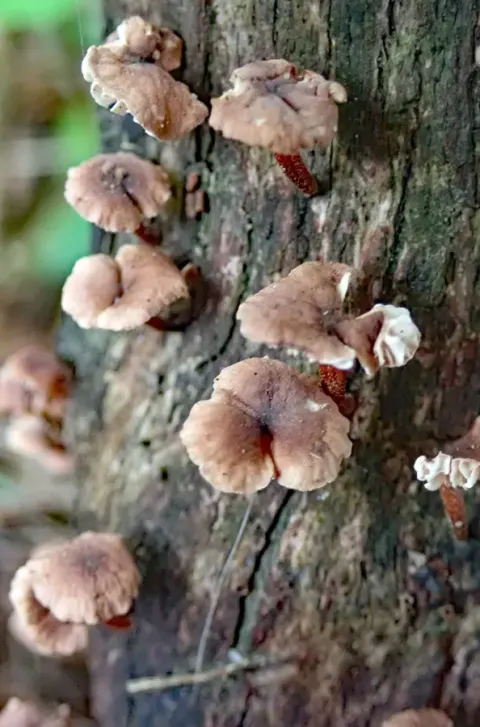
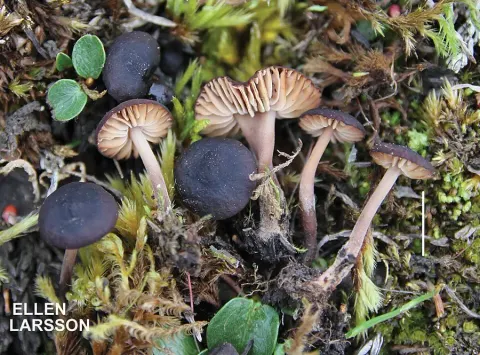
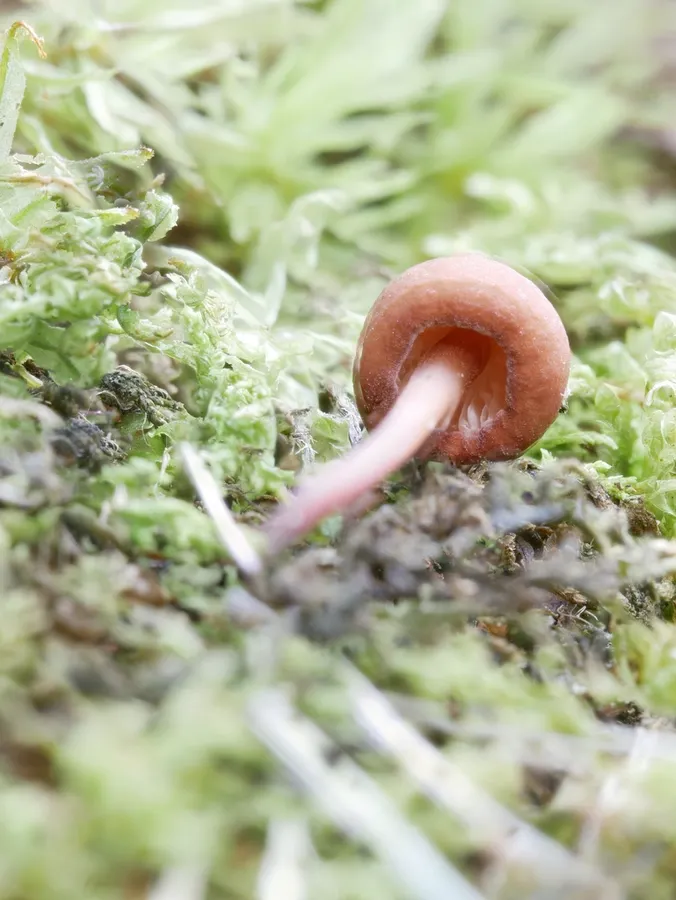
The species can be described as follows: The cap is red brown (or sometimes beige to ochre) and is hygrophanous, drying to a paler colour. It is sometimes slightly wrinkled and grows to 1–3 cm in diameter. The gills are white and fairly crowded, and the attachment to the stem varies from adnate to almost free. The spore powder is white. The stem can grow to 6 cm tall but is only up to 2 mm in diameter. It is bald and pale at the apex, reddish brown lower down, and dark brown or blackish at the base. The smell and taste are strongly of garlic. The spores are roughly ellipsoid and measure 7–11 μm x 3–5 μm. The cheilocystidia (on the gill edge) are of the "broom cell" type, that is, they are club-shaped with a number of finger-like protuberances.
Habitat dan peran ekologis
This mushroom is found from summer to late autumn especially on conifer needles, but also on sticks and other debris, on bark of conifers and deciduous trees, and on grasses and other plants. While usually a saprophyte, it has also been reported as a parasite of grass. It is fairly common in northern and central Europe, present in the remainder of Europe, and reported from eastern North America, North Africa and Asia, including Israel.
- Habitat atau konteks temuan
- Informasi belum tersedia pada sumber rilis ini.
- Substrat
- kulit kayu
- Peran atau konteks
- Belum dikategorikan pada rilis ini.
Reproduksi
The species can be described as follows: The cap is red brown (or sometimes beige to ochre) and is hygrophanous, drying to a paler colour. It is sometimes slightly wrinkled and grows to 1–3 cm in diameter. The gills are white and fairly crowded, and the attachment to the stem varies from adnate to almost free. The spore powder is white. The stem can grow to 6 cm tall but is only up to 2 mm in diameter. It is bald and pale at the apex, reddish brown lower down, and dark brown or blackish at the base. The smell and taste are strongly of garlic. The spores are roughly ellipsoid and measure 7–11 μm x 3–5 μm. The cheilocystidia (on the gill edge) are of the "broom cell" type, that is, they are club-shaped with a number of finger-like protuberances.
Catatan identitas dan cakupan
- Nama diterima mengikuti Catalogue of Life Base2026-09-11; uraian mempertahankan konsep dan nama sumber aslinya.
- Original geographic, specimen and life-cycle scope retained; source import awaits individual editorial review.
- Impor dan terjemahan otomatis belum diperiksa editorial per profil. Struktur reproduktif yang disebutkan tidak membuktikan seluruh siklus hidup diketahui.
- Pengukuran pada uraian mengikuti spesimen, kultur, dan metode sumber; angka tidak diperluas ke semua populasi.
Catatan distribusi dalam narasi mengikuti sumbernya. Dokumentasi spesimen atau foto mengikuti catatan sumber. Bukti wilayah Indonesia dan penilaian konservasi tidak disimpulkan dari gambar.
Melihat dengan konteks
Dokumentasi Mycetinis scorodonius menurut asosiasi foto pada record takson iNaturalist. Kredit: Garrett Taylor. Identitas mengikuti sumber; bukan penentuan spesimen independen.
- Jenis
- Fotografi
- Kredit
- no rights reserved, uploaded by Garrett Taylor
- Lisensi
- CC0 1.0
- Sumber media
- Buka entri sumber
Sumber profil
- [1] Mycetinis scorodonius — Wikipedia (en)
- [2] Catalogue of Life Base2026-09-11 — Mycetinis scorodonius
- [3] Dokumentasi visual — Mycetinis scorodonius
Rujukan halaman ini
Fungi. Mycetinis scorodonius. Rilis data fungi-2026-10-12-expansion-2. https://fungi-atlas.mgadib.chatgpt.site/jamur/mycetinis-scorodonius/.
Status: impor sumber; pemeriksaan editorial per profil belum selesai. Untuk klaim biologis, gunakan rujukan pada bagian terkait dan periksa konteks sumber aslinya.