Ciri dan struktur
This new species differs from N. fusiformis by conidia that are elongate-elliptical, blunter at both ends, and usually 3-septate and larger. Nagrajomyces laojunshanensis differs from N. dictyosporus by conidiomata that are unilocular and without stalks. Conidiomata solitary, pycnidial, unilocular, subglobose to ellipsoidal, subepidermal in origin, immersed at first, then becoming erumpent, 218–406 μm wide, 188–275 μm high, peridia black, 37–43 μm thick, opening irregularly in the upper part, with faint yellow content. Conidiophores ampulliform, smooth, hyaline, multiguttulate, 16.0–25.5 × 2–4 μm (x̄ = 21 × 3 μm, n = 20). Conidia elongate-elliptical, 1–3-septate, mostly 3-septate, smooth, hyaline, 18–23 × 5.5–7.0 μm (x̄ = 19.5 × 6.5 μm, n = 20), with a long, whip-like appendage at the tip of each conidium, 70–200 μm (x̄ = 143.5 μm, n = 20) in length. Sexual morph not observed. Cultures (ex-type CFCC 58177) on PDA 8 cm diameter after 1 month, with irregular margins, sparse aerial mycelium, colonies with whitish margins, with center turning black olive (#3b3c36) with increasing age. On MEA, 5.7 cm diameter after 1 month, with irregular margins, colonies with beaver (#9f8170) -colored margins, with center turning black olive (#3b3c36) with increasing age. Conidia not observed.
Habitat dan peran ekologis
China, Yunnan Province, Lijiang, Laojunshan, 26°39'44"N, 99°46'58"E, alt. 2910 m, on living twigs of Rhododendron cinnabarinum Hook. f., 20 June 2021, coll. C.L. Hou, M.J. Guo, H. Zhou (holotype CAF 800049). Ex-type culture CFCC 58177. Cultures (ex-type CFCC 58177) on PDA 8 cm diameter after 1 month, with irregular margins, sparse aerial mycelium, colonies with whitish margins, with center turning black olive (#3b3c36) with increasing age. On MEA, 5.7 cm diameter after 1 month, with irregular margins, colonies with beaver (#9f8170) -colored margins, with center turning black olive (#3b3c36) with increasing age. Conidia not observed. China, Yunnan province, Kunming, Luquan, Jiaozixueshan, 26°05'04"N, 102°50'54"E, alt. 3823 m, on living twigs of Rhododendron cinnabarinum Hook. f., 23 June 2021, coll. C.L. Hou, M.J. Guo, H. Zhou, (BJTC 1849).
- Habitat atau konteks temuan
- kultur yang didokumentasikan
- Substrat
- Informasi belum tersedia pada sumber rilis ini.
- Peran atau konteks
- Belum dikategorikan pada rilis ini.
Reproduksi
This new species differs from N. fusiformis by conidia that are elongate-elliptical, blunter at both ends, and usually 3-septate and larger. Nagrajomyces laojunshanensis differs from N. dictyosporus by conidiomata that are unilocular and without stalks. Conidiomata solitary, pycnidial, unilocular, subglobose to ellipsoidal, subepidermal in origin, immersed at first, then becoming erumpent, 218–406 μm wide, 188–275 μm high, peridia black, 37–43 μm thick, opening irregularly in the upper part, with faint yellow content. Conidiophores ampulliform, smooth, hyaline, multiguttulate, 16.0–25.5 × 2–4 μm (x̄ = 21 × 3 μm, n = 20). Conidia elongate-elliptical, 1–3-septate, mostly 3-septate, smooth, hyaline, 18–23 × 5.5–7.0 μm (x̄ = 19.5 × 6.5 μm, n = 20), with a long, whip-like appendage at the tip of each conidium, 70–200 μm (x̄ = 143.5 μm, n = 20) in length.
Catatan identitas dan cakupan
- Nama diterima mengikuti Catalogue of Life Base2026-09-11; uraian mempertahankan konsep dan nama sumber aslinya.
- Preserve original treatment localities, hosts and substrate scope. Materials examined describe documented specimens, not the full global range.
- Impor dan terjemahan otomatis belum diperiksa editorial per profil. Struktur reproduktif yang disebutkan tidak membuktikan seluruh siklus hidup diketahui.
- Pengukuran pada uraian mengikuti spesimen, kultur, dan metode sumber; angka tidak diperluas ke semua populasi.
Catatan distribusi dalam narasi mengikuti sumbernya. Dokumentasi spesimen atau foto mengikuti catatan sumber. Bukti wilayah Indonesia dan penilaian konservasi tidak disimpulkan dari gambar.
Melihat dengan konteks
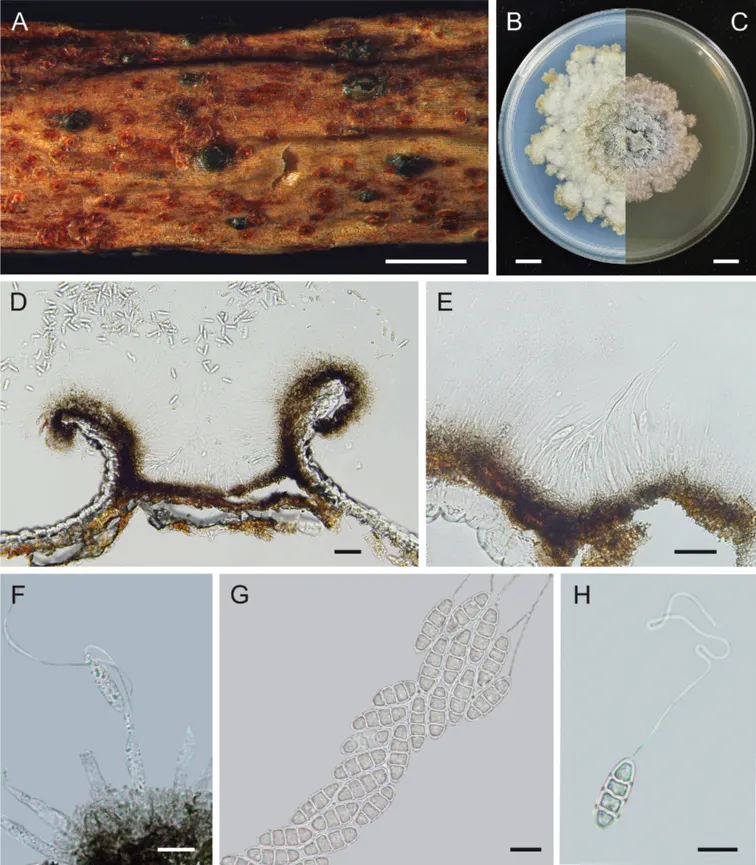
Micrographs of Nagrajomyces laojunshanensis on Rhododendron cinnabarinum (holotype CAF 800049) A conidiomata on a living twig B ex-type culture (CFCC 58177) on PDA after 30 days, seen from above C ex-type culture (CFCC 58177) on MEA after 30 days, seen from above D vertical section of a conidioma E, F conidiophores and conidia G conidia forming a cirrus H conidium with appendage. Scale bars: 1 mm (A); 1 cm (B, C); 100 µm (D, E); 10 µm (F–H).
- Jenis
- Pelat ilmiah
- Kredit
- Lan Zhuo, Mei-Jun Guo, Qiu-Tong Wang, Hao Zhou, Meike Piepenbring, Cheng-Lin Hou
- Lisensi
- CC BY 4.0
- Sumber media
- Buka entri sumber
Dokumentasi tambahan
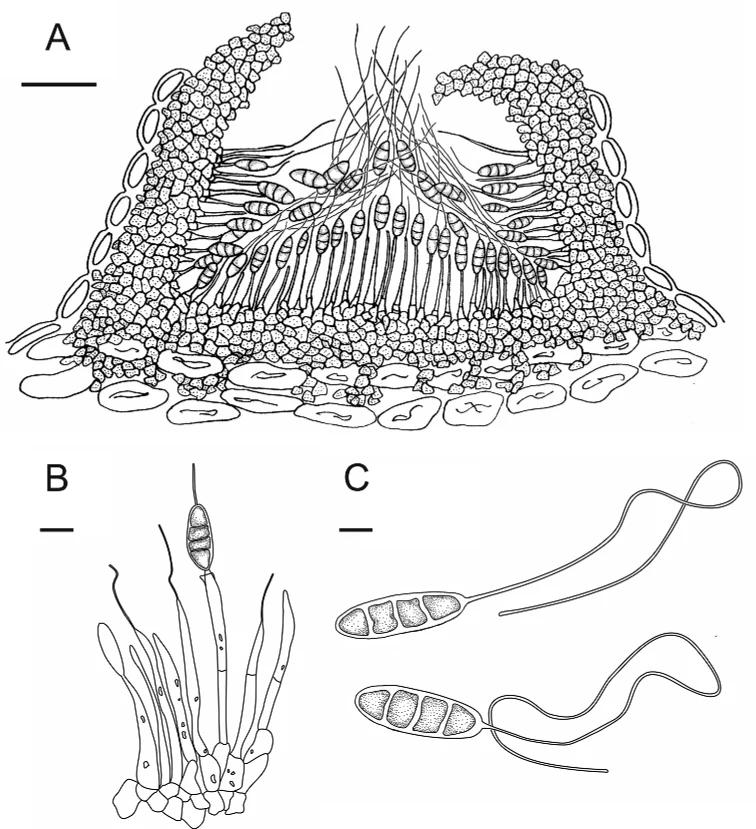
Nagrajomyces laojunshanensis (holotype CAF 800049) A vertical section of a conidioma B conidiophores and conidia C conidia with appendages. Scale bars: 50 µm (A); 10 µm (B); 5 µm (C).
Kredit dan penggunaan
Lan Zhuo, Mei-Jun Guo, Qiu-Tong Wang, Hao Zhou, Meike Piepenbring, Cheng-Lin Hou
Ukuran dan format gambar disesuaikan tanpa pemotongan, retus, atau penambahan skala. Lisensi sumber dipertahankan.
Sumber profil
- [1] A new study of Nagrajomyces: with two new species proposed and taxonomic status inferred by phylogenetic methods — Nagrajomyces laojunshanensis
- [2] Catalogue of Life Base2026-09-11 — Nagrajomyces laojunshanensis
- [3] Dokumentasi visual — Nagrajomyces laojunshanensis
- [4] Dokumentasi visual — Nagrajomyces laojunshanensis
Rujukan halaman ini
Fungi. Nagrajomyces laojunshanensis. Rilis data fungi-2026-10-12-expansion-2. https://fungi-atlas.mgadib.chatgpt.site/jamur/nagrajomyces-laojunshanensis/.
Status: impor sumber; pemeriksaan editorial per profil belum selesai. Untuk klaim biologis, gunakan rujukan pada bagian terkait dan periksa konteks sumber aslinya.