Ciri dan struktur
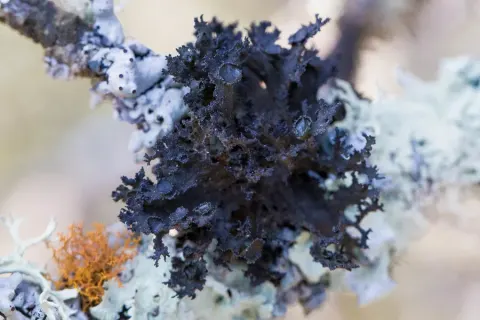
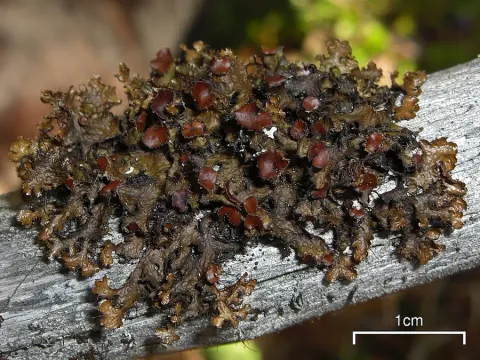
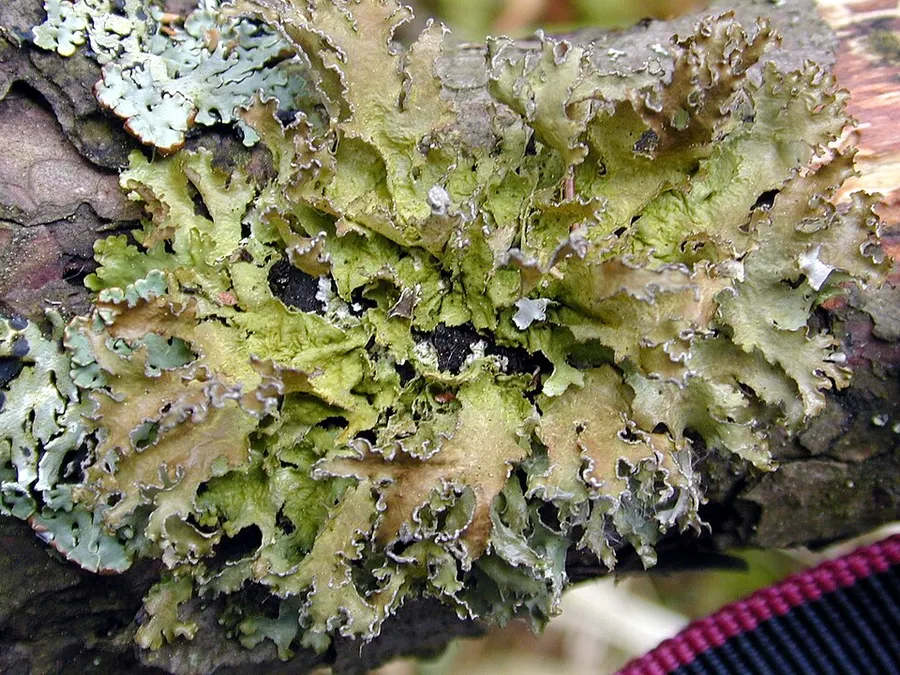
Tuckermannopsis chlorophylla is a small, leaf-like (foliose) lichen forming loose tufts 1–6 cm across, only occasionally making a neat rosette. Its are few to many, typically 1–3 cm long and 0.2–1 cm wide. They are shallowly channelled like a trough, with wavy, crinkled, or notched edges, and are often deeply cut; the lobes stand up from the substrate or lift along the margins rather than lying flat. The upper surface is pale to medium brown in dry weather, turning olive-green and slightly translucent when wet. Tiny pores (pseudocyphellae) are absent. Instead, powdery reproductive granules called soredia are frequent and sit along the lobe edges; these are grey-white and serve as the main means of spread. The underside is white to pale brown—paling toward the centre—wrinkled, and bears few of the root-like fasteners (rhizines); these, when present, are whitish. The partner is a green algal species in the Trebouxia implex/Trebouxia suecica species group. Sexual structures are uncommon. When present, the cup-like fruiting bodies (apothecia) sit directly on the thallus (), with up to 3 mm across and a rim () that is itself dusted with soredia. Microscopy shows club-shaped asci 30–40 × 7–10 μm, with straight, sparsely branched paraphyses that have swollen tips; the ascospores are spherical, about 5 μm in diameter. Asexual spore-bearing structures (pycnidia) are sparse, occur along the margins, and protrude slightly; they produce dumbbell-shaped conidia 5–6 × about 1.5 μm. Standard chemical spot tests on the inner layer (medulla) are negative (C−, K−, KC−, Pd−) and there is no fluorescence under UV light; the major secondary metabolite detected is protolichesterinic acid.
Habitat dan peran ekologis
Tuckermannopsis chlorophylla is described as having either a circumpolar distribution, or a cosmopolitan distribution, as it occurs on at least four continents and many oceanic islands. It grows on the bark of trees and shrubs in forests and along roadsides, as well as on wooden fence posts. Other more rarely reported substrates include coarse-grained siliceous rocks and stone monuments. In northern North America, it is common in western conifer forests along the Pacific Coast north to Alaska. In Mexico, it is only known to occur from historical collections made in Baja California. Its distribution also includes South Africa, South America (Argentina, Chile, Falkland Islands), Australia, and New Zealand.
- Habitat atau konteks temuan
- hutan
- Substrat
- Informasi belum tersedia pada sumber rilis ini.
- Peran atau konteks
- Pembentuk liken
Reproduksi
Tuckermannopsis chlorophylla is a small, leaf-like (foliose) lichen forming loose tufts 1–6 cm across, only occasionally making a neat rosette. Its are few to many, typically 1–3 cm long and 0.2–1 cm wide. They are shallowly channelled like a trough, with wavy, crinkled, or notched edges, and are often deeply cut; the lobes stand up from the substrate or lift along the margins rather than lying flat. The upper surface is pale to medium brown in dry weather, turning olive-green and slightly translucent when wet. Tiny pores (pseudocyphellae) are absent. Instead, powdery reproductive granules called soredia are frequent and sit along the lobe edges; these are grey-white and serve as the main means of spread.
Catatan identitas dan cakupan
- Nama diterima mengikuti Catalogue of Life Base2026-09-11; uraian mempertahankan konsep dan nama sumber aslinya.
- Original geographic, specimen and life-cycle scope retained; source import awaits individual editorial review.
- Impor dan terjemahan otomatis belum diperiksa editorial per profil. Struktur reproduktif yang disebutkan tidak membuktikan seluruh siklus hidup diketahui.
- Pengukuran pada uraian mengikuti spesimen, kultur, dan metode sumber; angka tidak diperluas ke semua populasi.
Catatan distribusi dalam narasi mengikuti sumbernya. Dokumentasi spesimen atau foto mengikuti catatan sumber. Bukti wilayah Indonesia dan penilaian konservasi tidak disimpulkan dari gambar.
Melihat dengan konteks
Dokumentasi Tuckermannopsis chlorophylla dari Wikimedia Commons. The foliose lichen Tuckermannopsis chlorophylla ; location: Germany, Bavaria, Hohenfels Identifikasi mengikuti record berkas sumber.
- Jenis
- Fotografi
- Kredit
- Wolfgang von Brackel
- Lisensi
- CC BY 4.0
- Sumber media
- Buka entri sumber
Sumber profil
- [1] Tuckermannopsis chlorophylla — Wikipedia (en)
- [2] Catalogue of Life Base2026-09-11 — Nephromopsis chlorophylla
- [3] Dokumentasi visual — Tuckermannopsis chlorophylla
Rujukan halaman ini
Fungi. Nephromopsis chlorophylla. Rilis data fungi-2026-10-12-expansion-2. https://fungi-atlas.mgadib.chatgpt.site/jamur/nephromopsis-chlorophylla/.
Status: impor sumber; pemeriksaan editorial per profil belum selesai. Untuk klaim biologis, gunakan rujukan pada bagian terkait dan periksa konteks sumber aslinya.