01 / Morfologi

Ciri dan struktur

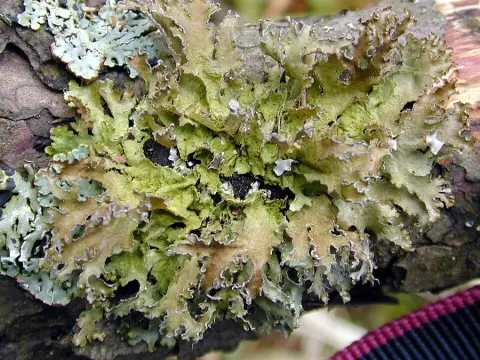
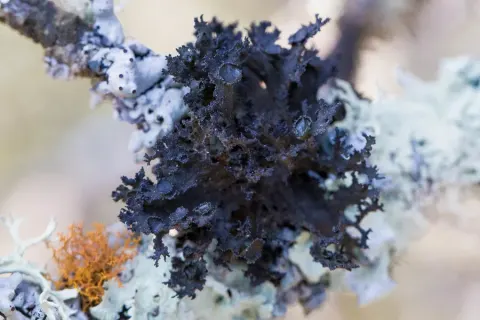
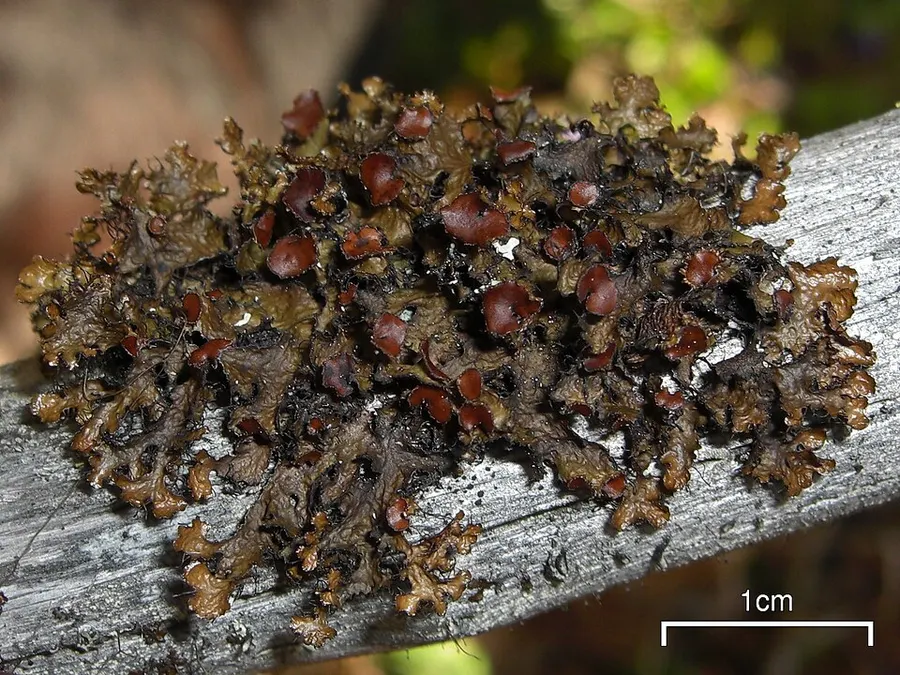
Tuckermannopsis orbata has a foliose (leafy) thallus that ranges in color from olive-brown to pale green when grown in the shade, to brown when exposed to the sun. It is loosely attached to its . The dthallus typically reaches up to 5 cm in diameter, although diameters up to 10 cm have been recorded. The thallus features ascending or appressed, ruffled that are 1.5 to 3.5 mm wide. The margins of the lobes can bear prominent black pycnidia, flattened and branched (small lobes originating from the edge or surface), or brown to black , with various combinations of these structures or none at all. This species lacks soredia and true isidia; however, the lobules, especially when branched and bearing pycnidia, can often resemble isidia. There are pseudocyphellae (tiny pores for gas exchange) scattered on the upper surface. The lower surface of the thallus is pale brown, strongly wrinkled, and sometimes scattered with pale rhizines. Apothecia (fruiting bodies) are very common and often abundant in Tuckermannopsis orbata. in form, they originate on both the lower and upper sides of the lobe margins or on the lobe surface. They are usually up to 7 mm wide (sometimes up to 10 mm) with a brown that is either concave or convex. The asci are cylindrical and with a small , and measure 30–40 by 8–10 μm. The are roughly spherical, measuring about 6 μm in diameter. Pycnidia can be found both and marginally. The pycnidia are dark and glossy, with a shape resembling a papilla or a barrel. The appearance of this species has been described as the most variable in genus Tuckermannopsis. There are no reactions to any of the standard spot tests (K−, KC−, C−, Pd−, UV−), but the lichen does contain protolichesterinic acid, a secondary metabolite (lichen product) that is a fatty acid.

Sebagian uraian ditampilkan dalam bahasa sumber; terjemahannya belum tersedia atau belum lolos pemeriksaan.

Rujukan: [1]

Pengukuran mengikuti objek, spesimen atau kultur, dan metode yang disebutkan sumber. Baca uraian asli untuk konteks lengkap.

02 / Kehidupan

Habitat dan peran ekologis

Tuckermannopsis orbata is typically found on the branches and twigs of birch and conifer trees, though it also occur on hardwoods, and, very rarely, on rock. In the Great Smoky Mountains National Park, it has been recorded on eastern hemlock, red spruce, yellow birch, and, at higher elevations, on Rhododendron. It occurs in both northeastern and northwestern North America. In the Pacific Northwest region, it prefers humid, low-elevation forests, and is common in areas close to the Pacific Coast. The western range of the species extends north to Alaska. In eastern North America it is more common at higher elevations. Tremella nephromopsidis is a lichenicolous fungus that has been recorded parasitizing the thalli of Tuckermannopsis orbata in California. Infection by the fungus results in the formation of a gall on the thallus surface, pale to medium brown in color and measuring 0.3–1.2 mm.

Sebagian uraian ditampilkan dalam bahasa sumber; terjemahannya belum tersedia atau belum lolos pemeriksaan.

Rujukan: [1]

Habitat atau konteks temuan
hutan
Substrat
Informasi belum tersedia pada sumber rilis ini.
Peran atau konteks
Pembentuk liken
Temukan hubungan serupa
03 / Siklus hidup

Reproduksi

Tuckermannopsis orbata has a foliose (leafy) thallus that ranges in color from olive-brown to pale green when grown in the shade, to brown when exposed to the sun. It is loosely attached to its . The dthallus typically reaches up to 5 cm in diameter, although diameters up to 10 cm have been recorded. The thallus features ascending or appressed, ruffled that are 1.5 to 3.5 mm wide. The margins of the lobes can bear prominent black pycnidia, flattened and branched (small lobes originating from the edge or surface), or brown to black , with various combinations of these structures or none at all. This species lacks soredia and true isidia; however, the lobules, especially when branched and bearing pycnidia, can often resemble isidia.

Sebagian uraian ditampilkan dalam bahasa sumber; terjemahannya belum tersedia atau belum lolos pemeriksaan.

Rujukan: [1]

Sinonim menurut acuan taksonomi rilis: Cetraria orbata; Platysma orbatum; Tuckermannopsis orbata
04 / Batas informasi

Catatan identitas dan cakupan

  • Nama diterima mengikuti Catalogue of Life Base2026-09-11; uraian mempertahankan konsep dan nama sumber aslinya.
  • Original geographic, specimen and life-cycle scope retained; source import awaits individual editorial review.
  • Impor dan terjemahan otomatis belum diperiksa editorial per profil. Struktur reproduktif yang disebutkan tidak membuktikan seluruh siklus hidup diketahui.
  • Pengukuran pada uraian mengikuti spesimen, kultur, dan metode sumber; angka tidak diperluas ke semua populasi.

Catatan distribusi dalam narasi mengikuti sumbernya. Dokumentasi spesimen atau foto mengikuti catatan sumber. Bukti wilayah Indonesia dan penilaian konservasi tidak disimpulkan dari gambar.

05 / Dokumentasi

Melihat dengan konteks

Dokumentasi Tuckermannopsis orbata dari Wikimedia Commons. Tuckermannopsis orbata 20090514.13 Wells Gray Provincial Park, BC Yuck! Wouldn't something like "crumpled brown rag lichen" be a better common name for this?? *Anything* else! Identifikasi mengikuti record berkas sumber.

Jenis
Fotografi
Kredit
Jason Hollinger
Lisensi
CC BY 2.0
Sumber media
Buka entri sumber

Gambar menunjukkan objek menurut identifikasi sumber, bukan verifikasi independen spesimen oleh Fungi. Tidak ada skala baru yang ditambahkan.

06 / Rujukan

Sumber profil

  1. [1] Tuckermannopsis orbata — Wikipedia (en)Bagian sumber: Frozen revision 1321028340
    Tanggal penghimpunan sumber: 2026-10-12
    Teks sumber: CC BY-SA4.0 · Wikipedia contributors
  2. [2] Catalogue of Life Base2026-09-11 — Nephromopsis orbataBagian sumber: ColDP NameUsage.tsv ID 4727K; accepted species; source 2073
    Tanggal penghimpunan sumber: 2026-10-12
  3. [3] Dokumentasi visual — Tuckermannopsis orbataBagian sumber: Individual media record; identification follows the source, not independent determination
    Tanggal penghimpunan sumber: 2026-10-12
    Media sumber: CC BY 2.0 · Jason Hollinger

Adaptasi teks: CC BY-SA 4.0. Wikipedia contributors — Tuckermannopsis orbata — Wikipedia (en)

Uraian asli dan riwayat sumber

Riwayat atau halaman sumber

Ringkasan sumber

Tuckermannopsis orbata, commonly known as the variable wrinkle lichen, is a species of foliose lichen in the family Parmeliaceae. It is a small , an informal growth form category that denotes lichens with erect, foliose thalli, and apothecia (sexual fruiting bodies) and pycnidia (asexual fruiting bodies) on the margins of the ruffled . Tuckermannopsis orbata is found in Asia and North America, growing primarily on the wood and bark of mostly birch and coniferous tree branches and twigs.

Revisi sumber

Morfologi sumber

Tuckermannopsis orbata has a foliose (leafy) thallus that ranges in color from olive-brown to pale green when grown in the shade, to brown when exposed to the sun. It is loosely attached to its . The dthallus typically reaches up to 5 cm in diameter, although diameters up to 10 cm have been recorded. The thallus features ascending or appressed, ruffled that are 1.5 to 3.5 mm wide. The margins of the lobes can bear prominent black pycnidia, flattened and branched (small lobes originating from the edge or surface), or brown to black , with various combinations of these structures or none at all. This species lacks soredia and true isidia; however, the lobules, especially when branched and bearing pycnidia, can often resemble isidia. There are pseudocyphellae (tiny pores for gas exchange) scattered on the upper surface. The lower surface of the thallus is pale brown, strongly wrinkled, and sometimes scattered with pale rhizines. Apothecia (fruiting bodies) are very common and often abundant in Tuckermannopsis orbata. in form, they originate on both the lower and upper sides of the lobe margins or on the lobe surface. They are usually up to 7 mm wide (sometimes up to 10 mm) with a brown that is either concave or convex. The asci are cylindrical and with a small , and measure 30–40 by 8–10 μm. The are roughly spherical, measuring about 6 μm in diameter. Pycnidia can be found both and marginally. The pycnidia are dark and glossy, with a shape resembling a papilla or a barrel. The appearance of this species has been described as the most variable in genus Tuckermannopsis. There are no reactions to any of the standard spot tests (K−, KC−, C−, Pd−, UV−), but the lichen does contain protolichesterinic acid, a secondary metabolite (lichen product) that is a fatty acid.

Revisi sumber

Ekologi sumber

Tuckermannopsis orbata is typically found on the branches and twigs of birch and conifer trees, though it also occur on hardwoods, and, very rarely, on rock. In the Great Smoky Mountains National Park, it has been recorded on eastern hemlock, red spruce, yellow birch, and, at higher elevations, on Rhododendron. It occurs in both northeastern and northwestern North America. In the Pacific Northwest region, it prefers humid, low-elevation forests, and is common in areas close to the Pacific Coast. The western range of the species extends north to Alaska. In eastern North America it is more common at higher elevations. Tremella nephromopsidis is a lichenicolous fungus that has been recorded parasitizing the thalli of Tuckermannopsis orbata in California. Infection by the fungus results in the formation of a gall on the thallus surface, pale to medium brown in color and measuring 0.3–1.2 mm.

Revisi sumber

Struktur reproduksi sumber

Tuckermannopsis orbata has a foliose (leafy) thallus that ranges in color from olive-brown to pale green when grown in the shade, to brown when exposed to the sun. It is loosely attached to its . The dthallus typically reaches up to 5 cm in diameter, although diameters up to 10 cm have been recorded. The thallus features ascending or appressed, ruffled that are 1.5 to 3.5 mm wide. The margins of the lobes can bear prominent black pycnidia, flattened and branched (small lobes originating from the edge or surface), or brown to black , with various combinations of these structures or none at all. This species lacks soredia and true isidia; however, the lobules, especially when branched and bearing pycnidia, can often resemble isidia.

Revisi sumber

Rujukan halaman ini

Fungi. Nephromopsis orbata. Rilis data fungi-2026-10-12-expansion-2. https://fungi-atlas.mgadib.chatgpt.site/jamur/nephromopsis-orbata/.

Status: impor sumber; pemeriksaan editorial per profil belum selesai. Untuk klaim biologis, gunakan rujukan pada bagian terkait dan periksa konteks sumber aslinya.