01 / Morfologi

Ciri dan struktur

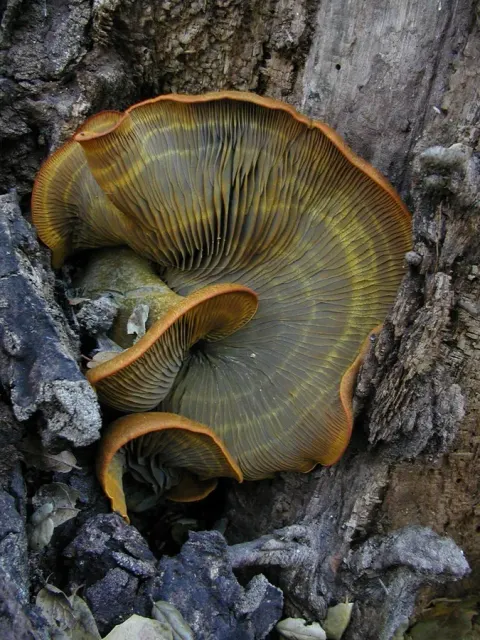
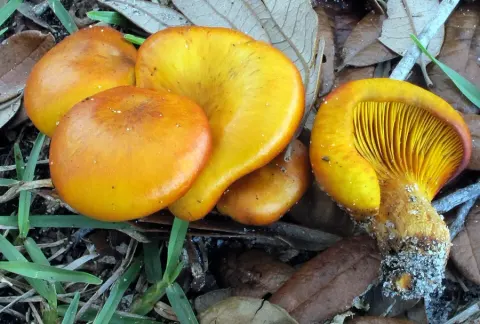
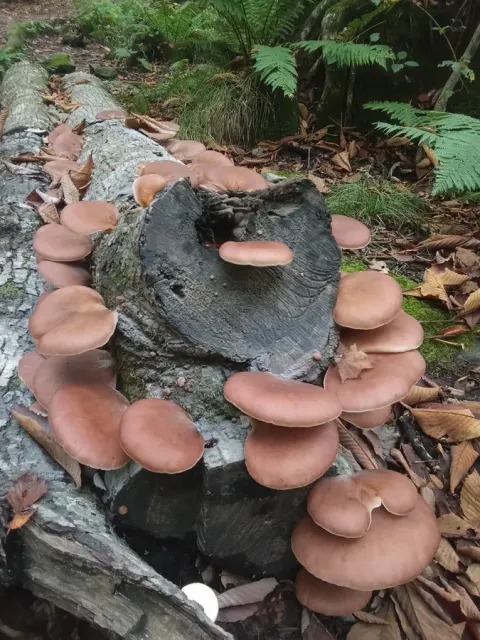
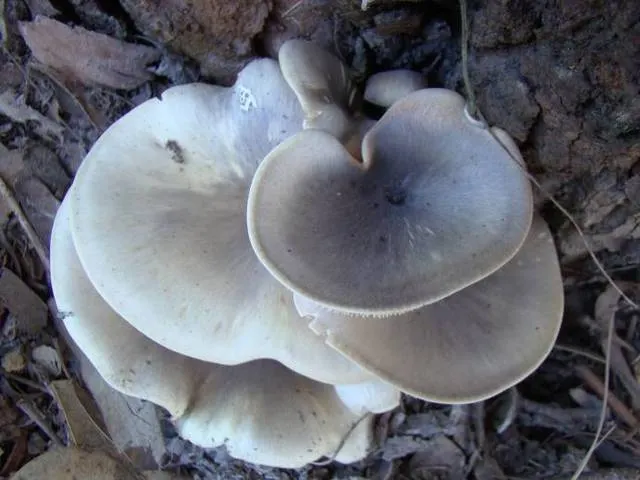
Tubuh buah jamur hantu dapat ditemukan pada kayu mati atau sakit. They may be first seen at night as a pale whitish glow at the base of trees in a eucalypt forest. Kap ini sangat bervariasi dalam warna, kadang-kadang krim meskipun sering diwarnai dengan warna oranye, cokelat, abu-abu, ungu atau bahkan biru-hitam. Margin lebih ringan, umumnya krim, meskipun bentuk cokelat memiliki tepi cokelat atau cokelat. Pusat umumnya memiliki beberapa warna yang lebih gelap, dan spesimen yang lebih muda sering lebih gelap. Growing up sampai 30 cm diameternya berbentuk corong atau berbentuk kipas dengan sisi terguling. The cream-white gills are decurrent and often drip with moisture. They are sampai 13 mm dalam, agak jauh dari jarak dekat, dan memiliki tepi halus sampai mereka mengikis dalam kematangan. stipe dapat berpusat pada sisi karena melekat pada tutup dan panjangnya sampai 8 cm dan bertepatan dengan dasar. Daging tipis umumnya berwarna putih krim, tetapi dapat memiliki nada merah muda di dekat dasar stipe. Tidak ada bau atau rasa yang khas. Printer spora putih. Spor-spora tersebut kira-kira eliptik, atau, kurang umum, agak bulat, dan memiliki dimensi 7.5–9.5 dengan 5–7 μm. They are dinding tipis, inamyloid, dan memiliki permukaan halus. Each features sebuah bagian hilar yang menonjol. The basidia (spore-bearing cells), measuring 32–42 by 6–9 μm, are club-shaped and four-spored, with sterigmata up to 7 μm long. keilosistidia (sistidia ditemukan di tepi gill) banyak, dan ukuran 15–40 dengan 3–6 μm; tidak ada pleurocystida (sistidia pada wajah gill) hadir. Kutikul tutup terdiri dari lapisan tipis dari 3–6 μm lebar hifa yang terjalin secara longgar atau ketat.

Sebagian uraian ditampilkan dalam bahasa sumber; terjemahannya belum tersedia atau belum lolos pemeriksaan.

Rujukan: [1]

Pengukuran mengikuti objek, spesimen atau kultur, dan metode yang disebutkan sumber. Baca uraian asli untuk konteks lengkap.

02 / Kehidupan

Habitat dan peran ekologis

Omphalotus nidiformis terjadi di dua kisaran yang berselisih di Australia selatan. Di barat daya Australia Barat, telah tercatat dari Perth and ke Avon wheatbelt barat daya ke Augusta and timur sepanjang garis pantai selatan ke Esperance. Di tenggara benua, ia ditemukan dari Australia Selatan timur, di mana ia telah tercatat dari Gunung Gambier and Semenanjung Fleurieu, Gunung Lofty Ranges around Adelaide, Murraylands, dan utara ke Flinders Ranges and dari Lincoln National Park at puncak Semenanjung Eyre, melalui Queensland tenggara. Hal ini juga terjadi di Tasmania. Hal ini dapat ditemukan di hutan eukalypt dan pinus, di habitat yang beragam seperti tanah kering dari Wyperfeld National Park and daerah subalpin Taman Nasional Gunung Buffalo, serta di taman dan taman kota. Fruit bodies dapat banyak dan terjadi dalam kelompok yang saling tumpang tindih pada kayu mati. Di luar Australia, ia telah direkam dari Pulau Norfolk. Di 2012, pertama kali dilaporkan dari Kerala, India, di mana ditemukan tumbuh di pohon kelapa. Saprobe atau parasit, O. nidiformis tidak spesifik dalam kebutuhannya dan kompatibel dengan berbagai host. Hal ini telah tercatat pada Banksia asli (termasuk B. attenuata dan B. menziesii), Hakea, Acacia, Nuytsia floribunda dan berbagai Myrtaceae, termasuk Agonis flexuosa dan Melaleuca species, dan terutama Eucalyptus, serta Nothofagus, Casuarina species dan Allocasuarina fraseriana, dan bahkan memperkenalkan pohon-pohon seperti Pinus or Platanus species.

Rujukan: [1]

Habitat atau konteks temuan
hutan
Substrat
kayu
Peran atau konteks
Belum dikategorikan pada rilis ini.
Temukan hubungan serupa
03 / Siklus hidup

Reproduksi

Tubuh buah jamur hantu dapat ditemukan pada kayu mati atau sakit. They may be first seen at night as a pale whitish glow at the base of trees in a eucalypt forest. Kap ini sangat bervariasi dalam warna, kadang-kadang krim meskipun sering diwarnai dengan warna oranye, cokelat, abu-abu, ungu atau bahkan biru-hitam. Margin lebih ringan, umumnya krim, meskipun bentuk cokelat memiliki tepi cokelat atau cokelat. Pusat umumnya memiliki beberapa warna yang lebih gelap, dan spesimen yang lebih muda sering lebih gelap. Growing up sampai 30 cm diameternya berbentuk corong atau berbentuk kipas dengan sisi terguling. The cream-white gills are decurrent and often drip with moisture. They are sampai 13 mm dalam, agak jauh dari jarak dekat, dan memiliki tepi halus sampai mereka mengikis dalam kematangan.

Sebagian uraian ditampilkan dalam bahasa sumber; terjemahannya belum tersedia atau belum lolos pemeriksaan.

Rujukan: [1]

Sinonim menurut acuan taksonomi rilis: Agaricus nidiformis; Pleurotus nidiformis
04 / Batas informasi

Catatan identitas dan cakupan

  • Nama diterima mengikuti Catalogue of Life Base2026-09-11; uraian mempertahankan konsep dan nama sumber aslinya.
  • Original geographic, specimen and life-cycle scope retained; source import awaits individual editorial review.
  • Impor dan terjemahan otomatis belum diperiksa editorial per profil. Struktur reproduktif yang disebutkan tidak membuktikan seluruh siklus hidup diketahui.
  • Pengukuran pada uraian mengikuti spesimen, kultur, dan metode sumber; angka tidak diperluas ke semua populasi.

Catatan distribusi dalam narasi mengikuti sumbernya. Dokumentasi spesimen atau foto mengikuti catatan sumber. Bukti wilayah Indonesia dan penilaian konservasi tidak disimpulkan dari gambar.

05 / Dokumentasi

Melihat dengan konteks

Dokumentasi Omphalotus nidiformis menurut asosiasi foto pada record takson iNaturalist. Kredit: tripsis. Identitas mengikuti sumber; bukan penentuan spesimen independen.

Jenis
Fotografi
Kredit
(c) tripsis, some rights reserved (CC BY-SA)
Sumber media
Buka entri sumber

Gambar menunjukkan objek menurut identifikasi sumber, bukan verifikasi independen spesimen oleh Fungi. Tidak ada skala baru yang ditambahkan.

06 / Rujukan

Sumber profil

  1. [1] Omphalotus nidiformis — Wikipedia (en)Bagian sumber: Frozen revision 1374108833
    Tanggal penghimpunan sumber: 2026-10-12
    Teks sumber: CC BY-SA4.0 · Wikipedia contributors
  2. [2] Catalogue of Life Base2026-09-11 — Omphalotus nidiformisBagian sumber: ColDP NameUsage.tsv ID 49F8R; accepted species; source 2073
    Tanggal penghimpunan sumber: 2026-10-12
  3. [3] Dokumentasi visual — Omphalotus nidiformisBagian sumber: Individual media record; identification follows the source, not independent determination
    Tanggal penghimpunan sumber: 2026-10-12
    Media sumber: CC BY-SA 4.0 · (c) tripsis, some rights reserved (CC BY-SA)

Adaptasi teks: CC BY-SA 4.0. Wikipedia contributors — Omphalotus nidiformis — Wikipedia (en)

Uraian asli dan riwayat sumber

Riwayat atau halaman sumber

Ringkasan sumber

Omphalotus nidiformis, or ghost fungus, is a gilled basidiomycete mushroom most notable for its bioluminescent properties. It is known to be found primarily in southern Australia and Tasmania, but was reported from India in 2012 and 2018. The fan or funnel shaped fruit bodies are up to 30 cm across, with cream-coloured caps overlain with shades of orange, brown, purple, or bluish-black. The white or cream gills run down the length of the stipe, which is up to 8 cm long and tapers in thickness to the base.

Revisi sumber

Morfologi sumber

The fruit bodies of the ghost fungus can be found on dead or diseased wood. They may be first seen at night as a pale whitish glow at the base of trees in a eucalypt forest. The cap is very variable in colour, sometimes cream though often tinted with orange, brownish, greyish, purple or even bluish-black shades. The margin is lighter, generally cream, though brown forms have tan or brown edges. The centre generally has several darker shades, and younger specimens are often darker. Growing up to 30 cm in diameter it is funnel-shaped or fan-shaped in appearance with inrolled margins. The cream-white gills are decurrent and often drip with moisture. They are up to 13 mm deep, somewhat distant to closely spaced, and have a smooth edge until they erode in maturity. The stipe may be central to lateral in its attachment to the cap and is up to 8 cm long and tapers to the base. The thin flesh is generally creamy white in colour, but can have reddish tones near the base of the stipe. There is no distinctive smell or taste. The spore print is white. The spores are roughly elliptical, or, less commonly, somewhat spherical, and have dimensions of 7.5–9.5 by 5–7 μm. They are thin-walled, inamyloid, and have a smooth surface. Each features a prominent hilar appendage. The basidia (spore-bearing cells), measuring 32–42 by 6–9 μm, are club-shaped and four-spored, with sterigmata up to 7 μm long. Cheilocystidia (cystidia found on the gill edges) are abundant, and measure 15–40 by 3–6 μm; no pleurocystida (cystidia on the gill faces) are present. The cap cuticle comprises a thin layer of 3–6 μm-wide hyphae that are interwoven either loosely or tightly.

Revisi sumber

Ekologi sumber

Omphalotus nidiformis occurs in two disjunct ranges in southern Australia. In southwest Western Australia, it has been recorded from Perth and the Avon wheatbelt southwest to Augusta and east along the southern coastline to Esperance. In the southeast of the continent, it is found from eastern South Australia, where it has been recorded from Mount Gambier and the Fleurieu Peninsula, the Mount Lofty Ranges around Adelaide, the Murraylands, and north to the Flinders Ranges and from Lincoln National Park at the apex of the Eyre Peninsula, through to southeast Queensland. It also occurs in Tasmania. It can be found in eucalypt and pine forests, in habitats as diverse as the arid scrubland of Wyperfeld National Park and subalpine areas of Mount Buffalo National Park, as well as in urban parks and gardens. Fruit bodies can be numerous and occur in overlapping clusters on dead wood. Outside Australia, it has been recorded from Norfolk Island. In 2012, it was reported for the first time from Kerala, India, where it was discovered growing on a coconut tree stump. A saprobe or parasite, O. nidiformis is nonspecific in its needs and is compatible with a wide variety of hosts. It has been recorded on native Banksia (including B. attenuata and B. menziesii), Hakea, Acacia, Nuytsia floribunda and various Myrtaceae, including Agonis flexuosa and Melaleuca species, and especially Eucalyptus, as well as Nothofagus, Casuarina species and Allocasuarina fraseriana, and even introduced trees such as Pinus or Platanus species.

Revisi sumber

Struktur reproduksi sumber

The fruit bodies of the ghost fungus can be found on dead or diseased wood. They may be first seen at night as a pale whitish glow at the base of trees in a eucalypt forest. The cap is very variable in colour, sometimes cream though often tinted with orange, brownish, greyish, purple or even bluish-black shades. The margin is lighter, generally cream, though brown forms have tan or brown edges. The centre generally has several darker shades, and younger specimens are often darker. Growing up to 30 cm in diameter it is funnel-shaped or fan-shaped in appearance with inrolled margins. The cream-white gills are decurrent and often drip with moisture. They are up to 13 mm deep, somewhat distant to closely spaced, and have a smooth edge until they erode in maturity.

Revisi sumber

Rujukan halaman ini

Fungi. Omphalotus nidiformis. Rilis data fungi-2026-10-12-expansion-2. https://fungi-atlas.mgadib.chatgpt.site/jamur/omphalotus-nidiformis/.

Status: impor sumber; pemeriksaan editorial per profil belum selesai. Untuk klaim biologis, gunakan rujukan pada bagian terkait dan periksa konteks sumber aslinya.