Ciri dan struktur
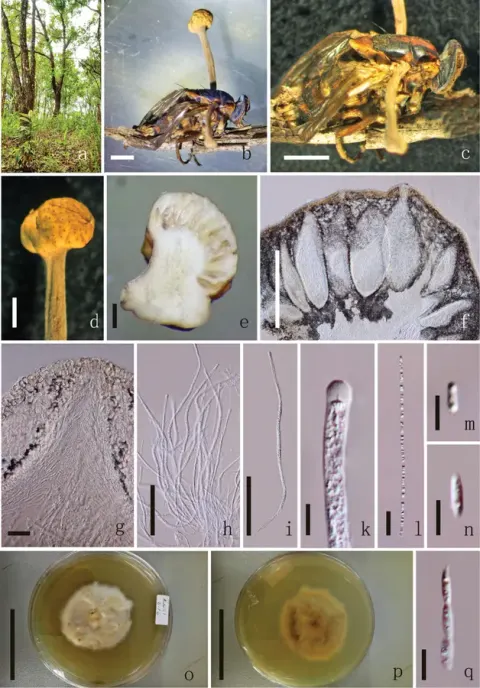
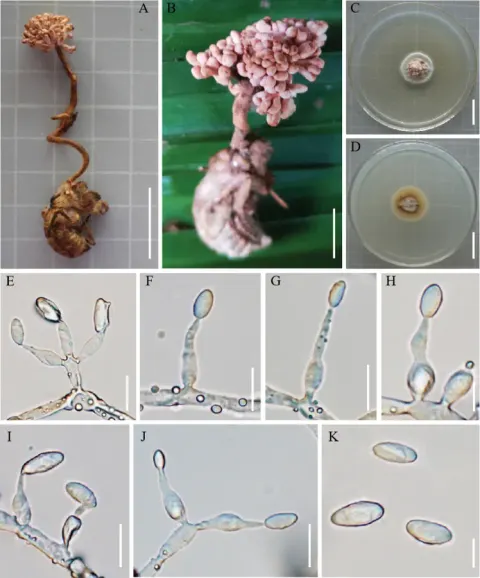
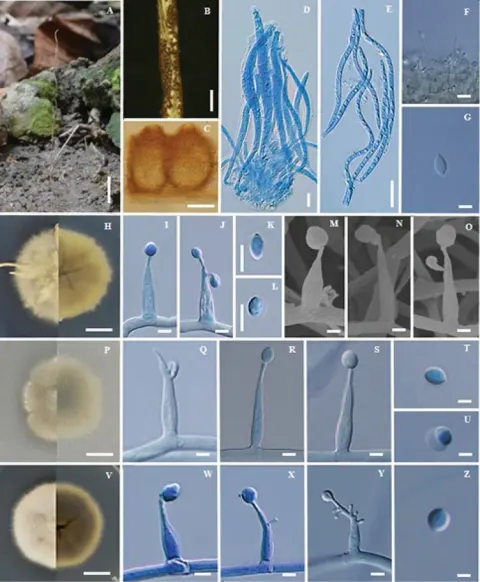
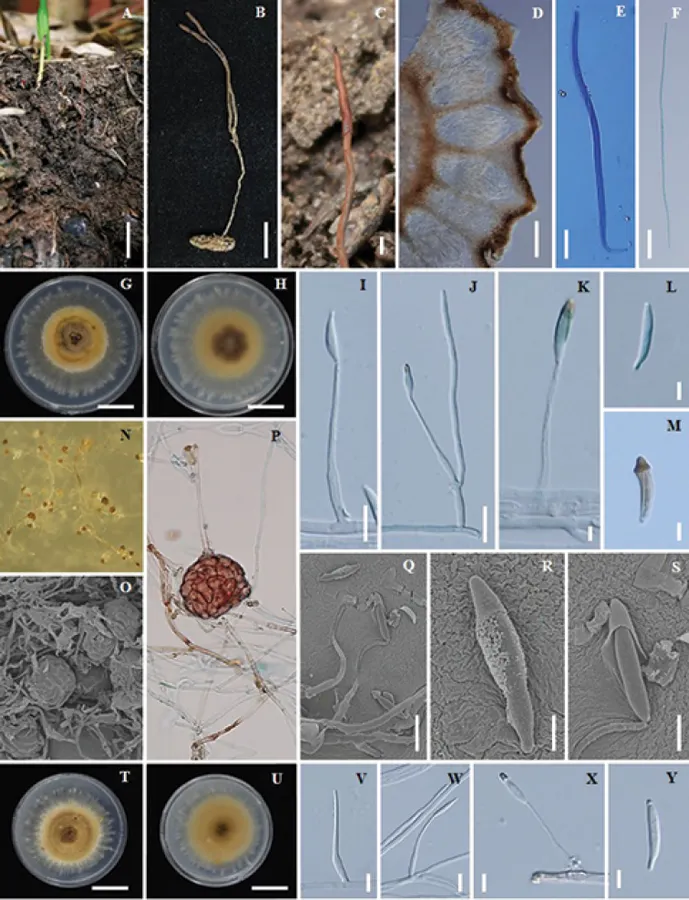
Stroma solitary, simple or branched, narrowly clavate, slender and wiry, up to 9.5 cm long, 0.5 mm wide. Fertile head cylindric, orange brown (oac642) to red brown (oac635), up to 8 mm long, 1 mm wide. Perithecia immersed, ovoid, ordinal in arrangement, (300–)334.5–400(–403) × (130–)138.5–178(–200) µm. Asci 8-spored, cylindrical, (155–)176–214.5(–225) × 4.5–7(–8) µm. Ascospores whole, filiform, 156.5–197.5 × 2–3 µm, with septa. Colonies on PDA, attaining a diam. of 25 mm within 20 d at 25 °C, orange (oac651) to orange brown (oac639). Conidiogenous cells monophialidic, arising from hyphae laterally or terminally, hyaline, tapering gradually or abruptly into a long slender neck, (32–)35.5–43.5(–50) µm long, (2–)2.5–3µm wide at the base, 1–1.5 µm wide at tip with warty surface. Conidia hyaline, one-celled, with a distinct gold cap covering the tip of the conidia, fusiform, (12–)13.5–15.5(–17) × 2–3 (–4) µm. Sclerotia formed in culture after 1 month, dark brown (oac635). Colonies on PSA, attaining a diam. of 25 mm within 20 d at 25 °C, orange brown (oac716) to brown (oac721), reverse orange brown (oac721). Conidiogenous cells monophialidic, arising from hyphae laterally or terminally, hyaline, tapering gradually or abruptly into a long slender neck, (30–)32.5–39.5(–41) µm long, (2–)2.5–3.5(–4) µm wide at the base, 1–1.5 µm wide at tip with warty surface. Conidia hyaline, one-celled, arising from phialides, with a distinct gold cap covering the tip of the conidia, fusiform, (13–)14–16(–17) × 2–3 µm. Colonies on SDYA /4, attaining a diam. of 25 mm within 20 d at 25 °C, dark brown (oac733), reverse orange brown (oac728).
Habitat dan peran ekologis
Thailand, only known from Huai Kha Kaeng Wildlife Sanctuary. Parasitic on a subterranean termite (Order Isoptera: Family Termitidae, Subfamily Macrotermitinae), collected from the soil. These termites belong to the reproductive caste (king or queen alates). The fungus emerged from between head and thoraxes of termite alates.
- Habitat atau konteks temuan
- Informasi belum tersedia pada sumber rilis ini.
- Substrat
- Informasi belum tersedia pada sumber rilis ini.
- Peran atau konteks
- Belum dikategorikan pada rilis ini.
Reproduksi
Stroma solitary, simple or branched, narrowly clavate, slender and wiry, up to 9.5 cm long, 0.5 mm wide. Fertile head cylindric, orange brown (oac642) to red brown (oac635), up to 8 mm long, 1 mm wide. Perithecia immersed, ovoid, ordinal in arrangement, (300–)334.5–400(–403) × (130–)138.5–178(–200) µm. Asci 8-spored, cylindrical, (155–)176–214.5(–225) × 4.5–7(–8) µm. Ascospores whole, filiform, 156.5–197.5 × 2–3 µm, with septa. Colonies on PDA, attaining a diam. of 25 mm within 20 d at 25 °C, orange (oac651) to orange brown (oac639). Conidiogenous cells monophialidic, arising from hyphae laterally or terminally, hyaline, tapering gradually or abruptly into a long slender neck, (32–)35.5–43.5(–50) µm long, (2–)2.5–3µm wide at the base, 1–1.5 µm wide at tip with warty surface.
Catatan identitas dan cakupan
- Nama diterima mengikuti Catalogue of Life Base2026-09-11; uraian mempertahankan konsep dan nama sumber aslinya.
- Preserve original treatment localities, hosts and substrate scope. Materials examined describe documented specimens, not the full global range.
- Impor dan terjemahan otomatis belum diperiksa editorial per profil. Struktur reproduktif yang disebutkan tidak membuktikan seluruh siklus hidup diketahui.
- Pengukuran pada uraian mengikuti spesimen, kultur, dan metode sumber; angka tidak diperluas ke semua populasi.
Catatan distribusi dalam narasi mengikuti sumbernya. Dokumentasi spesimen atau foto mengikuti catatan sumber. Bukti wilayah Indonesia dan penilaian konservasi tidak disimpulkan dari gambar.
Melihat dengan konteks
Ophiocordyceps brunneirubra (BBH 9008, BCC14478) A, B fungus on termite C part of stroma showing perithecia D immersed perithecia E asci F ascospore G, H colony on PDA at 20 d (G) colony obverse (H) colony reverse I, J, K phialides with conidia on PDA L, M conidia on PDA N, P, O sclerotia formed in culture Q, R, S scanning electron micrographs of phialides with conidia T, U colony on PSA at 20 d (T) colony obverse (U) colony reverse V, W, X phialides with conidia on PSA Y conidia on PSA. Scale bars: 25 mm (A); 15 mm (B, G, H, T, U); 1 mm (C); 130 μm (D); 10 μm (I, Q, W); 15 μm (J); 3 μm (K, R); 5 μm (L); 4 μm (M, S, Y); 6 μm (V); 7 μm (X).
- Jenis
- Pelat ilmiah
- Kredit
- Kanoksri Tasanathai, Wasana Noisripoom, Thanyarat Chaitika, Artit Khonsanit, Sasitorn Hasin, Jennifer Luangsa-ard
- Lisensi
- CC BY 4.0
- Sumber media
- Buka entri sumber
Sumber profil
- [1] Phylogenetic and morphological classification of Ophiocordyceps species on termites from Thailand — Ophiocordyceps brunneirubra
- [2] Catalogue of Life Base2026-09-11 — Ophiocordyceps brunneirubra
- [3] Dokumentasi visual — Ophiocordyceps brunneirubra
Rujukan halaman ini
Fungi. Ophiocordyceps brunneirubra. Rilis data fungi-2026-10-12-expansion-2. https://fungi-atlas.mgadib.chatgpt.site/jamur/ophiocordyceps-brunneirubra/.
Status: impor sumber; pemeriksaan editorial per profil belum selesai. Untuk klaim biologis, gunakan rujukan pada bagian terkait dan periksa konteks sumber aslinya.