01 / Morfologi

Ciri dan struktur

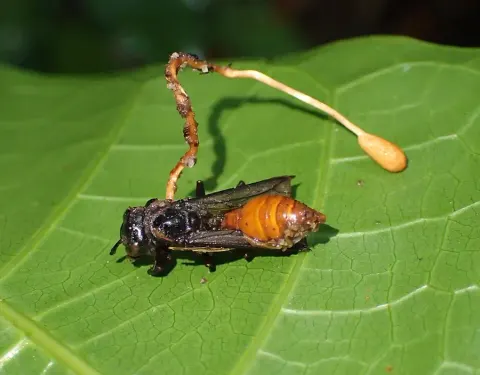
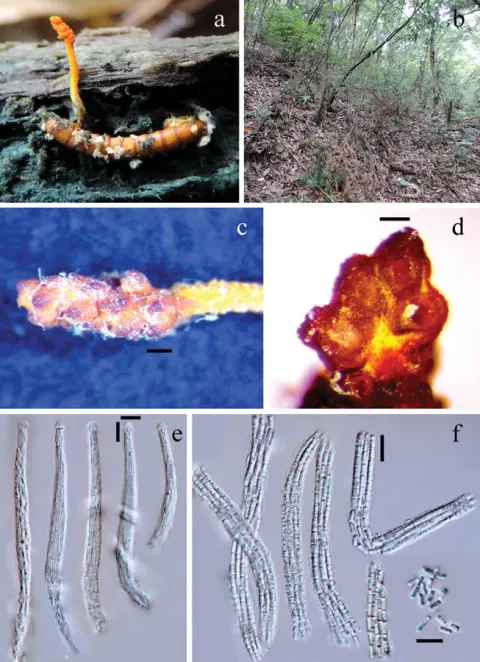
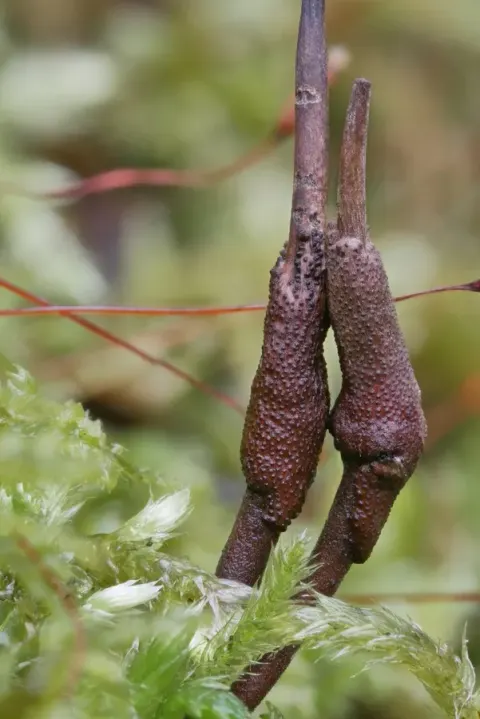
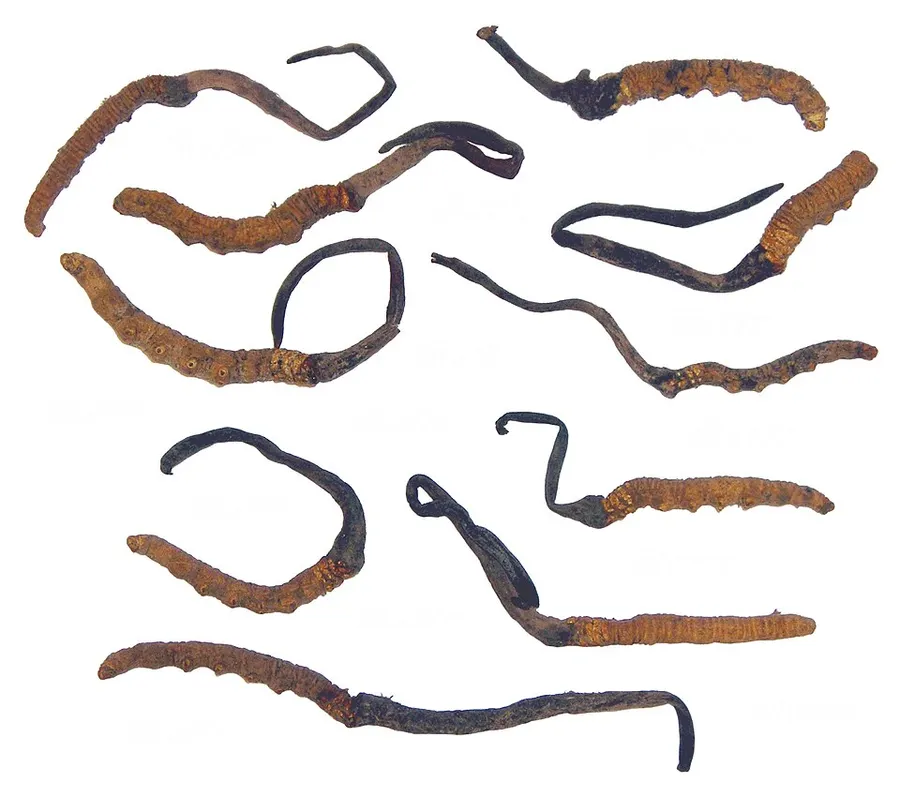
Ophiocordyceps sinensis consists of two parts, a fungal endosclerotium (within the caterpillar) and stroma. The stroma varies from dark brown or black, but can be a yellow color when fresh, and longer than the caterpillar itself, usually 4–10 cm. It grows singly from the larval head, and is clavate, sublanceolate or fusiform, and distinct from the stipe (stalk). The stipe is slender, glabrous, and longitudinally furrowed or ridged. The fertile part of the stroma is the head. The head is granular because of the ostioles of the embedded perithecia. The perithecia are ordinally arranged and ovoid. The asci are cylindrical or slightly tapering at both ends, and may be straight or curved, with a capitate and hemispheroid apex, and may be two to four spored. Similarly, ascospores are hyaline, filiform, multiseptate at a length of 5–12 μm and subattenuated on both sides. Perithecial, ascus and ascospore characters in the fruiting bodies are the key identification characteristics of O. sinensis. Ophiocordyceps species produce whole ascospores and do not separate into part spores. This is different from other Cordyceps species, which produce either immersed or superficial perithecia perpendicular to stromal surface, and the ascospores at maturity are disarticulated into part spores. Generally, Cordyceps species possess brightly colored and fleshy stromata, but O. sinensis has dark pigments and tough to pliant stromata, a typical characteristic feature of most of the Ophiocordyceps species.

Sebagian uraian ditampilkan dalam bahasa sumber; terjemahannya belum tersedia atau belum lolos pemeriksaan.

Rujukan: [1]

Pengukuran mengikuti objek, spesimen atau kultur, dan metode yang disebutkan sumber. Baca uraian asli untuk konteks lengkap.

02 / Kehidupan

Habitat dan peran ekologis

Caterpillars prone to infection by O. sinensis generally live 15 cm underground in alpine grass and shrub-lands on the Tibetan Plateau and the Himalayas at an altitude between 3000 and 5000 m. The fungus is reported from the northern range of Nepal, Bhutan, and also from the northern states of India, apart from northern Yunnan, eastern Qinghai, eastern Tibet, western Sichuan, southwestern Gansu provinces. During late summer, the fruiting body disperses spores. The caterpillars, which live underground feeding on roots, are most vulnerable to the fungus after shedding their skin, during late summer. In late autumn, chemicals on the skin of the caterpillar interact with the fungal spores and release the fungal mycelia, which then infects the caterpillar. The slow growing O. sinensis grows at a comparatively low temperature, i.e., below 21 °C. Temperature requirements and growth rates are crucial factors that distinguish O. sinensis from other similar fungi. The search for Ophiocordyceps sinensis is often perceived to threaten the environment of the Tibetan Plateau where it grows. While it has been collected for centuries and is still common in such areas, current collection rates are much higher than in historical times.

Sebagian uraian ditampilkan dalam bahasa sumber; terjemahannya belum tersedia atau belum lolos pemeriksaan.

Rujukan: [1]

Habitat atau konteks temuan
Informasi belum tersedia pada sumber rilis ini.
Substrat
Informasi belum tersedia pada sumber rilis ini.
Peran atau konteks
Belum dikategorikan pada rilis ini.
Temukan hubungan serupa
03 / Siklus hidup

Reproduksi

The fertile part of the stroma is the head. The head is granular because of the ostioles of the embedded perithecia. The perithecia are ordinally arranged and ovoid. The asci are cylindrical or slightly tapering at both ends, and may be straight or curved, with a capitate and hemispheroid apex, and may be two to four spored. Similarly, ascospores are hyaline, filiform, multiseptate at a length of 5–12 μm and subattenuated on both sides. Perithecial, ascus and ascospore characters in the fruiting bodies are the key identification characteristics of O. sinensis. Ophiocordyceps species produce whole ascospores and do not separate into part spores. This is different from other Cordyceps species, which produce either immersed or superficial perithecia perpendicular to stromal surface, and the ascospores at maturity are disarticulated into part spores.

Sebagian uraian ditampilkan dalam bahasa sumber; terjemahannya belum tersedia atau belum lolos pemeriksaan.

Rujukan: [1]

Sinonim menurut acuan taksonomi rilis: Cordyceps sinensis; Hirsutella sinensis; Sphaeria sinensis; Torrubia sinensis
04 / Batas informasi

Catatan identitas dan cakupan

  • Nama diterima mengikuti Catalogue of Life Base2026-09-11; uraian mempertahankan konsep dan nama sumber aslinya.
  • Original geographic, specimen and life-cycle scope retained; source import awaits individual editorial review.
  • Impor dan terjemahan otomatis belum diperiksa editorial per profil. Struktur reproduktif yang disebutkan tidak membuktikan seluruh siklus hidup diketahui.
  • Pengukuran pada uraian mengikuti spesimen, kultur, dan metode sumber; angka tidak diperluas ke semua populasi.

Catatan distribusi dalam narasi mengikuti sumbernya. Dokumentasi spesimen atau foto mengikuti catatan sumber. Bukti wilayah Indonesia dan penilaian konservasi tidak disimpulkan dari gambar.

05 / Dokumentasi

Melihat dengan konteks

Dokumentasi Ophiocordyceps sinensis dari Wikimedia Commons. Cordyceps sinensis choice specimens, mostly whole. Created by William Rafti of the William Rafti Institute Identifikasi mengikuti record berkas sumber.

Jenis
Fotografi
Kredit
The original uploader was Rafti Institute at English Wikipedia .
Lisensi
CC BY 2.5
Sumber media
Buka entri sumber

Gambar menunjukkan objek menurut identifikasi sumber, bukan verifikasi independen spesimen oleh Fungi. Tidak ada skala baru yang ditambahkan.

06 / Rujukan

Sumber profil

  1. [1] Ophiocordyceps sinensis — Wikipedia (en)Bagian sumber: Frozen revision 1373267198
    Tanggal penghimpunan sumber: 2026-10-12
    Teks sumber: CC BY-SA4.0 · Wikipedia contributors
  2. [2] Catalogue of Life Base2026-09-11 — Ophiocordyceps sinensisBagian sumber: ColDP NameUsage.tsv ID 49WRV; accepted species; source 2073
    Tanggal penghimpunan sumber: 2026-10-12
  3. [3] Dokumentasi visual — Ophiocordyceps sinensisBagian sumber: Individual media record; identification follows the source, not independent determination
    Tanggal penghimpunan sumber: 2026-10-12
    Media sumber: CC BY 2.5 · The original uploader was Rafti Institute at English Wikipedia .

Adaptasi teks: CC BY-SA 4.0. Wikipedia contributors — Ophiocordyceps sinensis — Wikipedia (en)

Uraian asli dan riwayat sumber

Riwayat atau halaman sumber

Ringkasan sumber

O. sinensis parasitizes the larvae of moths within the family Hepialidae, specifically genera found on the Tibetan Plateau and in the Himalayas between elevations of 3,000–5,000 meters ft. found across Tibet, the Himalayan regions of India, Bhutan and Nepal, and several Chinese provinces (Qinghai, Sichuan, and Yunnan). The fungus germinates in the living larva, kills and mummifies it, and a fruiting body emerges from the corpse as an upright stalk. O. sinensis is classified as a medicinal mushroom, and its use has a long history in traditional Chinese medicine as well as in traditional Tibetan medicine.

Revisi sumber

Morfologi sumber

Ophiocordyceps sinensis consists of two parts, a fungal endosclerotium (within the caterpillar) and stroma. The stroma varies from dark brown or black, but can be a yellow color when fresh, and longer than the caterpillar itself, usually 4–10 cm. It grows singly from the larval head, and is clavate, sublanceolate or fusiform, and distinct from the stipe (stalk). The stipe is slender, glabrous, and longitudinally furrowed or ridged. The fertile part of the stroma is the head. The head is granular because of the ostioles of the embedded perithecia. The perithecia are ordinally arranged and ovoid. The asci are cylindrical or slightly tapering at both ends, and may be straight or curved, with a capitate and hemispheroid apex, and may be two to four spored. Similarly, ascospores are hyaline, filiform, multiseptate at a length of 5–12 μm and subattenuated on both sides. Perithecial, ascus and ascospore characters in the fruiting bodies are the key identification characteristics of O. sinensis. Ophiocordyceps species produce whole ascospores and do not separate into part spores. This is different from other Cordyceps species, which produce either immersed or superficial perithecia perpendicular to stromal surface, and the ascospores at maturity are disarticulated into part spores. Generally, Cordyceps species possess brightly colored and fleshy stromata, but O. sinensis has dark pigments and tough to pliant stromata, a typical characteristic feature of most of the Ophiocordyceps species.

Revisi sumber

Ekologi sumber

Caterpillars prone to infection by O. sinensis generally live 15 cm underground in alpine grass and shrub-lands on the Tibetan Plateau and the Himalayas at an altitude between 3000 and 5000 m. The fungus is reported from the northern range of Nepal, Bhutan, and also from the northern states of India, apart from northern Yunnan, eastern Qinghai, eastern Tibet, western Sichuan, southwestern Gansu provinces. During late summer, the fruiting body disperses spores. The caterpillars, which live underground feeding on roots, are most vulnerable to the fungus after shedding their skin, during late summer. In late autumn, chemicals on the skin of the caterpillar interact with the fungal spores and release the fungal mycelia, which then infects the caterpillar. The slow growing O. sinensis grows at a comparatively low temperature, i.e., below 21 °C. Temperature requirements and growth rates are crucial factors that distinguish O. sinensis from other similar fungi. The search for Ophiocordyceps sinensis is often perceived to threaten the environment of the Tibetan Plateau where it grows. While it has been collected for centuries and is still common in such areas, current collection rates are much higher than in historical times.

Revisi sumber

Struktur reproduksi sumber

The fertile part of the stroma is the head. The head is granular because of the ostioles of the embedded perithecia. The perithecia are ordinally arranged and ovoid. The asci are cylindrical or slightly tapering at both ends, and may be straight or curved, with a capitate and hemispheroid apex, and may be two to four spored. Similarly, ascospores are hyaline, filiform, multiseptate at a length of 5–12 μm and subattenuated on both sides. Perithecial, ascus and ascospore characters in the fruiting bodies are the key identification characteristics of O. sinensis. Ophiocordyceps species produce whole ascospores and do not separate into part spores. This is different from other Cordyceps species, which produce either immersed or superficial perithecia perpendicular to stromal surface, and the ascospores at maturity are disarticulated into part spores.

Revisi sumber

Rujukan halaman ini

Fungi. Ophiocordyceps sinensis. Rilis data fungi-2026-10-12-expansion-2. https://fungi-atlas.mgadib.chatgpt.site/jamur/ophiocordyceps-sinensis/.

Status: impor sumber; pemeriksaan editorial per profil belum selesai. Untuk klaim biologis, gunakan rujukan pada bagian terkait dan periksa konteks sumber aslinya.