Ciri dan struktur
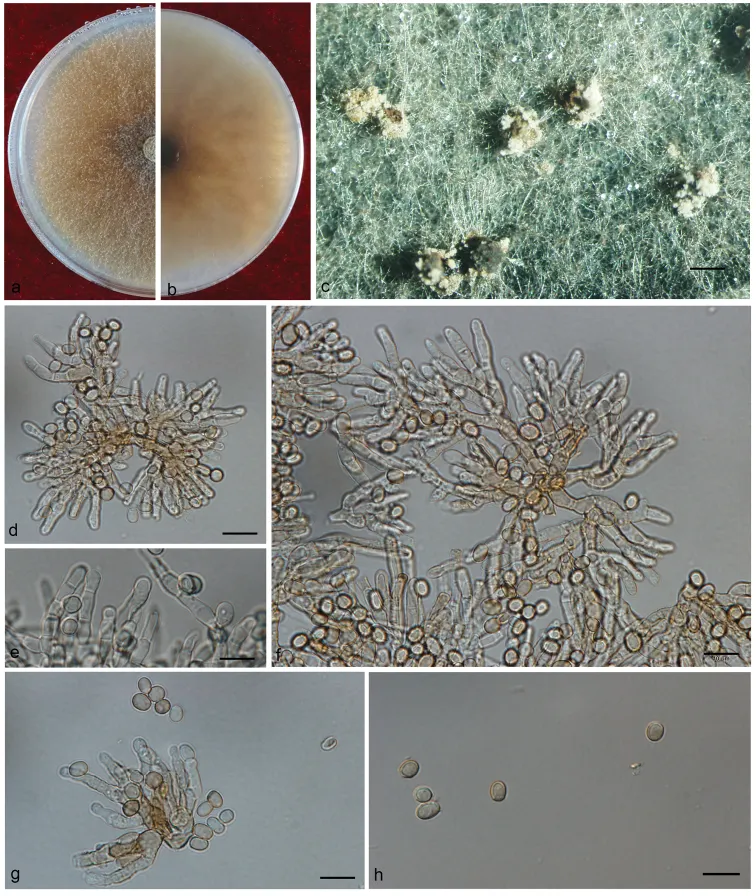
Sexual form: unknown. Asexual form: Leptographium -like. Conidiophores macronematous, mononematous, gathered in groups up to 5, (28.5–) 34–45.5 (–52) μm long; stipes cylindrical, 1–2 septate, not constricted at septa, umber-brown to dark olivaceous, (6.3–) 7.3–14.5 (–18) μm long × (2.2–) 3.1–4.6 (–5.8) μm wide. Conidiogenous apparatus (22–) 26.5–31 (–34) μm long, with 2–3 series of cylindrical branches; primary branches olivaceous, smooth, cylindrical all over, (5.9–) 7.2–13.5 (–20.5) × (3–) 3.3–4.2 (–4.6) μm; conidiogenous cells discrete, 2–3 per branch, aseptate, cylindrical, hyaline to pale umber, (5.8) 7.2–12.1 (–18.5) × (2.1–) 2.8–4.0 (–4.7) μm; conidia 1-celled, globose, elliptical with truncate bases, hyaline to pale umber, (4.0–) 4.8–5.9 (–6.3) × (3.1–) 4.0–5.0 (–5.6) μm. Colonies on 2% MEA fast growing in the dark, reaching 90 mm in diam. in 8 days at 25 °C, growth rate up to 13 mm/day at the fastest; colony margin smooth. Hyphae submerged and aerial, umber-brown to dark olivaceous, flocculose or floccose; reverse hyphae umber-brown to dark olivaceous. Optimal growth temperature 25 °C, able to grow at 5 °C and 30 °C. No growth at 35 °C.
Habitat dan peran ekologis
Ophiostoma aggregatum produced a single asexual, Leptographium -like state in vitro. This species is phylogenetically closely related to O. macrosporum, O. tingens, O. floccosum, O. tapionis and O. piliferum in LSU -, ITS - and TUB2 -based phylogenetic inferences. Ophiostoma aggregatum and O. tingens are shown to be sympatric in Yunnan pine forest; both taxa were isolated from galleries and adults of T. minor and T. yunnanensis infesting P. yunnanensis (Table 2). Ophiostoma tingens was also reported from T. minor infesting P. yunnanensis in Yunnan (Pan et al. 2017). Ophiostoma aggregatum and O. tingens differ in their asexual state. Ophiostoma aggregatum only produces a Leptographium -like state. Inversely, the asexual states of O. tingens are variable. Our strains produced a Pesotum -like and a Sporothrix -like state whereas previously, Francke-Grosmann (1952) and de Beer et al. (2013b) reported a Hyalorhinocladiella - to Raffaelea -like state in European strains. The origin of this variability and its importance for taxonomy is uncertain. Ophiostoma macrosporum, O. floccosum, O. tapionis and O. piliferum also differ from O. aggregatum by their asexual state. Ophiostoma macrosporum and O. floccosum produce a Pesotum -like asexual state, O. tapionis a Hyalorhinocladiella -like state and O. piliferum produces a Sporothrix -like state (Francke-Grosmann 1952, Upadhyay 1981, Yamaoka et al. 2004, Linnakoski et al. 2008).
- Habitat atau konteks temuan
- hutan
- Substrat
- Informasi belum tersedia pada sumber rilis ini.
- Peran atau konteks
- Belum dikategorikan pada rilis ini.
Reproduksi
Sexual form: unknown. Asexual form: Leptographium -like. Conidiophores macronematous, mononematous, gathered in groups up to 5, (28.5–) 34–45.5 (–52) μm long; stipes cylindrical, 1–2 septate, not constricted at septa, umber-brown to dark olivaceous, (6.3–) 7.3–14.5 (–18) μm long × (2.2–) 3.1–4.6 (–5.8) μm wide. Conidiogenous apparatus (22–) 26.5–31 (–34) μm long, with 2–3 series of cylindrical branches; primary branches olivaceous, smooth, cylindrical all over, (5.9–) 7.2–13.5 (–20.5) × (3–) 3.3–4.2 (–4.6) μm; conidiogenous cells discrete, 2–3 per branch, aseptate, cylindrical, hyaline to pale umber, (5.8) 7.2–12.1 (–18.5) × (2.1–) 2.8–4.0 (–4.7) μm; conidia 1-celled, globose, elliptical with truncate bases, hyaline to pale umber, (4.0–) 4.8–5.9 (–6.3) × (3.1–) 4.0–5.0 (–5.6) μm.
Catatan identitas dan cakupan
- Nama diterima mengikuti Catalogue of Life Base2026-09-11; uraian mempertahankan konsep dan nama sumber aslinya.
- Preserve original treatment localities, hosts and substrate scope. Materials examined describe documented specimens, not the full global range.
- Impor dan terjemahan otomatis belum diperiksa editorial per profil. Struktur reproduktif yang disebutkan tidak membuktikan seluruh siklus hidup diketahui.
- Pengukuran pada uraian mengikuti spesimen, kultur, dan metode sumber; angka tidak diperluas ke semua populasi.
Catatan distribusi dalam narasi mengikuti sumbernya. Dokumentasi spesimen atau foto mengikuti catatan sumber. Bukti wilayah Indonesia dan penilaian konservasi tidak disimpulkan dari gambar.
Melihat dengan konteks
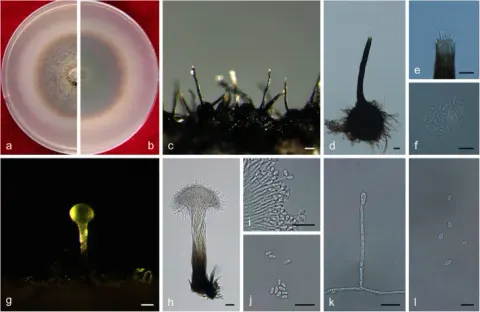
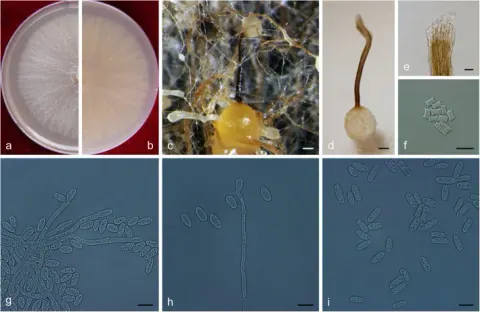
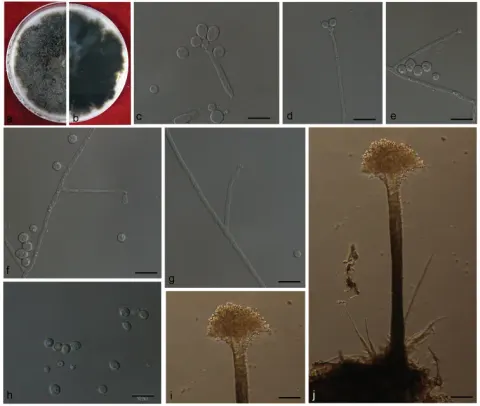
Morphological characters of Ophiostoma aggregatum sp. n. A, B upper and reverse of cultures on 2% MEA 8 d after inoculation C conidiomata on 2% MEA (bar = 50 μm) D–H conidiogenous cells of Leptographium -like asexual state and conidia. Scale bars: 20 μm (C); 10 μm (D–H).
- Jenis
- Pelat ilmiah
- Kredit
- Wang HuiMin, Zheng Wang, Fu Liu, Cheng Xu Wu, Su Fang Zhang, Xiang Bo Kong, Cony Decock, Quan Lu, Zhen Zhang
- Lisensi
- CC BY 4.0
- Sumber media
- Buka entri sumber
Sumber profil
- [1] Differential patterns of ophiostomatoid fungal communities associated with three sympatric Tomicus species infesting pines in south-western China, with a description of four new species — Ophiostoma aggregatum
- [2] Catalogue of Life Base2026-09-11 — Ophiostoma aggregatum
- [3] Dokumentasi visual — Ophiostoma aggregatum
Rujukan halaman ini
Fungi. Ophiostoma aggregatum. Rilis data fungi-2026-10-12-expansion-2. https://fungi-atlas.mgadib.chatgpt.site/jamur/ophiostoma-aggregatum/.
Status: impor sumber; pemeriksaan editorial per profil belum selesai. Untuk klaim biologis, gunakan rujukan pada bagian terkait dan periksa konteks sumber aslinya.