01 / Morfologi

Ciri dan struktur

This is a rock-dwelling (saxicolous) crustose lichen that forms irregular patches 3–4 cm across. The thallus surface is bright orange in open sites but fades to wax-yellow in shaded crevices. It appears -—that is, broken into warty, roughly polygonal blocks up to about 1 mm wide—and the centre of each block can be 1.5–2 mm tall, giving the colony a bumpy texture. An unusually thick outer skin ()—over 1.2 mm at the centre—makes up most of the thallus. This cortex consists of densely packed fungal threads (hyphae) arranged perpendicular to the surface, while upright columns of green algal cells (a Coccomyxa-like ) periodically pierce the cortex almost to the surface, supplying photosynthate even through the thick wall. Beneath the cortex, the internal tissue (medulla) is thin and ill-defined, mingling with mineral grains from the underlying rock. Small urn-shaped () fruiting bodies (apothecia) are common. They begin as tiny pores within the and expand to 0.5–0.7 mm in diameter, remaining flush with the surface. Around each pore the thallus darkens to brown-black, sometimes carrying a faint white bloom. Internally, the apothecial cup is lined with colourless tissue and slender unbranched paraphyses. Each cylindrical ascus holds eight colourless, single-celled ascospores measuring 25–29 × 16–19 micrometres (μm). Microscopic asexual structures (pycnidia) produce curved, thread-like conidia 15–25 μm long. No lichen products were detected in O. kerguelensis by high-performance thin-layer chromatography.

Sebagian uraian ditampilkan dalam bahasa sumber; terjemahannya belum tersedia atau belum lolos pemeriksaan.

Rujukan: [1]

Pengukuran mengikuti objek, spesimen atau kultur, dan metode yang disebutkan sumber. Baca uraian asli untuk konteks lengkap.

02 / Kehidupan

Habitat dan peran ekologis

Orceolina kerguelensis is a non-maritime species of the subantarctic zone. It occurs from near sea level to about 650 m in both lowland and alpine situations, invariably on exposed basaltic or granitic rocks and pebbles where wind and desiccation keep competing vegetation sparse. The lichen is frequent, though seldom abundant, across the western and upland parts of the Kerguelen archipelago, and equally common on Crozet Islands. Beyond these French Southern Territories it has been recorded on Marion Island and Prince Edward Islands in the southern Indian Ocean and on Heard Island in the southern Atlantic sector, suggesting a distribution that tracks cold, oceanic climates of isolated subantarctic islands. Its predators include the land snail Notodiscus hookeri.

Sebagian uraian ditampilkan dalam bahasa sumber; terjemahannya belum tersedia atau belum lolos pemeriksaan.

Rujukan: [1]

Habitat atau konteks temuan
Informasi belum tersedia pada sumber rilis ini.
Substrat
Informasi belum tersedia pada sumber rilis ini.
Peran atau konteks
Pembentuk liken
Temukan hubungan serupa
03 / Siklus hidup

Reproduksi

Small urn-shaped () fruiting bodies (apothecia) are common. They begin as tiny pores within the and expand to 0.5–0.7 mm in diameter, remaining flush with the surface. Around each pore the thallus darkens to brown-black, sometimes carrying a faint white bloom. Internally, the apothecial cup is lined with colourless tissue and slender unbranched paraphyses. Each cylindrical ascus holds eight colourless, single-celled ascospores measuring 25–29 × 16–19 micrometres (μm). Microscopic asexual structures (pycnidia) produce curved, thread-like conidia 15–25 μm long. No lichen products were detected in O. kerguelensis by high-performance thin-layer chromatography.

Sebagian uraian ditampilkan dalam bahasa sumber; terjemahannya belum tersedia atau belum lolos pemeriksaan.

Rujukan: [1]

Sinonim menurut acuan taksonomi rilis: Lecanora kerguelensis; Placodium kerguelense; Urceolina kerguelensis
04 / Batas informasi

Catatan identitas dan cakupan

  • Nama diterima mengikuti Catalogue of Life Base2026-09-11; uraian mempertahankan konsep dan nama sumber aslinya.
  • Original geographic, specimen and life-cycle scope retained; source import awaits individual editorial review.
  • Impor dan terjemahan otomatis belum diperiksa editorial per profil. Struktur reproduktif yang disebutkan tidak membuktikan seluruh siklus hidup diketahui.
  • Pengukuran pada uraian mengikuti spesimen, kultur, dan metode sumber; angka tidak diperluas ke semua populasi.

Catatan distribusi dalam narasi mengikuti sumbernya. Dokumentasi spesimen atau foto mengikuti catatan sumber. Bukti wilayah Indonesia dan penilaian konservasi tidak disimpulkan dari gambar.

05 / Dokumentasi

Melihat dengan konteks

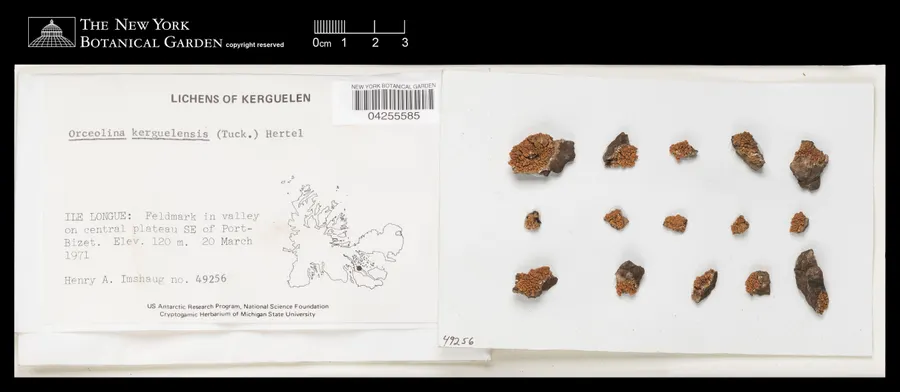
Voucher herbarium Orceolina kerguelensis (4255585), The New York Botanical Garden. Identifikasi mengikuti record spesimen sumber. Foto bahan, kemasan, atau label herbarium sebagaimana tersedia pada record institusi; bukan foto lapangan atau penentuan spesimen independen.

Jenis
Voucher herbarium
Kredit
The New York Botanical Garden
Lisensi
CC BY 4.0
Sumber media
Buka entri sumber

Gambar menunjukkan objek menurut identifikasi sumber, bukan verifikasi independen spesimen oleh Fungi. Tidak ada skala baru yang ditambahkan.

06 / Rujukan

Sumber profil

  1. [1] Orceolina kerguelensis — Wikipedia (en)Bagian sumber: Frozen revision 1299903937
    Tanggal penghimpunan sumber: 2026-10-12
    Teks sumber: CC BY-SA4.0 · Wikipedia contributors
  2. [2] Catalogue of Life Base2026-09-11 — Orceolina kerguelensisBagian sumber: ColDP NameUsage.tsv ID 6T5DF; accepted species; source 2073
    Tanggal penghimpunan sumber: 2026-10-12
  3. [3] Dokumentasi visual — Orceolina kerguelensisBagian sumber: Individual media record; identification follows the source, not independent determination
    Tanggal penghimpunan sumber: 2026-10-12
    Media sumber: CC BY 4.0 · The New York Botanical Garden

Adaptasi teks: CC BY-SA 4.0. Wikipedia contributors — Orceolina kerguelensis — Wikipedia (en)

Uraian asli dan riwayat sumber

Riwayat atau halaman sumber

Ringkasan sumber

Orceolina kerguelensis is a saxicolous (rock-dwelling) crustose lichen in the family Trapeliaceae. It is the type species of the genus Orceolina. The species is endemic to subantarctic islands in the southern Indian and Atlantic oceans, where it grows on exposed basaltic and granitic rocks from sea level to alpine elevations. With its thick and bright orange colouration that fades to wax-yellow in shade, this lichen is adapted to the harsh, wind-swept environments of isolated subantarctic territories.

Revisi sumber

Morfologi sumber

This is a rock-dwelling (saxicolous) crustose lichen that forms irregular patches 3–4 cm across. The thallus surface is bright orange in open sites but fades to wax-yellow in shaded crevices. It appears -—that is, broken into warty, roughly polygonal blocks up to about 1 mm wide—and the centre of each block can be 1.5–2 mm tall, giving the colony a bumpy texture. An unusually thick outer skin ()—over 1.2 mm at the centre—makes up most of the thallus. This cortex consists of densely packed fungal threads (hyphae) arranged perpendicular to the surface, while upright columns of green algal cells (a Coccomyxa-like ) periodically pierce the cortex almost to the surface, supplying photosynthate even through the thick wall. Beneath the cortex, the internal tissue (medulla) is thin and ill-defined, mingling with mineral grains from the underlying rock. Small urn-shaped () fruiting bodies (apothecia) are common. They begin as tiny pores within the and expand to 0.5–0.7 mm in diameter, remaining flush with the surface. Around each pore the thallus darkens to brown-black, sometimes carrying a faint white bloom. Internally, the apothecial cup is lined with colourless tissue and slender unbranched paraphyses. Each cylindrical ascus holds eight colourless, single-celled ascospores measuring 25–29 × 16–19 micrometres (μm). Microscopic asexual structures (pycnidia) produce curved, thread-like conidia 15–25 μm long. No lichen products were detected in O. kerguelensis by high-performance thin-layer chromatography.

Revisi sumber

Ekologi sumber

Orceolina kerguelensis is a non-maritime species of the subantarctic zone. It occurs from near sea level to about 650 m in both lowland and alpine situations, invariably on exposed basaltic or granitic rocks and pebbles where wind and desiccation keep competing vegetation sparse. The lichen is frequent, though seldom abundant, across the western and upland parts of the Kerguelen archipelago, and equally common on Crozet Islands. Beyond these French Southern Territories it has been recorded on Marion Island and Prince Edward Islands in the southern Indian Ocean and on Heard Island in the southern Atlantic sector, suggesting a distribution that tracks cold, oceanic climates of isolated subantarctic islands. Its predators include the land snail Notodiscus hookeri.

Revisi sumber

Struktur reproduksi sumber

Small urn-shaped () fruiting bodies (apothecia) are common. They begin as tiny pores within the and expand to 0.5–0.7 mm in diameter, remaining flush with the surface. Around each pore the thallus darkens to brown-black, sometimes carrying a faint white bloom. Internally, the apothecial cup is lined with colourless tissue and slender unbranched paraphyses. Each cylindrical ascus holds eight colourless, single-celled ascospores measuring 25–29 × 16–19 micrometres (μm). Microscopic asexual structures (pycnidia) produce curved, thread-like conidia 15–25 μm long. No lichen products were detected in O. kerguelensis by high-performance thin-layer chromatography.

Revisi sumber

Rujukan halaman ini

Fungi. Orceolina kerguelensis. Rilis data fungi-2026-10-12-expansion-2. https://fungi-atlas.mgadib.chatgpt.site/jamur/orceolina-kerguelensis/.

Status: impor sumber; pemeriksaan editorial per profil belum selesai. Untuk klaim biologis, gunakan rujukan pada bagian terkait dan periksa konteks sumber aslinya.