01 / Morfologi

Ciri dan struktur

Notes: Otidea cupulata is recognized by the stipitate, broadly cup-shaped, dark-orange-brown to dark-purple-brown hymenium, yellowish-brown to brown receptacle surface, ellipsoid to subfusoid ascospores, forked or notched paraphyses, and furfuraceous receptacle surface. The forked paraphyses is rarely found in other species in the O. bufonia-onotica clade. Several species in the O. bufonia-onotica clade are similar to O. cupulata in apothecial shape and color, including O. bufonia, O. filiformis, O. mirabilis, and O. olivaceobrunnea Harmaja, but O. bufonia can be distinguished by its distinctly narrowly fusoid ascospores, the presence of hyphae with striate resinous exudates in the medullary excipulum, and resinous exudates of the ectal excipulum that does not turn bright yellow in KOH. Otidea filiformis differs in its apothecia with pinkish shades, distinctly narrowly fusoid ascospores, unenlarged and curved to hooked paraphyses, and higher warts (40–75 µm) on the receptacle surface. Otidea mirabilis differs by having purple to lilaceous-bluish shades on the receptacle surface and narrowly fusoid ascospores (Q m = 2.1–2.3). Otidea olivaceobrunnea can be separated by its olive-brown hymenium and wider ascospores (14–17 × 8–8.5 µm). Four species (O. purpureogrisea Pfister, F. Xu & Z.W. Ge, O. purpureobrunnea, O. simithii Kanouse and O. subpurpurea) have more or less bluish or lilaceous shades on apothecia that resembles that of O. cupulata. However, O. purpureogrisea is distinguished by its ear-shaped apothecia, dark-purple-brown to purple-gray receptacle surface, and the resinous exudate in the ectal excipulum turning amber and brown in KOH.

Sebagian uraian ditampilkan dalam bahasa sumber; terjemahannya belum tersedia atau belum lolos pemeriksaan.

Rujukan: [1]

Pengukuran mengikuti objek, spesimen atau kultur, dan metode yang disebutkan sumber. Baca uraian asli untuk konteks lengkap.

02 / Kehidupan

Habitat dan peran ekologis

Holotype: China. Shanxi Province, Jiaocheng County, Pangquangou Township, Badaogou valley, alt. 2200m, on soil in mixed forest of Larix sp. and Betula sp., 28 August 2018, L.J. Guo, LH218 (HSA 218). Notes: Otidea cupulata is recognized by the stipitate, broadly cup-shaped, dark-orange-brown to dark-purple-brown hymenium, yellowish-brown to brown receptacle surface, ellipsoid to subfusoid ascospores, forked or notched paraphyses, and furfuraceous receptacle surface. The forked paraphyses is rarely found in other species in the O. bufonia-onotica clade. Several species in the O. bufonia-onotica clade are similar to O. cupulata in apothecial shape and color, including O. bufonia, O. filiformis, O. mirabilis, and O. olivaceobrunnea Harmaja, but O. bufonia can be distinguished by its distinctly narrowly fusoid ascospores, the presence of hyphae with striate resinous exudates in the medullary excipulum, and resinous exudates of the ectal excipulum that does not turn bright yellow in KOH. Otidea filiformis differs in its apothecia with pinkish shades, distinctly narrowly fusoid ascospores, unenlarged and curved to hooked paraphyses, and higher warts (40–75 µm) on the receptacle surface. Otidea mirabilis differs by having purple to lilaceous-bluish shades on the receptacle surface and narrowly fusoid ascospores (Q m = 2.1–2.3).

Sebagian uraian ditampilkan dalam bahasa sumber; terjemahannya belum tersedia atau belum lolos pemeriksaan.

Rujukan: [1]

Habitat atau konteks temuan
hutan
Substrat
tanah
Peran atau konteks
Belum dikategorikan pada rilis ini.
Temukan hubungan serupa
03 / Siklus hidup

Reproduksi

Notes: Otidea cupulata is recognized by the stipitate, broadly cup-shaped, dark-orange-brown to dark-purple-brown hymenium, yellowish-brown to brown receptacle surface, ellipsoid to subfusoid ascospores, forked or notched paraphyses, and furfuraceous receptacle surface. The forked paraphyses is rarely found in other species in the O. bufonia-onotica clade. Several species in the O. bufonia-onotica clade are similar to O. cupulata in apothecial shape and color, including O. bufonia, O. filiformis, O. mirabilis, and O. olivaceobrunnea Harmaja, but O. bufonia can be distinguished by its distinctly narrowly fusoid ascospores, the presence of hyphae with striate resinous exudates in the medullary excipulum, and resinous exudates of the ectal excipulum that does not turn bright yellow in KOH.

Sebagian uraian ditampilkan dalam bahasa sumber; terjemahannya belum tersedia atau belum lolos pemeriksaan.

Rujukan: [1]

04 / Batas informasi

Catatan identitas dan cakupan

  • Nama diterima mengikuti Catalogue of Life Base2026-09-11; uraian mempertahankan konsep dan nama sumber aslinya.
  • Preserve original treatment localities, hosts and substrate scope. Materials examined describe documented specimens, not the full global range.
  • Impor dan terjemahan otomatis belum diperiksa editorial per profil. Struktur reproduktif yang disebutkan tidak membuktikan seluruh siklus hidup diketahui.
  • Pengukuran pada uraian mengikuti spesimen, kultur, dan metode sumber; angka tidak diperluas ke semua populasi.

Catatan distribusi dalam narasi mengikuti sumbernya. Dokumentasi spesimen atau foto mengikuti catatan sumber. Bukti wilayah Indonesia dan penilaian konservasi tidak disimpulkan dari gambar.

05 / Dokumentasi

Melihat dengan konteks

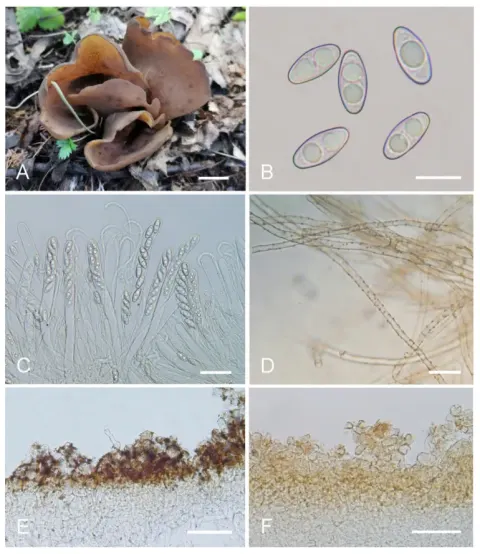
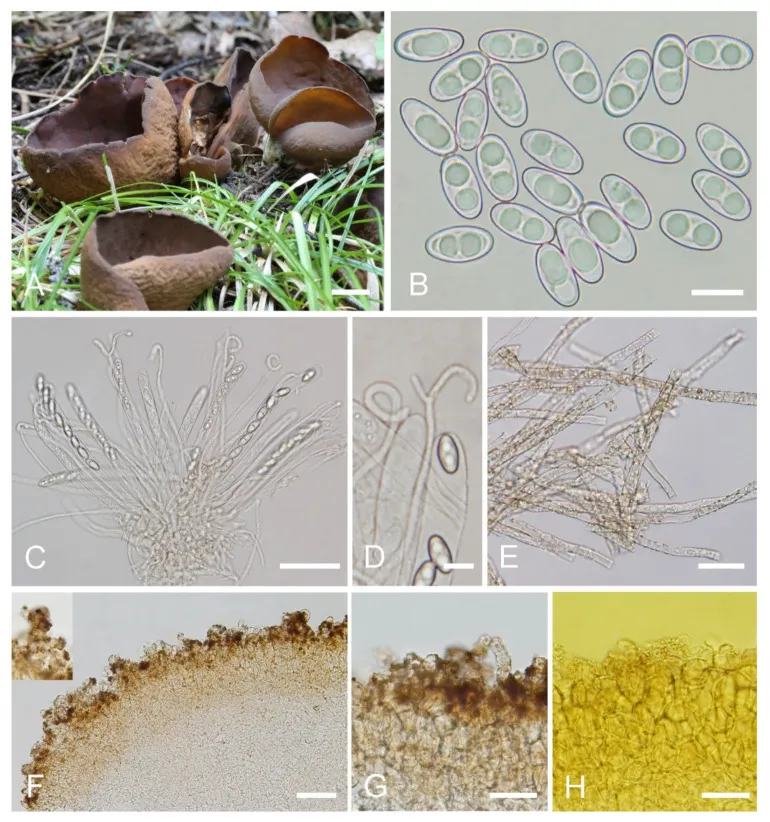
Otidea cupulata (HSA 218) (A) apothecia, (B) ascospores, (C) asci and paraphyses, (D) paraphyses, (E) basal mycelium, and (F) ectal and medullary excipulum in water, (G) ectal excipulum in water, (H) ectal excipulum in MLZ. Scale bars: (A) = 1 cm, (B) = 10 μm, (C) = 50 μm, (D) = 10 μm, (E) = 25 μm, (F) = 50 μm, (G, H) = 30 μm.

Jenis
Pelat ilmiah
Kredit
© 2022 by the authors.
Lisensi
CC BY 4.0
Sumber media
Buka entri sumber

Gambar menunjukkan objek menurut identifikasi sumber, bukan verifikasi independen spesimen oleh Fungi. Tidak ada skala baru yang ditambahkan.

06 / Rujukan

Sumber profil

  1. [1] New Species and New Records of Otidea from China Based on Molecular and Morphological Data — Otidea cupulataBagian sumber: sec3dot2-jof-08-00272_paragraph_9
    Tanggal penghimpunan sumber: 2026-10-12
    Teks sumber: CC BY 4.0 · Xu YY, Mao N, Yang JJ, Fan L.
  2. [2] Catalogue of Life Base2026-09-11 — Otidea cupulataBagian sumber: ColDP NameUsage.tsv ID B2NHT; accepted species; source 2073
    Tanggal penghimpunan sumber: 2026-10-12
  3. [3] Dokumentasi visual — Otidea cupulataBagian sumber: Individual media record; identification follows the source, not independent determination
    Tanggal penghimpunan sumber: 2026-10-12
    Media sumber: CC BY 4.0 · © 2022 by the authors.

Adaptasi teks: CC BY 4.0. Xu YY, Mao N, Yang JJ, Fan L. — New Species and New Records of Otidea from China Based on Molecular and Morphological Data — Otidea cupulata

Uraian asli dan riwayat sumber

Riwayat atau halaman sumber

Ringkasan sumber

Notes: Otidea cupulata is recognized by the stipitate, broadly cup-shaped, dark-orange-brown to dark-purple-brown hymenium, yellowish-brown to brown receptacle surface, ellipsoid to subfusoid ascospores, forked or notched paraphyses, and furfuraceous receptacle surface. The forked paraphyses is rarely found in other species in the O. bufonia-onotica clade. Several species in the O. bufonia-onotica clade are similar to O. cupulata in apothecial shape and color, including O. bufonia, O. filiformis, O. mirabilis, and O. olivaceobrunnea Harmaja, but O. bufonia can be distinguished by its distinctly narrowly fusoid ascospores, the presence of hyphae with striate resinous exudates in the medullary excipulum, and resinous exudates of the ectal excipulum that does not turn bright yellow in KOH.

Revisi sumber

Morfologi sumber

Notes: Otidea cupulata is recognized by the stipitate, broadly cup-shaped, dark-orange-brown to dark-purple-brown hymenium, yellowish-brown to brown receptacle surface, ellipsoid to subfusoid ascospores, forked or notched paraphyses, and furfuraceous receptacle surface. The forked paraphyses is rarely found in other species in the O. bufonia-onotica clade. Several species in the O. bufonia-onotica clade are similar to O. cupulata in apothecial shape and color, including O. bufonia, O. filiformis, O. mirabilis, and O. olivaceobrunnea Harmaja, but O. bufonia can be distinguished by its distinctly narrowly fusoid ascospores, the presence of hyphae with striate resinous exudates in the medullary excipulum, and resinous exudates of the ectal excipulum that does not turn bright yellow in KOH. Otidea filiformis differs in its apothecia with pinkish shades, distinctly narrowly fusoid ascospores, unenlarged and curved to hooked paraphyses, and higher warts (40–75 µm) on the receptacle surface. Otidea mirabilis differs by having purple to lilaceous-bluish shades on the receptacle surface and narrowly fusoid ascospores (Q m = 2.1–2.3). Otidea olivaceobrunnea can be separated by its olive-brown hymenium and wider ascospores (14–17 × 8–8.5 µm). Four species (O. purpureogrisea Pfister, F. Xu & Z.W. Ge, O. purpureobrunnea, O. simithii Kanouse and O. subpurpurea) have more or less bluish or lilaceous shades on apothecia that resembles that of O. cupulata. However, O. purpureogrisea is distinguished by its ear-shaped apothecia, dark-purple-brown to purple-gray receptacle surface, and the resinous exudate in the ectal excipulum turning amber and brown in KOH.

Revisi sumber

Ekologi sumber

Holotype: China. Shanxi Province, Jiaocheng County, Pangquangou Township, Badaogou valley, alt. 2200m, on soil in mixed forest of Larix sp. and Betula sp., 28 August 2018, L.J. Guo, LH218 (HSA 218). Notes: Otidea cupulata is recognized by the stipitate, broadly cup-shaped, dark-orange-brown to dark-purple-brown hymenium, yellowish-brown to brown receptacle surface, ellipsoid to subfusoid ascospores, forked or notched paraphyses, and furfuraceous receptacle surface. The forked paraphyses is rarely found in other species in the O. bufonia-onotica clade. Several species in the O. bufonia-onotica clade are similar to O. cupulata in apothecial shape and color, including O. bufonia, O. filiformis, O. mirabilis, and O. olivaceobrunnea Harmaja, but O. bufonia can be distinguished by its distinctly narrowly fusoid ascospores, the presence of hyphae with striate resinous exudates in the medullary excipulum, and resinous exudates of the ectal excipulum that does not turn bright yellow in KOH. Otidea filiformis differs in its apothecia with pinkish shades, distinctly narrowly fusoid ascospores, unenlarged and curved to hooked paraphyses, and higher warts (40–75 µm) on the receptacle surface. Otidea mirabilis differs by having purple to lilaceous-bluish shades on the receptacle surface and narrowly fusoid ascospores (Q m = 2.1–2.3).

Revisi sumber

Struktur reproduksi sumber

Notes: Otidea cupulata is recognized by the stipitate, broadly cup-shaped, dark-orange-brown to dark-purple-brown hymenium, yellowish-brown to brown receptacle surface, ellipsoid to subfusoid ascospores, forked or notched paraphyses, and furfuraceous receptacle surface. The forked paraphyses is rarely found in other species in the O. bufonia-onotica clade. Several species in the O. bufonia-onotica clade are similar to O. cupulata in apothecial shape and color, including O. bufonia, O. filiformis, O. mirabilis, and O. olivaceobrunnea Harmaja, but O. bufonia can be distinguished by its distinctly narrowly fusoid ascospores, the presence of hyphae with striate resinous exudates in the medullary excipulum, and resinous exudates of the ectal excipulum that does not turn bright yellow in KOH.

Revisi sumber

Rujukan halaman ini

Fungi. Otidea cupulata. Rilis data fungi-2026-10-12-expansion-2. https://fungi-atlas.mgadib.chatgpt.site/jamur/otidea-cupulata/.

Status: impor sumber; pemeriksaan editorial per profil belum selesai. Untuk klaim biologis, gunakan rujukan pada bagian terkait dan periksa konteks sumber aslinya.