Ciri dan struktur
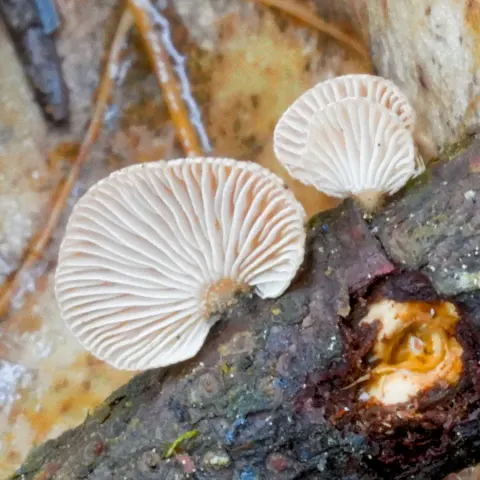
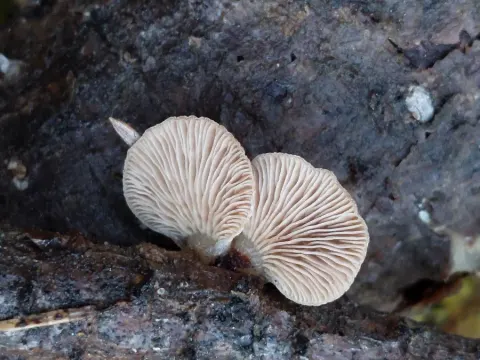
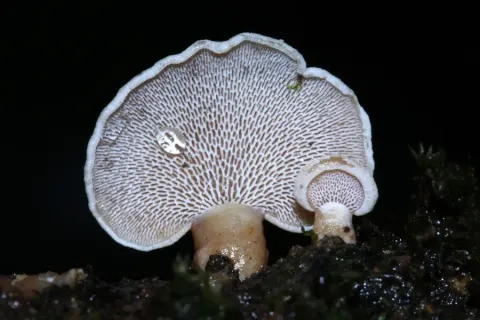
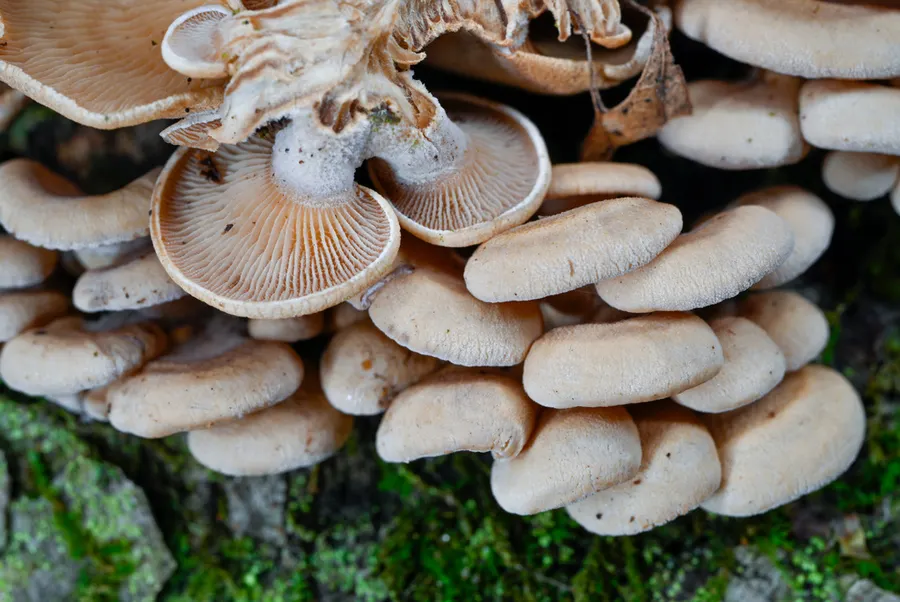
The fungus normally exists unseen, in the form of a mass of threadlike vegetative cells called a mycelium, inhabiting rotting wood; only when suitable environmental conditions of temperature, moisture, and nutrient availability are achieved does the fungus produce the reproductive structures known as fruit bodies, or mushrooms. The cap of the fruit body is kidney- or clamshell-shaped, convex to roughly flat, with dimensions of 1.2 to 3.2 cm by 1.2 to 2.5 cm. The edges of the caps are scalloped with small rounded teeth, and curved slightly inward. The cap surface is dry, with a pattern of block-like areas similar to cracked dried mud; the surface is also covered with small fine hairs that give it a somewhat woolly consistency. It may have several concentric ridges or zones. Fresh fruit bodies range in color from yellowish-orange to buff to cinnamon; when dried they may be various shades of tan, brown or clay. The faded colors of dried fruit bodies tend to revive when moistened. On the underside of the cap, the gills are narrow and spaced closely together, often forked, brownish to buff, and with numerous interconnecting cross-veins. Supporting the cap is a stem that is 0.5 to 2 cm long by 0.3 to 0.8 cm thick and has an off-center attachment to the cap, either at or near the cap side. The dull-white stem is covered with minute silk-like fibers and is narrower at the base where it attaches to the substrate. Fruit bodies do not have any distinctive odor. The flesh is thin, tough, and dark yellow-brown to cream-colored. Various microscopic characteristics may be used to help identify the fungus from other morphologically similar species.
Habitat dan peran ekologis
Panellus stipticus umum di daerah beriklim sedang di Eropa utara, dan juga telah dikumpulkan di Australia, Selandia Baru, Anatolia, Jepang, dan China. Di Amerika Utara, jamur ini lebih umum di timur daripada di barat; wilayah utara jamur ini mencapai Alaska, dan telah dikumpulkan sejauh selatan hingga Costa Rica. Panellus stipticus adalah spesies saprobik, dan menyebabkan kutu putih. Ini adalah bentuk kerusakan kayu di mana kayu mengambil penampilan pemutih dan di mana lignin serta selulosa dan hemicellulose dipecah oleh enzim yang dikesresikan oleh jamur. Fruit bodies biasanya ditemukan dalam kelompok yang saling bertumpuk di sisi pohon-pohon keras, pada batang, batang, dan cabang yang jatuh. Although most yang biasanya ditemukan pada kayu mati, juga dapat tumbuh secara oportunis di luka pohon hidup. Di Amerika Utara, tuan rumah yang disukai adalah ek, birch, maple, hickory, pecan, dan American hornbeam, sementara di Eropa, biasanya ditemukan tumbuh di ek, birch, alder, beech, hazel, chestnut, dan abu. It has also been found growing on Ericia in North Africa. Although the fungus favors hardwoods, it has been reported to grow on loblolly pine and eastern white pine. Fruiting occurs September through November in Eropa, Kepulauan Canary, dan Amerika Utara, meskipun kadang-kadang juga dapat ditemukan di musim semi.
- Habitat atau konteks temuan
- Informasi belum tersedia pada sumber rilis ini.
- Substrat
- kayu
- Peran atau konteks
- Pengurai
Reproduksi
The fungus normally exists unseen, in the form of a mass of threadlike vegetative cells called a mycelium, inhabiting rotting wood; only when suitable environmental conditions of temperature, moisture, and nutrient availability are achieved does the fungus produce the reproductive structures known as fruit bodies, or mushrooms. The cap of the fruit body is kidney- or clamshell-shaped, convex to roughly flat, with dimensions of 1.2 to 3.2 cm by 1.2 to 2.5 cm. The edges of the caps are scalloped with small rounded teeth, and curved slightly inward. The cap surface is dry, with a pattern of block-like areas similar to cracked dried mud; the surface is also covered with small fine hairs that give it a somewhat woolly consistency.
Catatan identitas dan cakupan
- Nama diterima mengikuti Catalogue of Life Base2026-09-11; uraian mempertahankan konsep dan nama sumber aslinya.
- Original geographic, specimen and life-cycle scope retained; source import awaits individual editorial review.
- Impor dan terjemahan otomatis belum diperiksa editorial per profil. Struktur reproduktif yang disebutkan tidak membuktikan seluruh siklus hidup diketahui.
- Pengukuran pada uraian mengikuti spesimen, kultur, dan metode sumber; angka tidak diperluas ke semua populasi.
Catatan distribusi dalam narasi mengikuti sumbernya. Dokumentasi spesimen atau foto mengikuti catatan sumber. Bukti wilayah Indonesia dan penilaian konservasi tidak disimpulkan dari gambar.
Melihat dengan konteks
Dokumentasi Panellus stipticus menurut asosiasi foto pada record takson iNaturalist. Kredit: Alan Rockefeller. Identitas mengikuti sumber; bukan penentuan spesimen independen.
- Jenis
- Fotografi
- Kredit
- (c) Alan Rockefeller, some rights reserved (CC BY), uploaded by Alan Rockefeller
- Lisensi
- CC BY 4.0
- Sumber media
- Buka entri sumber
Sumber profil
- [1] Panellus stipticus — Wikipedia (en)
- [2] Catalogue of Life Base2026-09-11 — Panellus stipticus
- [3] Dokumentasi visual — Panellus stipticus
Rujukan halaman ini
Fungi. Panellus stipticus. Rilis data fungi-2026-10-12-expansion-2. https://fungi-atlas.mgadib.chatgpt.site/jamur/panellus-stipticus/.
Status: impor sumber; pemeriksaan editorial per profil belum selesai. Untuk klaim biologis, gunakan rujukan pada bagian terkait dan periksa konteks sumber aslinya.