01 / Morfologi

Ciri dan struktur

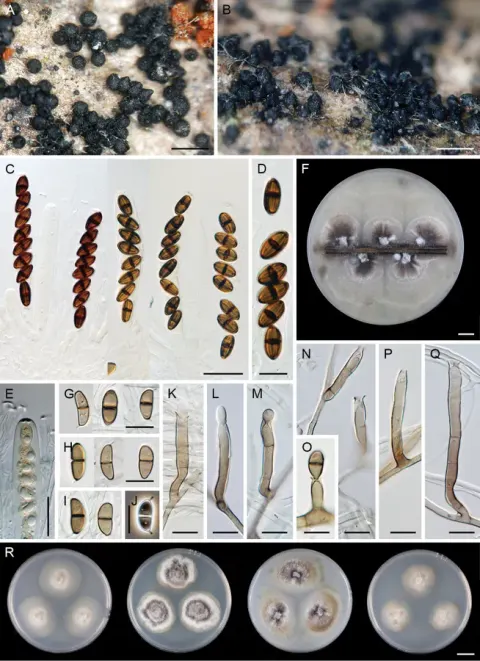
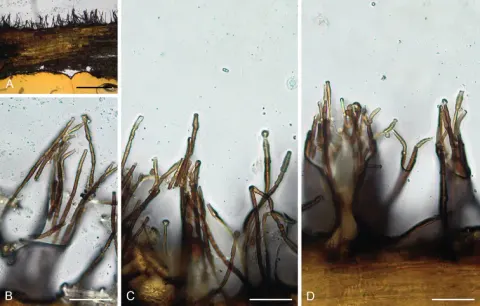
For description, illustration and holotype information see Carroll and Munk (1964) and Huhndorf and Fernández (2005). Paragaeumannomyces lapazianus has 7-septate ascospores and the largest ascomata in the genus, (400–)500–950 μm diam and 525–825(–1025) μm high fide Huhndorf and Fernández (2005), and forms a craspedodidymum-like anamorph in vitro. The anamorph is characterised by inflated, pigmented conidiogenous cells with a flared collarette and oblate to horizontally oblong conidia with a short abscission scar or frill and without setulae.

Sebagian uraian ditampilkan dalam bahasa sumber; terjemahannya belum tersedia atau belum lolos pemeriksaan.

Rujukan: [1]

Pengukuran mengikuti objek, spesimen atau kultur, dan metode yang disebutkan sumber. Baca uraian asli untuk konteks lengkap.

02 / Kehidupan

Habitat dan peran ekologis

Paragaeumannomyces lapazianus is common on decaying wood in the neotropics and is known from the Caribbean in Puerto Rico and Jamaica, from Central America in Costa Rica, and from South America in French Guiana (Carroll and Munk 1964; Huhndorf and Fernández 2005).

Sebagian uraian ditampilkan dalam bahasa sumber; terjemahannya belum tersedia atau belum lolos pemeriksaan.

Rujukan: [1]

Habitat atau konteks temuan
Informasi belum tersedia pada sumber rilis ini.
Substrat
kayu
Peran atau konteks
Belum dikategorikan pada rilis ini.
Temukan hubungan serupa
03 / Siklus hidup

Reproduksi

For description, illustration and holotype information see Carroll and Munk (1964) and Huhndorf and Fernández (2005). Paragaeumannomyces lapazianus has 7-septate ascospores and the largest ascomata in the genus, (400–)500–950 μm diam and 525–825(–1025) μm high fide Huhndorf and Fernández (2005), and forms a craspedodidymum-like anamorph in vitro. The anamorph is characterised by inflated, pigmented conidiogenous cells with a flared collarette and oblate to horizontally oblong conidia with a short abscission scar or frill and without setulae.

Sebagian uraian ditampilkan dalam bahasa sumber; terjemahannya belum tersedia atau belum lolos pemeriksaan.

Rujukan: [1]

Sinonim menurut acuan taksonomi rilis: Chaetosphaeria lapaziana; Lasiosphaeria lapaziana
04 / Batas informasi

Catatan identitas dan cakupan

  • Nama diterima mengikuti Catalogue of Life Base2026-09-11; uraian mempertahankan konsep dan nama sumber aslinya.
  • Preserve original treatment localities, hosts and substrate scope. Materials examined describe documented specimens, not the full global range.
  • Impor dan terjemahan otomatis belum diperiksa editorial per profil. Struktur reproduktif yang disebutkan tidak membuktikan seluruh siklus hidup diketahui.
  • Pengukuran pada uraian mengikuti spesimen, kultur, dan metode sumber; angka tidak diperluas ke semua populasi.

Catatan distribusi dalam narasi mengikuti sumbernya. Dokumentasi spesimen atau foto mengikuti catatan sumber. Bukti wilayah Indonesia dan penilaian konservasi tidak disimpulkan dari gambar.

05 / Dokumentasi

Melihat dengan konteks

Dokumentasi visual yang memenuhi pemeriksaan subjek dan hak penggunaan belum tersedia. Foto gejala, label, dan gambar yang meragukan tidak dihitung.

06 / Rujukan

Sumber profil

  1. [1] Delimitation, new species and teleomorph-anamorph relationships in Codinaea, Dendrophoma, Paragaeumannomyces and Striatosphaeria (Chaetosphaeriaceae) — Paragaeumannomyces lapazianusBagian sumber: PMC7588497_section_59
    Tanggal penghimpunan sumber: 2026-10-12
    Teks sumber: CC BY 4.0 · Réblová M, Nekvindová J, Fournier J, Miller AN.
  2. [2] Catalogue of Life Base2026-09-11 — Paragaeumannomyces lapazianusBagian sumber: ColDP NameUsage.tsv ID 9ZCX5; accepted species; source 2073
    Tanggal penghimpunan sumber: 2026-10-12

Adaptasi teks: CC BY 4.0. Réblová M, Nekvindová J, Fournier J, Miller AN. — Delimitation, new species and teleomorph-anamorph relationships in Codinaea, Dendrophoma, Paragaeumannomyces and Striatosphaeria (Chaetosphaeriaceae) — Paragaeumannomyces lapazianus

Uraian asli dan riwayat sumber

Riwayat atau halaman sumber

Ringkasan sumber

For description, illustration and holotype information see Carroll and Munk (1964) and Huhndorf and Fernández (2005). Paragaeumannomyces lapazianus has 7-septate ascospores and the largest ascomata in the genus, (400–)500–950 μm diam and 525–825(–1025) μm high fide Huhndorf and Fernández (2005), and forms a craspedodidymum-like anamorph in vitro. The anamorph is characterised by inflated, pigmented conidiogenous cells with a flared collarette and oblate to horizontally oblong conidia with a short abscission scar or frill and without setulae.

Revisi sumber

Morfologi sumber

For description, illustration and holotype information see Carroll and Munk (1964) and Huhndorf and Fernández (2005). Paragaeumannomyces lapazianus has 7-septate ascospores and the largest ascomata in the genus, (400–)500–950 μm diam and 525–825(–1025) μm high fide Huhndorf and Fernández (2005), and forms a craspedodidymum-like anamorph in vitro. The anamorph is characterised by inflated, pigmented conidiogenous cells with a flared collarette and oblate to horizontally oblong conidia with a short abscission scar or frill and without setulae.

Revisi sumber

Ekologi sumber

Paragaeumannomyces lapazianus is common on decaying wood in the neotropics and is known from the Caribbean in Puerto Rico and Jamaica, from Central America in Costa Rica, and from South America in French Guiana (Carroll and Munk 1964; Huhndorf and Fernández 2005).

Revisi sumber

Struktur reproduksi sumber

For description, illustration and holotype information see Carroll and Munk (1964) and Huhndorf and Fernández (2005). Paragaeumannomyces lapazianus has 7-septate ascospores and the largest ascomata in the genus, (400–)500–950 μm diam and 525–825(–1025) μm high fide Huhndorf and Fernández (2005), and forms a craspedodidymum-like anamorph in vitro. The anamorph is characterised by inflated, pigmented conidiogenous cells with a flared collarette and oblate to horizontally oblong conidia with a short abscission scar or frill and without setulae.

Revisi sumber

Rujukan halaman ini

Fungi. Paragaeumannomyces lapazianus. Rilis data fungi-2026-10-12-expansion-2. https://fungi-atlas.mgadib.chatgpt.site/jamur/paragaeumannomyces-lapazianus/.

Status: impor sumber; pemeriksaan editorial per profil belum selesai. Untuk klaim biologis, gunakan rujukan pada bagian terkait dan periksa konteks sumber aslinya.