Ciri dan struktur
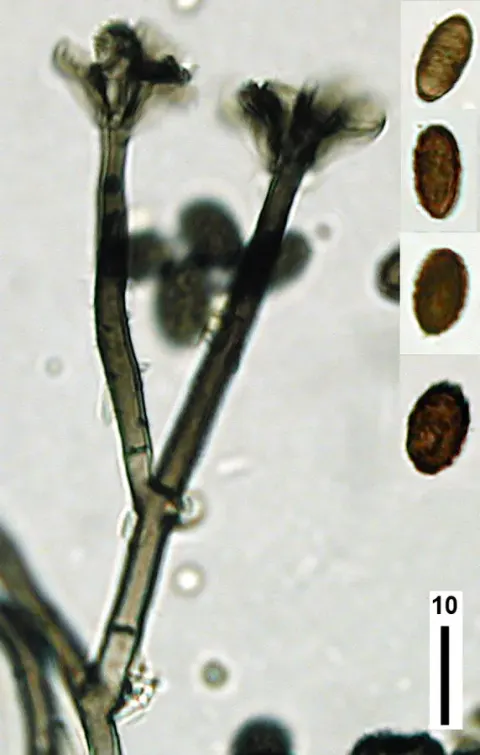
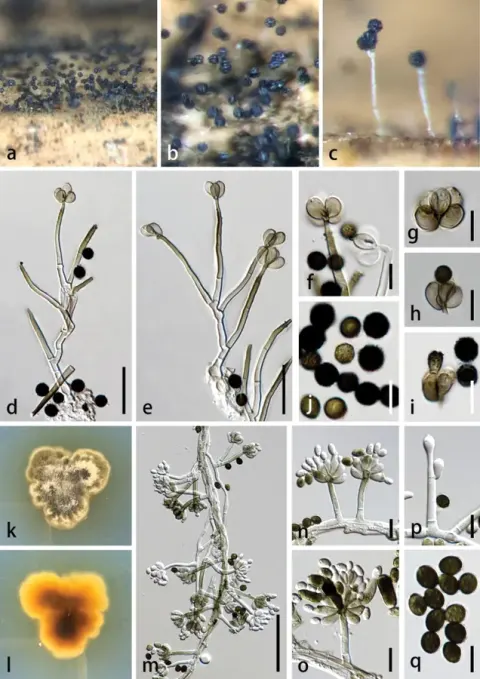
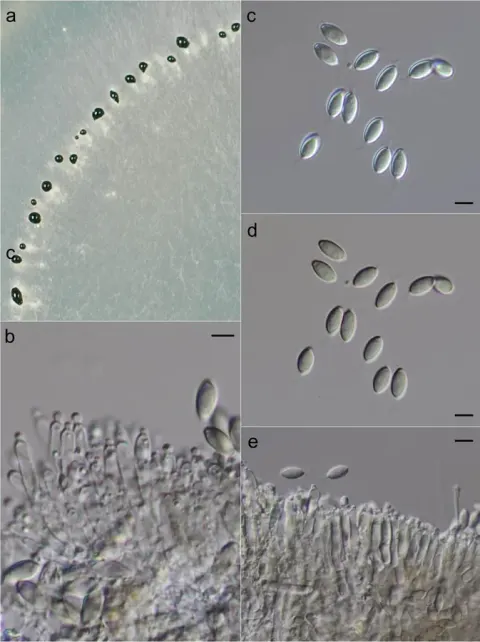
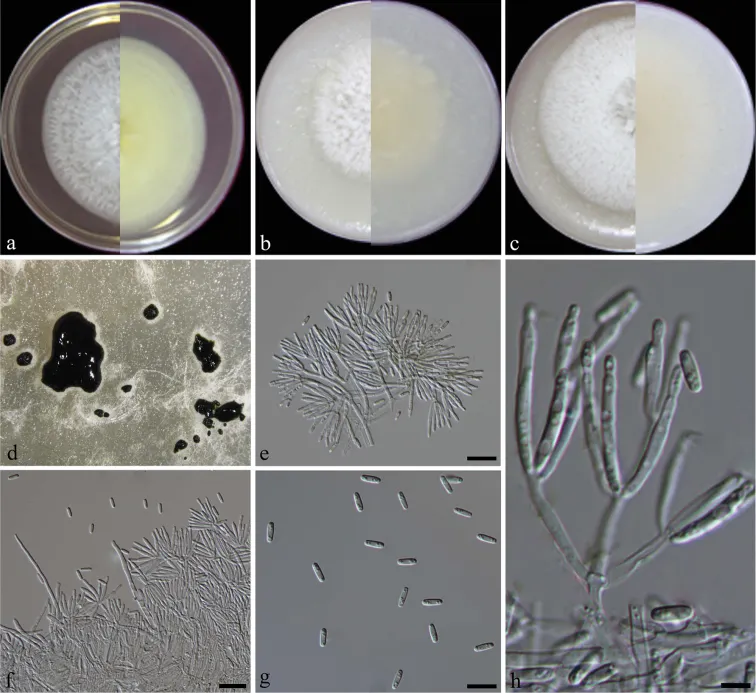
Colonies on PDA, CMA and OA approx. 5–6 cm diam. after 7 d at 25 °C. Hyphae white, hyaline, smooth, branched, 1–2 μm wide, reverse on PDA pale luteous. Conidiomata sporodochial, stromatic, cupulate, superficial, scattered or gregarious, oval or irregular in outline, 80–600 μm diam., 50–150 μm deep, with a white setose fringe surrounding an olivaceous green to black agglutinated slimy mass of conidia. Stroma poorly developed, hyaline, of textura angularis. Setae arising from stroma, thin-walled, hyaline, 1–3-septate, straight to flexuous, 45–90 μm long, 1–3 μm wide, tapering to an acutely rounded apex. Conidiophores arising from the basal stroma, consisting of a stipe and a penicillately branched conidiogenous apparatus; stipes unbranched, hyaline, septate, smooth, 20–30 × 2–3 μm; primary branches aseptate, unbranched, smooth, 13–40 × 2–3 μm; secondary branches aseptate, unbranched, smooth, 8–15 × 2–3 μm; terminating in a whorl of 3–6 conidiogenous cells; conidiogenous cell phialidic, cylindrical to subcylindrical, hyaline, smooth, straight to slightly curved, 7–16 × 1–3 μm, with conspicuous collarettes and periclinal thickenings. Conidia aseptate, hyaline, smooth, cylindrical, 6–7 × 2–3 μm (av. 7 ± 0.3 × 2 ± 0.2 μm, n = 40), rounded at both ends.
Habitat dan peran ekologis
Colonies on PDA, CMA and OA approx. 5–6 cm diam. after 7 d at 25 °C. Hyphae white, hyaline, smooth, branched, 1–2 μm wide, reverse on PDA pale luteous. Conidiomata sporodochial, stromatic, cupulate, superficial, scattered or gregarious, oval or irregular in outline, 80–600 μm diam., 50–150 μm deep, with a white setose fringe surrounding an olivaceous green to black agglutinated slimy mass of conidia. Stroma poorly developed, hyaline, of textura angularis. Setae arising from stroma, thin-walled, hyaline, 1–3-septate, straight to flexuous, 45–90 μm long, 1–3 μm wide, tapering to an acutely rounded apex. Conidiophores arising from the basal stroma, consisting of a stipe and a penicillately branched conidiogenous apparatus; stipes unbranched, hyaline, septate, smooth, 20–30 × 2–3 μm; primary branches aseptate, unbranched, smooth, 13–40 × 2–3 μm; secondary branches aseptate, unbranched, smooth, 8–15 × 2–3 μm; terminating in a whorl of 3–6 conidiogenous cells; conidiogenous cell phialidic, cylindrical to subcylindrical, hyaline, smooth, straight to slightly curved, 7–16 × 1–3 μm, with conspicuous collarettes and periclinal thickenings. Conidia aseptate, hyaline, smooth, cylindrical, 6–7 × 2–3 μm (av. 7 ± 0.3 × 2 ± 0.2 μm, n = 40), rounded at both ends.
- Habitat atau konteks temuan
- kultur yang didokumentasikan
- Substrat
- Informasi belum tersedia pada sumber rilis ini.
- Peran atau konteks
- Belum dikategorikan pada rilis ini.
Reproduksi
Colonies on PDA, CMA and OA approx. 5–6 cm diam. after 7 d at 25 °C. Hyphae white, hyaline, smooth, branched, 1–2 μm wide, reverse on PDA pale luteous. Conidiomata sporodochial, stromatic, cupulate, superficial, scattered or gregarious, oval or irregular in outline, 80–600 μm diam., 50–150 μm deep, with a white setose fringe surrounding an olivaceous green to black agglutinated slimy mass of conidia. Stroma poorly developed, hyaline, of textura angularis. Setae arising from stroma, thin-walled, hyaline, 1–3-septate, straight to flexuous, 45–90 μm long, 1–3 μm wide, tapering to an acutely rounded apex. Conidiophores arising from the basal stroma, consisting of a stipe and a penicillately branched conidiogenous apparatus; stipes unbranched, hyaline, septate, smooth, 20–30 × 2–3 μm; primary branches aseptate, unbranched, smooth, 13–40 × 2–3 μm; secondary branches aseptate, unbranched, smooth, 8–15 × 2–3 μm; terminating in a whorl of 3–6 conidiogenous cells; conidiogenous cell phialidic, cylindrical to subcylindrical, hyaline, smooth, straight to slightly curved, 7–16 × 1–3 μm, with conspicuous collarettes and periclinal thickenings.
Catatan identitas dan cakupan
- Nama diterima mengikuti Catalogue of Life Base2026-09-11; uraian mempertahankan konsep dan nama sumber aslinya.
- Preserve original treatment localities, hosts and substrate scope. Materials examined describe documented specimens, not the full global range.
- Impor dan terjemahan otomatis belum diperiksa editorial per profil. Struktur reproduktif yang disebutkan tidak membuktikan seluruh siklus hidup diketahui.
- Pengukuran pada uraian mengikuti spesimen, kultur, dan metode sumber; angka tidak diperluas ke semua populasi.
Catatan distribusi dalam narasi mengikuti sumbernya. Dokumentasi spesimen atau foto mengikuti catatan sumber. Bukti wilayah Indonesia dan penilaian konservasi tidak disimpulkan dari gambar.
Melihat dengan konteks
Paramyrothecium sinense (from ex-type CGMCC3.19212) a–c colony on PDA, CMA, OA d conidiomata on SNA e sporodochial conidioma f setae g conidia h conidiogenous cells. Scale bars: 20 μm (e, f); 10 μm (g); 5 μm (h).
- Jenis
- Pelat ilmiah
- Kredit
- Junmin Liang, Guangshuo Li, Shiyue Zhou, Meiqi Zhao, Lei Cai
- Lisensi
- CC BY 4.0
- Sumber media
- Buka entri sumber
Sumber profil
- [1] Myrothecium-like new species from turfgrasses and associated rhizosphere — Paramyrothecium sinense
- [2] Catalogue of Life Base2026-09-11 — Paramyrothecium sinense
- [3] Dokumentasi visual — Paramyrothecium sinense
Rujukan halaman ini
Fungi. Paramyrothecium sinense. Rilis data fungi-2026-10-12-expansion-2. https://fungi-atlas.mgadib.chatgpt.site/jamur/paramyrothecium-sinense/.
Status: impor sumber; pemeriksaan editorial per profil belum selesai. Untuk klaim biologis, gunakan rujukan pada bagian terkait dan periksa konteks sumber aslinya.