Ciri dan struktur
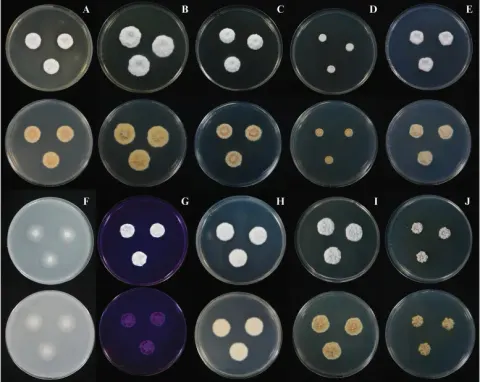
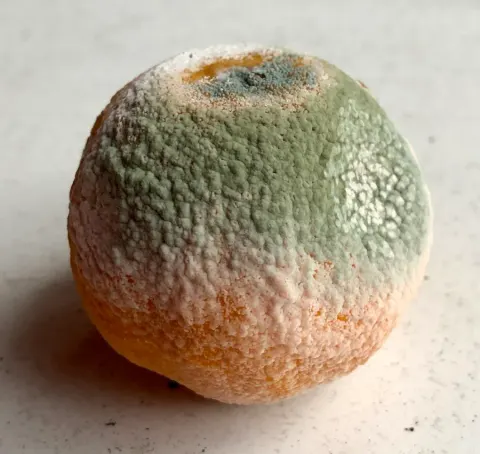
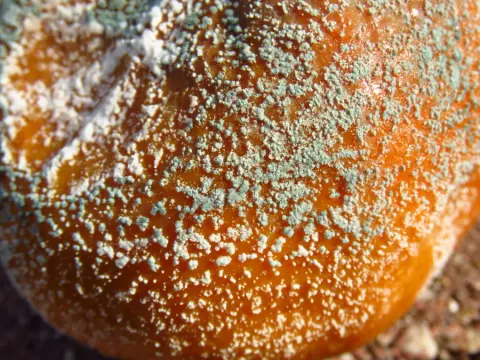
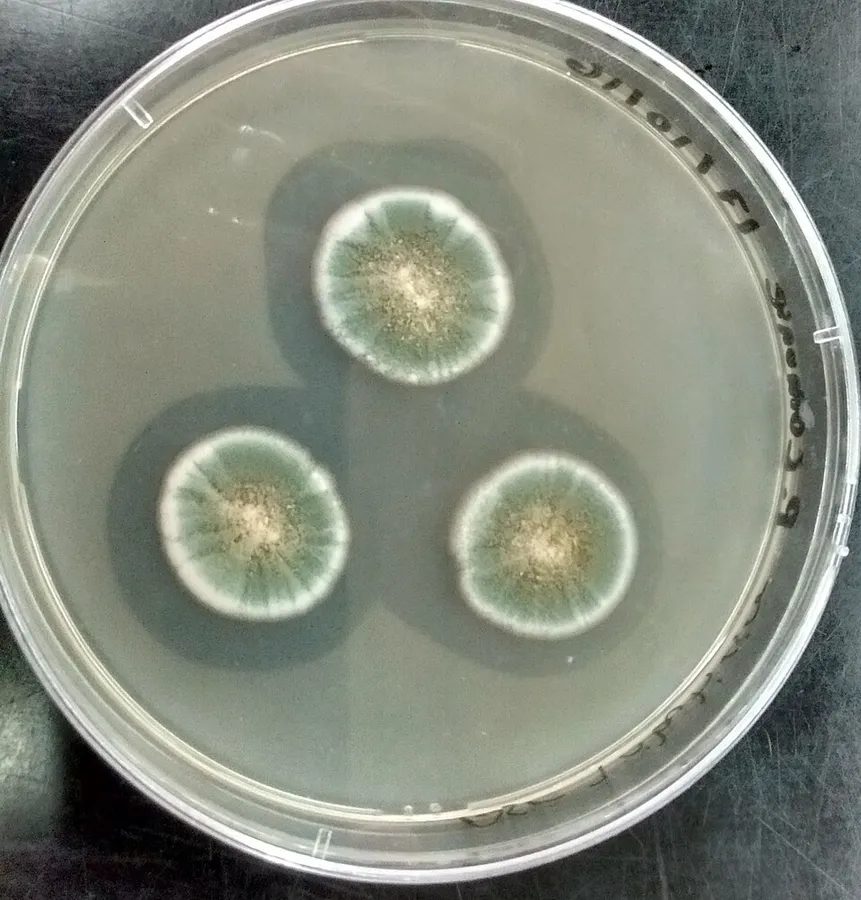
The asexually produced spores (i.e., conidia) of P. commune are smooth and spherical, ranging from 3.5 to 5.0 μm in diameter, borne in disordered chains on conidiophores with rough-walled stipes. The conidium-bearing stalks are either produced singularly or in bundled groups known as fascicles. The stalk lengths are usually 200 to 400 μm. Conidia are dull grey green or grey turquoise in colour. Penicillium commune can be distinguished by its fast growth on creatine sucrose neutral agar (CSN) while showing a slow growth rate on malt extract agar (MEA) and restricted growth on Czapek medium (CZA) and Czapek yeast extract agar (CYA). The appearance of colonies on MEA ranges from soft, velvety and grown in unison to granular and barely grown together. The underside of colonies produced on MEA are pale-yellow coloured and sun-yellow coloured. Colonies on CZA and CYA range from soft and velvety to slightly fluffy with exudate present that can be clear to brown coloured. In addition, the underside of the colonies grown on CZA and CYA are creamy/ dull yellow to brown-yellow in colour. The production of purple pigment has also been observed. No sexual stage has been described. However, genetic analysis indicate that none of the P. commune (in the "lumper" sense, sensu lato) genomes sequenced include loss-of-function mutations related to sexual reproduction. P. fuscoglaucum is likely sexual as there is a 1:1 balance between the MAT1-1 and MAT1-2 mating types and obvious recombination signatures. P. biforme shows a distortion in the ratio favoring MAT1-2 as well as signatures, consistent with early human clonal intervention in open-air environments where sexual reproduction occurs in a limited fashion.
Habitat dan peran ekologis
Penicillium commune is found indoors and most commonly, on food products. The main habitat for the fungus is cheese, including both hard and soft cheese. With cheese being produced in an environment that is characterized by refrigeration temperatures, low oxygen availability, lipid breakdown activity, preservation actions of free fatty acids and reduced water availability, the physiology of P. commune allows the fungus to still grow in these conditions. Therefore, as it is known as one of the most successful spoilage moulds of cheese, it is also the main reason for their spoilage. In addition, the fungus is frequently found as a mould growing on dry-cured meat products as well. This species has been isolated from other food products such as nuts, fats, margarine, fermented sausages, yogurt, sour cream, lactose powder, and high fat-filling cakes. It has been known to cause "phenol defect" in foods like ripening Italian ham, apples, pears and flours where the taste and smell of these products are off due to spoilage by the fungus. Aside from colonizing on food products, the fungus of P. commune has also been isolated from disposed used oil.
- Habitat atau konteks temuan
- Informasi belum tersedia pada sumber rilis ini.
- Substrat
- Informasi belum tersedia pada sumber rilis ini.
- Peran atau konteks
- Belum dikategorikan pada rilis ini.
Reproduksi
The asexually produced spores (i.e., conidia) of P. commune are smooth and spherical, ranging from 3.5 to 5.0 μm in diameter, borne in disordered chains on conidiophores with rough-walled stipes. The conidium-bearing stalks are either produced singularly or in bundled groups known as fascicles. The stalk lengths are usually 200 to 400 μm. Conidia are dull grey green or grey turquoise in colour. No sexual stage has been described. However, genetic analysis indicate that none of the P. commune (in the "lumper" sense, sensu lato) genomes sequenced include loss-of-function mutations related to sexual reproduction. P. fuscoglaucum is likely sexual as there is a 1:1 balance between the MAT1-1 and MAT1-2 mating types and obvious recombination signatures.
Catatan identitas dan cakupan
- Nama diterima mengikuti Catalogue of Life Base2026-09-11; uraian mempertahankan konsep dan nama sumber aslinya.
- Original geographic, specimen and life-cycle scope retained; source import awaits individual editorial review.
- Impor dan terjemahan otomatis belum diperiksa editorial per profil. Struktur reproduktif yang disebutkan tidak membuktikan seluruh siklus hidup diketahui.
- Pengukuran pada uraian mengikuti spesimen, kultur, dan metode sumber; angka tidak diperluas ke semua populasi.
Catatan distribusi dalam narasi mengikuti sumbernya. Dokumentasi spesimen atau foto mengikuti catatan sumber. Bukti wilayah Indonesia dan penilaian konservasi tidak disimpulkan dari gambar.
Melihat dengan konteks
Dokumentasi Penicillium commune dari Wikimedia Commons. Penicillium commune isolate M35 (from cheese) in tributyrin agar (9 d/25ºC) Identifikasi mengikuti record berkas sumber.
- Jenis
- Fotografi
- Kredit
- Teresa María López
- Lisensi
- CC BY 4.0
- Sumber media
- Buka entri sumber
Sumber profil
- [1] Penicillium commune — Wikipedia (en)
- [2] Catalogue of Life Base2026-09-11 — Penicillium commune
- [3] Dokumentasi visual — Penicillium commune
Rujukan halaman ini
Fungi. Penicillium commune. Rilis data fungi-2026-10-12-expansion-2. https://fungi-atlas.mgadib.chatgpt.site/jamur/penicillium-commune/.
Status: impor sumber; pemeriksaan editorial per profil belum selesai. Untuk klaim biologis, gunakan rujukan pada bagian terkait dan periksa konteks sumber aslinya.