01 / Morfologi

Ciri dan struktur

Phacopsis thallicola is a species of lichenicolous (lichen-dwelling) fungus in the family Parmeliaceae. It was first formally described as a new species in 1852 by Italian botanist Abramo Bartolommeo Massalongo, as Lecidea thallicola. The type specimen, collected from the province of Treviso in Italy, was growing on the foliose lichen Parmelia caperata (now known as Flavoparmelia caperata). Dagmar Triebel and Gerhard Walter Rambold transferred the taxon to the genus Phacopsis in 1988. The known generic hosts of Phacopsis thallicola are all in the Parmeliaceae: Parmotrema, Cetrelia, Flavopunctelia, and Hypotrachyna. Some historical synonyms of Phacopsis thallicola have resulted from proposed taxonomic transfers from its original genus Lecidea to the genera Scutula, Mycoblastus, and Nesolechia. Abrothallus curreyi, first reported by William Lauder Lindsay from New Zealand in 1866, is a synonym of Phacopsis thallicola. Characteristics of Phacopsis thallicola include its dark-brown hypothecium (the area of tissue in the apothecium immediately below the subhymenium), and the mostly sessile, marginate apothecia. Its ascospores are typically 8–11 by 5–6.5 μm. Its pycnidia are spherical and measure about 120 μm; they are immersed in the thallus of the host. Pycnospores have a bacilliform shape and dimensions of 7 by 1 μm. The fungus has been recorded from Italy, Java, New Zealand (as Abrothallus curreyi), and the United States.

Sebagian uraian ditampilkan dalam bahasa sumber; terjemahannya belum tersedia atau belum lolos pemeriksaan.

Rujukan: [1]

Pengukuran mengikuti objek, spesimen atau kultur, dan metode yang disebutkan sumber. Baca uraian asli untuk konteks lengkap.

02 / Kehidupan

Habitat dan peran ekologis

Phacopsis thallicola is a species of lichenicolous (lichen-dwelling) fungus in the family Parmeliaceae. It was first formally described as a new species in 1852 by Italian botanist Abramo Bartolommeo Massalongo, as Lecidea thallicola. The type specimen, collected from the province of Treviso in Italy, was growing on the foliose lichen Parmelia caperata (now known as Flavoparmelia caperata). Dagmar Triebel and Gerhard Walter Rambold transferred the taxon to the genus Phacopsis in 1988. The known generic hosts of Phacopsis thallicola are all in the Parmeliaceae: Parmotrema, Cetrelia, Flavopunctelia, and Hypotrachyna.

Sebagian uraian ditampilkan dalam bahasa sumber; terjemahannya belum tersedia atau belum lolos pemeriksaan.

Rujukan: [1]

Habitat atau konteks temuan
Informasi belum tersedia pada sumber rilis ini.
Substrat
Informasi belum tersedia pada sumber rilis ini.
Peran atau konteks
Pembentuk liken
Temukan hubungan serupa
03 / Siklus hidup

Reproduksi

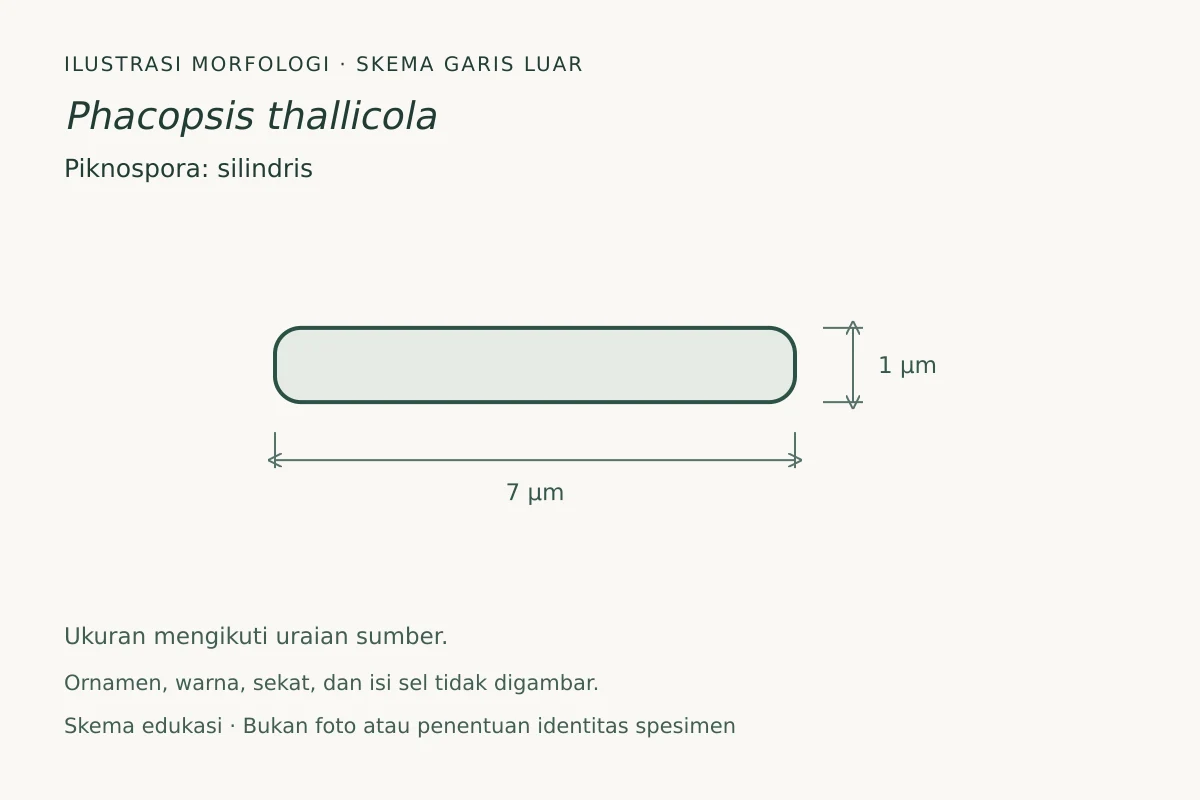
Characteristics of Phacopsis thallicola include its dark-brown hypothecium (the area of tissue in the apothecium immediately below the subhymenium), and the mostly sessile, marginate apothecia. Its ascospores are typically 8–11 by 5–6.5 μm. Its pycnidia are spherical and measure about 120 μm; they are immersed in the thallus of the host. Pycnospores have a bacilliform shape and dimensions of 7 by 1 μm. The fungus has been recorded from Italy, Java, New Zealand (as Abrothallus curreyi), and the United States.

Sebagian uraian ditampilkan dalam bahasa sumber; terjemahannya belum tersedia atau belum lolos pemeriksaan.

Rujukan: [1]

Sinonim menurut acuan taksonomi rilis: Lecidea thallicola; Mycoblastus thallicola; Nesolechia thallicola; Scutula massalongiana; Scutula thallicola
04 / Batas informasi

Catatan identitas dan cakupan

  • Nama diterima mengikuti Catalogue of Life Base2026-09-11; uraian mempertahankan konsep dan nama sumber aslinya.
  • Original geographic, specimen and life-cycle scope retained; source import awaits individual editorial review.
  • Impor dan terjemahan otomatis belum diperiksa editorial per profil. Struktur reproduktif yang disebutkan tidak membuktikan seluruh siklus hidup diketahui.
  • Pengukuran pada uraian mengikuti spesimen, kultur, dan metode sumber; angka tidak diperluas ke semua populasi.

Catatan distribusi dalam narasi mengikuti sumbernya. Dokumentasi spesimen atau foto mengikuti catatan sumber. Bukti wilayah Indonesia dan penilaian konservasi tidak disimpulkan dari gambar.

05 / Dokumentasi

Melihat dengan konteks

Ilustrasi skematis garis luar piknospora Phacopsis thallicola, berdasarkan uraian sumber; ukuran yang dilaporkan 7 × 1 µm. Proporsi disederhanakan, bukan salinan satu spesimen. Ornamen permukaan, warna, sekat, dan isi sel tidak direkonstruksi. Piknospora berbentuk batang, dengan satu pasangan ukuran yang dilaporkan 7 × 1 µm. Angka ini bukan rentang populasi. Ornamen, warna, sekat, dan isi sel tidak digambar. Skema edukasi, bukan alat identifikasi.

Jenis
Ilustrasi skematis
Kredit
Fungi, ilustrasi orisinal (2026); fakta morfologi berdasarkan Wikipedia contributors
Sumber media
Buka entri sumber

Gambar menunjukkan objek menurut identifikasi sumber, bukan verifikasi independen spesimen oleh Fungi. Tidak ada skala baru yang ditambahkan.

06 / Rujukan

Sumber profil

  1. [1] Phacopsis thallicola — Wikipedia (en)Bagian sumber: Frozen revision 1194758501
    Tanggal penghimpunan sumber: 2026-10-12
    Media sumber: CC BY-SA4.0 · Wikipedia contributors
  2. [2] Catalogue of Life Base2026-09-11 — Phacopsis thallicolaBagian sumber: ColDP NameUsage.tsv ID 4FKN8; accepted species; source 2073
    Tanggal penghimpunan sumber: 2026-10-12

Adaptasi teks: CC BY-SA 4.0. Wikipedia contributors — Phacopsis thallicola — Wikipedia (en)

Uraian asli dan riwayat sumber

Riwayat atau halaman sumber

Ringkasan sumber

Phacopsis thallicola is a species of lichenicolous (lichen-dwelling) fungus in the family Parmeliaceae. It was first formally described as a new species in 1852 by Italian botanist Abramo Bartolommeo Massalongo, as Lecidea thallicola. The type specimen, collected from the province of Treviso in Italy, was growing on the foliose lichen Parmelia caperata (now known as Flavoparmelia caperata). Dagmar Triebel and Gerhard Walter Rambold transferred the taxon to the genus Phacopsis in 1988. The known generic hosts of Phacopsis thallicola are all in the Parmeliaceae: Parmotrema, Cetrelia, Flavopunctelia, and Hypotrachyna.

Revisi sumber

Morfologi sumber

Phacopsis thallicola is a species of lichenicolous (lichen-dwelling) fungus in the family Parmeliaceae. It was first formally described as a new species in 1852 by Italian botanist Abramo Bartolommeo Massalongo, as Lecidea thallicola. The type specimen, collected from the province of Treviso in Italy, was growing on the foliose lichen Parmelia caperata (now known as Flavoparmelia caperata). Dagmar Triebel and Gerhard Walter Rambold transferred the taxon to the genus Phacopsis in 1988. The known generic hosts of Phacopsis thallicola are all in the Parmeliaceae: Parmotrema, Cetrelia, Flavopunctelia, and Hypotrachyna. Some historical synonyms of Phacopsis thallicola have resulted from proposed taxonomic transfers from its original genus Lecidea to the genera Scutula, Mycoblastus, and Nesolechia. Abrothallus curreyi, first reported by William Lauder Lindsay from New Zealand in 1866, is a synonym of Phacopsis thallicola. Characteristics of Phacopsis thallicola include its dark-brown hypothecium (the area of tissue in the apothecium immediately below the subhymenium), and the mostly sessile, marginate apothecia. Its ascospores are typically 8–11 by 5–6.5 μm. Its pycnidia are spherical and measure about 120 μm; they are immersed in the thallus of the host. Pycnospores have a bacilliform shape and dimensions of 7 by 1 μm. The fungus has been recorded from Italy, Java, New Zealand (as Abrothallus curreyi), and the United States.

Revisi sumber

Ekologi sumber

Phacopsis thallicola is a species of lichenicolous (lichen-dwelling) fungus in the family Parmeliaceae. It was first formally described as a new species in 1852 by Italian botanist Abramo Bartolommeo Massalongo, as Lecidea thallicola. The type specimen, collected from the province of Treviso in Italy, was growing on the foliose lichen Parmelia caperata (now known as Flavoparmelia caperata). Dagmar Triebel and Gerhard Walter Rambold transferred the taxon to the genus Phacopsis in 1988. The known generic hosts of Phacopsis thallicola are all in the Parmeliaceae: Parmotrema, Cetrelia, Flavopunctelia, and Hypotrachyna.

Revisi sumber

Struktur reproduksi sumber

Characteristics of Phacopsis thallicola include its dark-brown hypothecium (the area of tissue in the apothecium immediately below the subhymenium), and the mostly sessile, marginate apothecia. Its ascospores are typically 8–11 by 5–6.5 μm. Its pycnidia are spherical and measure about 120 μm; they are immersed in the thallus of the host. Pycnospores have a bacilliform shape and dimensions of 7 by 1 μm. The fungus has been recorded from Italy, Java, New Zealand (as Abrothallus curreyi), and the United States.

Revisi sumber

Rujukan halaman ini

Fungi. Phacopsis thallicola. Rilis data fungi-2026-10-12-expansion-2. https://fungi-atlas.mgadib.chatgpt.site/jamur/phacopsis-thallicola/.

Status: impor sumber; pemeriksaan editorial per profil belum selesai. Untuk klaim biologis, gunakan rujukan pada bagian terkait dan periksa konteks sumber aslinya.