Ciri dan struktur
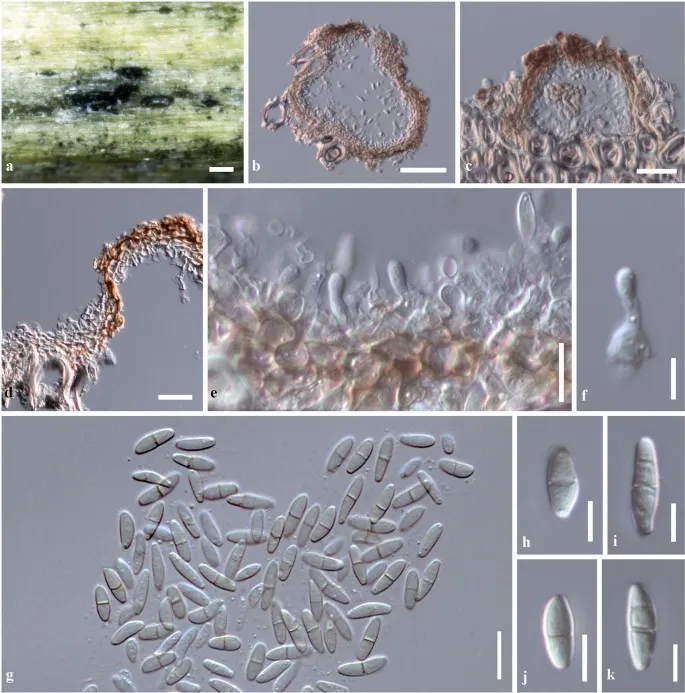
Associated with leaf spots on Cycas sp. (Cycadaceae). Sexual morph Undetermined. Asexual morph Coelomycetous. Conidiomata (60–)100–160 μm high, (60–)135–200 μm diam., pycnidial, visible as black dot on host surface, scattered to clustered, solitary to gregarious, semi-immersed to erumpent, uni-loculate, subglobose to ampulliform, or irregular in shape, ostiolate, with minute papilla. Conidiomata walls 10–20(–30) μm wide, composed of 4–5 cell layers, of brown to dark brown pseudoparenchymatous cells, of textura angularis. Conidiophores reduced to conidiogenous cells. Conidiogenous cells (3.5–)4.5–8 × 4–8(–10) μm (\(\bar{x} \) = 6.4 × 5.7 μm, n = 30), ampulliform to broadly conical, gradually tapering toward the apex, holoblastic, phialidic, hyaline, smooth-walled, with periclinal wall thickening, arising from the inner cavity of the conidioma wall. Conidia (10–)12–14(– 16) × 3–5 μm (\(\bar{x} \) = 12.9 × 3.9 μm, n = 50), pale brown to light yellowish, oblong to ellipsoidal, or subcylindrical, (0–)1–2-septate, truncate to obtuse base, with obtuse apex, not constricted at the septa, smooth-walled. Culture characteristics: Colonies on PDA reaching 50–52 mm diam. after 3 weeks at room temperature (20–30 °C). Colony dense, irregular in shape, flattened, surface slightly smooth, edge undulate, with entire margin, cottony to floccose, slightly sparse near the margin; from above, white to cream, slightly radiated outwards colony; from below, slightly radiating, cream at the margin, pale brown to yellowish-brown at the centre, sectering with golden brown; not producing pigmentation on agar medium.
Habitat dan peran ekologis
Culture characteristics: Colonies on PDA reaching 50–52 mm diam. after 3 weeks at room temperature (20–30 °C). Colony dense, irregular in shape, flattened, surface slightly smooth, edge undulate, with entire margin, cottony to floccose, slightly sparse near the margin; from above, white to cream, slightly radiated outwards colony; from below, slightly radiating, cream at the margin, pale brown to yellowish-brown at the centre, sectering with golden brown; not producing pigmentation on agar medium. Notes: In the NCBI BLASTn search of ITS sequences, Phaeosphaeria cycadis most closely matches P. acaciae Tennakoon et al. with 99% similarity. Multigene phylogenetic analyses based on a combined LSU, SSU, TEF1-α and ITS sequence dataset show that P. cycadis forms a sister lineage with P. acaciae with high support (100% ML and 1.00 BYPP; Fig. 29). The ITS gene could not clarify the novelty of P. cycadis in this study as the species is not significantly different from P. acaciae in a comparison of ITS sequences (5/452 bp). Phookamsak et al. (2014b) mentioned that Phaeosphaeria contains species complexes that cannot be resolved based only on the ITS gene and that a combination of protein coding genes, such as TEF1-α and RPB2, is necessary to clarify species in this genus.
- Habitat atau konteks temuan
- kultur yang didokumentasikan
- Substrat
- Informasi belum tersedia pada sumber rilis ini.
- Peran atau konteks
- Belum dikategorikan pada rilis ini.
Reproduksi
Associated with leaf spots on Cycas sp. (Cycadaceae). Sexual morph Undetermined. Asexual morph Coelomycetous. Conidiomata (60–)100–160 μm high, (60–)135–200 μm diam., pycnidial, visible as black dot on host surface, scattered to clustered, solitary to gregarious, semi-immersed to erumpent, uni-loculate, subglobose to ampulliform, or irregular in shape, ostiolate, with minute papilla. Conidiomata walls 10–20(–30) μm wide, composed of 4–5 cell layers, of brown to dark brown pseudoparenchymatous cells, of textura angularis. Conidiophores reduced to conidiogenous cells. Conidiogenous cells (3.5–)4.5–8 × 4–8(–10) μm (\(\bar{x} \) = 6.4 × 5.7 μm, n = 30), ampulliform to broadly conical, gradually tapering toward the apex, holoblastic, phialidic, hyaline, smooth-walled, with periclinal wall thickening, arising from the inner cavity of the conidioma wall.
Catatan identitas dan cakupan
- Nama diterima mengikuti Catalogue of Life Base2026-09-11; uraian mempertahankan konsep dan nama sumber aslinya.
- Preserve original monograph treatment localities, hosts and specimen/substrate scope. Materials examined document specimens, not the full global range.
- Impor dan terjemahan otomatis belum diperiksa editorial per profil. Struktur reproduktif yang disebutkan tidak membuktikan seluruh siklus hidup diketahui.
- Pengukuran pada uraian mengikuti spesimen, kultur, dan metode sumber; angka tidak diperluas ke semua populasi.
Catatan distribusi dalam narasi mengikuti sumbernya. Dokumentasi spesimen atau foto mengikuti catatan sumber. Bukti wilayah Indonesia dan penilaian konservasi tidak disimpulkan dari gambar.
Melihat dengan konteks
Phaeosphaeria cycadis (KUN-HKAS 102235, holotype). a Appearance of conidiomata on host. b, c Section through conidiomata. d Section through conidioma wall. e, f Conidiogenous cells. g–k Conidia. Scale bars a = 100 μm, b = 50 μm, c, d = 20 μm, e, g = 10 μm, f, h–k = 5 μm
- Jenis
- Pelat ilmiah
- Kredit
- Penulis dan sumber artikel: Phookamsak, Rungtiwa; Hyde, Kevin D.; Jeewon, Rajesh; Bhat, D. Jayarama; Jones, E. B. Gareth; Maharachchikumbura, Sajeewa S. N.; Raspé, Olivier; Karunarathna, Samantha C.; Wanasinghe, Dhanushka N.; Hongsanan, Sinang; Doilom, Mingkwan; Tennakoon, Danushka S.; Machado, Alexandre R.; Firmino, André L.; Ghosh, Aniket; Karunarathna, Anuruddha; Mešić, Armin; Dutta, Arun Kumar; Thongbai, Benjarong; Devadatha, Bandarupalli; Norphanphoun, Chada; Senwanna, Chanokned; Wei, Deping; Pem, Dhandevi; Ackah, Frank Kwekucher; Wang, Gen-Nuo; Jiang, Hong-Bo; Madrid, Hugo; Lee, Hyang Burm; Goonasekara, Ishani D.; Manawasinghe, Ishara S.; Kušan, Ivana; Cano, Josep; Gené, Josepa; Li, Junfu; Das, Kanad; Acharya, Krishnendu; Raj, K. N. Anil; Latha, K. P. Deepna; Chethana, K. W. Thilini; He, Mao-Qiang; Dueñas, Margarita; Jadan, Margita; Martín, María P.; Samarakoon, Milan C.; Dayarathne, Monika C.; Raza, Mubashar; Park, Myung Soo; Telleria, M. Teresa; Chaiwan, Napalai; Matočec, Neven; de Silva, Nimali I.; Pereira, Olinto L.; Singh, Paras Nath; Manimohan, Patinjareveettil; Uniyal, Priyanka; Shang, Qiu-Ju; Bhatt, Rajendra P.; Perera, Rekhani H.; Alvarenga, Renato Lúcio Mendes; Nogal-Prata, Sandra; Singh, Sanjay K.; Vadthanarat, Santhiti; Oh, Seung-Yoon; Huang, Shi-Ke; Rana, Shiwali; Konta, Sirinapa; Paloi, Soumitra; Jayasiri, Subashini C.; Jeon, Sun Jeong; Mehmood, Tahir; Gibertoni, Tatiana Baptista; Nguyen, Thuong T. T.; Singh, Upendra; Thiyagaraja, Vinodhini; Sarma, V. Venkateswara; Dong, Wei; Yu, Xian-Dong; Lu, Yong-Zhong; Lim, Young Woon; Chen, Yun; Tkalčec, Zdenko; Zhang, Zhi-Feng; Luo, Zong-Long; Daranagama, Dinushani A.; Thambugala, Kasun M.; Tibpromma, Saowaluck; Camporesi, Erio; Bulgakov, Timur S.; Dissanayake, Asha J.; Senanayake, Indunil C.; Dai, Dong Qin; Tang, Li-Zhou; Khan, Sehroon; Zhang, Huang; Promputtha, Itthayakorn; Cai, Lei; Chomnunti, Putarak; Zhao, Rui-Lin; Lumyong, Saisamorn; Boonmee, Saranyaphat; Wen, Ting-Chi; Mortimer, Peter E.; Xu, Jianchu
- Lisensi
- CC BY 4.0
- Sumber media
- Buka entri sumber
Sumber profil
- [1] Fungal diversity notes 929–1035: taxonomic and phylogenetic contributions on genera and species of fungi — Phaeosphaeria cycadis
- [2] Catalogue of Life Base2026-09-11 — Phaeosphaeria cycadis
- [3] Dokumentasi visual — Phaeosphaeria cycadis
Rujukan halaman ini
Fungi. Phaeosphaeria cycadis. Rilis data fungi-2026-10-12-expansion-2. https://fungi-atlas.mgadib.chatgpt.site/jamur/phaeosphaeria-cycadis/.
Status: impor sumber; pemeriksaan editorial per profil belum selesai. Untuk klaim biologis, gunakan rujukan pada bagian terkait dan periksa konteks sumber aslinya.