01 / Morfologi

Ciri dan struktur

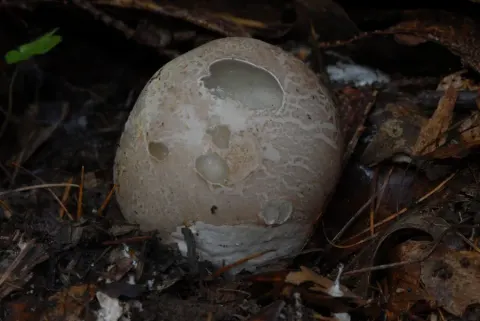
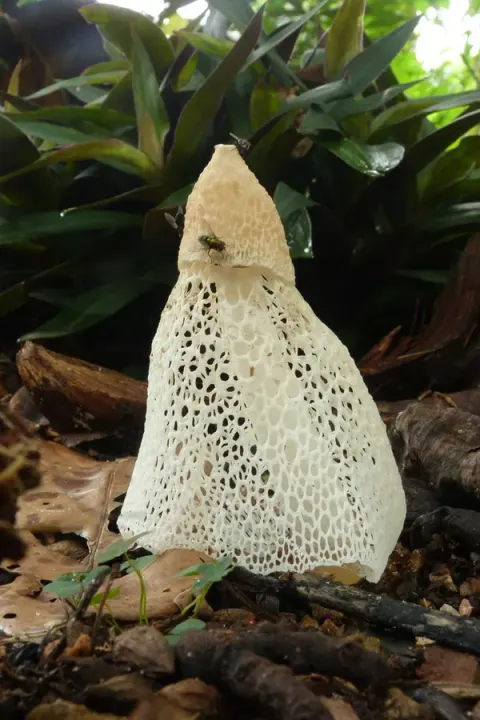
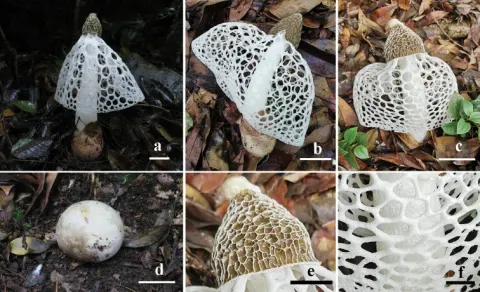
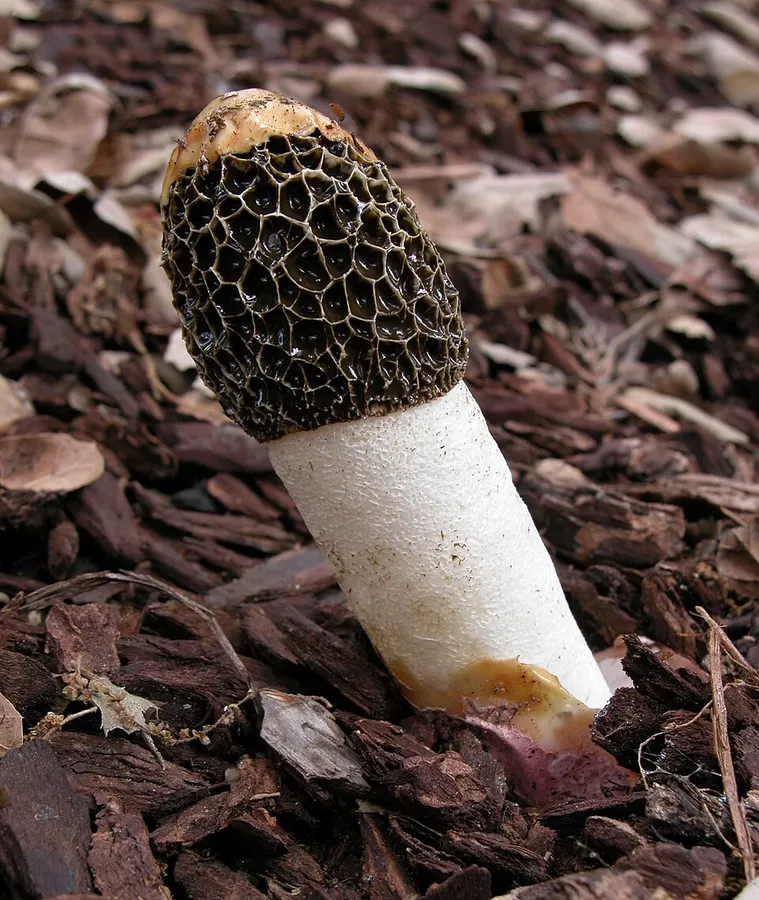
The immature fruiting bodies of P. hadriani in the egg stage have dimensions of 4 to 6 cm by 3 to 4 cm, and are colored rosy-pink to violet. with rhizomorphs (aggregations of mycelium resembling plant roots) at the base. The eggs are enclosed in a tough covering and a gelatinous layer that breaks down as the stinkhorn emerges. Mature fruiting bodies may be 10 to 20 cm tall by 3 to 4 cm thick. The white- or cream-colored stipe is up to 3 cm wide, hollow, spongy and honeycombed. The head is reticulate, ridged and pitted, and covered with olive green glebal mass. The volva is cuplike, and typically retains its pink color although it may turn brownish with age. Fruit bodies are short-lived, typically lasting only one or two days. Although the odor of P. hadriani has been described by some authors as faint and pleasant or like violets, others describe the smell as fetid or putrid. The gleba is known to attract insects, including flies, bees, and beetles, some of which consume the spore-containing slime. It is thought that long-distance spore dispersal is facilitated by these insects, who may deposit in their feces intact spores that survive the passage through the digestive tract. The spores are cylindrical, smooth, and hyaline (translucent), with dimensions of 3–4 by 1–2 μm. The basidia (spore-bearing cells) are cylindrical, with dimensions of 20–25 by 3–4 μm. They have eight sterigmata (slender extensions that attach to the spores), as well as a clamp at their base.

Sebagian uraian ditampilkan dalam bahasa sumber; terjemahannya belum tersedia atau belum lolos pemeriksaan.

Rujukan: [1]

Pengukuran mengikuti objek, spesimen atau kultur, dan metode yang disebutkan sumber. Baca uraian asli untuk konteks lengkap.

02 / Kehidupan

Habitat dan peran ekologis

Phallus hadriani diketahui berada di Australia (di mana diyakini spesies yang diimpor dari kayu lapis yang digunakan dalam berkebun dan berkebun), Amerika Utara, Eropa (termasuk Denmark, Irlandia, Latvia, Belanda, Norwegia, Polandia, Slowakia, Swedia, Ukraina, dan Wales), Turki (Provinsi Iğdır), Jepang, dan China (Provinsi Jilin). Phallus hadriani adalah spesies saprobik, dan dengan demikian mendapatkan nutrisi dengan membusuk materi organik. Di Amerika Utara, biasanya dikaitkan dengan batang pohon, atau akar batang yang membusuk di tanah. Di Inggris, distribusiannya lebih kurang terbatas pada pasir pantai, sementara di Polandia, telah dicatat untuk menghindari tanah hutan lembap dan humik, dan hidup dalam simbiosis dengan rumput xerophilous dan pohon loak hitam, Robinia pseudoacacia. Jamur adalah salah satu dari tiga spesies yang dilindungi oleh Red Data Book of Latvia.

Rujukan: [1]

Habitat atau konteks temuan
hutan
Substrat
Informasi belum tersedia pada sumber rilis ini.
Peran atau konteks
Pengurai
Temukan hubungan serupa
03 / Siklus hidup

Reproduksi

Although the odor of P. hadriani has been described by some authors as faint and pleasant or like violets, others describe the smell as fetid or putrid. The gleba is known to attract insects, including flies, bees, and beetles, some of which consume the spore-containing slime. It is thought that long-distance spore dispersal is facilitated by these insects, who may deposit in their feces intact spores that survive the passage through the digestive tract. The spores are cylindrical, smooth, and hyaline (translucent), with dimensions of 3–4 by 1–2 μm. The basidia (spore-bearing cells) are cylindrical, with dimensions of 20–25 by 3–4 μm. They have eight sterigmata (slender extensions that attach to the spores), as well as a clamp at their base.

Sebagian uraian ditampilkan dalam bahasa sumber; terjemahannya belum tersedia atau belum lolos pemeriksaan.

Rujukan: [1]

Sinonim menurut acuan taksonomi rilis: Hymenophallus hadriani; Ithyphallus imperialis; Ithyphallus impudicus var. imperialis; Ithyphallus impudicus var. iosmos; Phallus caninus var. hadriani; Phallus hadriani f. minor; Phallus imperialis; Phallus impudicus var. iosmus; Phallus iosmos
04 / Batas informasi

Catatan identitas dan cakupan

  • Nama diterima mengikuti Catalogue of Life Base2026-09-11; uraian mempertahankan konsep dan nama sumber aslinya.
  • Original geographic, specimen and life-cycle scope retained; source import awaits individual editorial review.
  • Impor dan terjemahan otomatis belum diperiksa editorial per profil. Struktur reproduktif yang disebutkan tidak membuktikan seluruh siklus hidup diketahui.
  • Pengukuran pada uraian mengikuti spesimen, kultur, dan metode sumber; angka tidak diperluas ke semua populasi.

Catatan distribusi dalam narasi mengikuti sumbernya. Dokumentasi spesimen atau foto mengikuti catatan sumber. Bukti wilayah Indonesia dan penilaian konservasi tidak disimpulkan dari gambar.

05 / Dokumentasi

Melihat dengan konteks

Dokumentasi Phallus hadriani dari Wikimedia Commons. The stinkhorn fungus Phallus hadriani vent in Descanso Gardens , La Crescenta , Los Angeles County , California , United States . Identifikasi mengikuti record berkas sumber.

Jenis
Fotografi
Kredit
Nathan Wilson — Nathan Wilson
Sumber media
Buka entri sumber

Gambar menunjukkan objek menurut identifikasi sumber, bukan verifikasi independen spesimen oleh Fungi. Tidak ada skala baru yang ditambahkan.

06 / Rujukan

Sumber profil

  1. [1] Phallus hadriani — Wikipedia (en)Bagian sumber: Frozen revision 1379608149
    Tanggal penghimpunan sumber: 2026-10-12
    Teks sumber: CC BY-SA4.0 · Wikipedia contributors
  2. [2] Catalogue of Life Base2026-09-11 — Phallus hadrianiBagian sumber: ColDP NameUsage.tsv ID 777KN; accepted species; source 2073
    Tanggal penghimpunan sumber: 2026-10-12
  3. [3] Dokumentasi visual — Phallus hadrianiBagian sumber: Individual media record; identification follows the source, not independent determination
    Tanggal penghimpunan sumber: 2026-10-12
    Media sumber: CC BY-SA 3.0 · Nathan Wilson — Nathan Wilson

Adaptasi teks: CC BY-SA 4.0. Wikipedia contributors — Phallus hadriani — Wikipedia (en)

Uraian asli dan riwayat sumber

Riwayat atau halaman sumber

Ringkasan sumber

{{Speciesbox It is a widely distributed species, and is native to Eurasia and North America. In Australia, it is probably an introduced species. It typically grows in public lawns, yards and gardens, usually in sandy soils. It is said to be edible in its immature egg-like stage.

Revisi sumber

Morfologi sumber

The immature fruiting bodies of P. hadriani in the egg stage have dimensions of 4 to 6 cm by 3 to 4 cm, and are colored rosy-pink to violet. with rhizomorphs (aggregations of mycelium resembling plant roots) at the base. The eggs are enclosed in a tough covering and a gelatinous layer that breaks down as the stinkhorn emerges. Mature fruiting bodies may be 10 to 20 cm tall by 3 to 4 cm thick. The white- or cream-colored stipe is up to 3 cm wide, hollow, spongy and honeycombed. The head is reticulate, ridged and pitted, and covered with olive green glebal mass. The volva is cuplike, and typically retains its pink color although it may turn brownish with age. Fruit bodies are short-lived, typically lasting only one or two days. Although the odor of P. hadriani has been described by some authors as faint and pleasant or like violets, others describe the smell as fetid or putrid. The gleba is known to attract insects, including flies, bees, and beetles, some of which consume the spore-containing slime. It is thought that long-distance spore dispersal is facilitated by these insects, who may deposit in their feces intact spores that survive the passage through the digestive tract. The spores are cylindrical, smooth, and hyaline (translucent), with dimensions of 3–4 by 1–2 μm. The basidia (spore-bearing cells) are cylindrical, with dimensions of 20–25 by 3–4 μm. They have eight sterigmata (slender extensions that attach to the spores), as well as a clamp at their base.

Revisi sumber

Ekologi sumber

Phallus hadriani is known to be in Australia (where it is thought to be an introduced species imported on woodchip mulch used in gardening and landscaping), North America, Europe (including Denmark, Ireland, Latvia, The Netherlands, Norway, Poland, Slovakia, Sweden, Ukraine, and Wales) Turkey (Iğdır Province), Japan, and China (Jilin Province). Phallus hadriani is a saprobic species, and thus obtains nutrients by decomposing organic matter. In North America, it is commonly associated with tree stumps, or roots of stumps that are decomposing in the ground. In Great Britain, its distribution is more or less restricted to coastal dunes, while in Poland, it has been noted to avoid humid and humic forest soils, and live in symbiosis with xerophilous grasses and the black locust tree, Robinia pseudoacacia. The mushroom is one of three species protected by the Red Data Book of Latvia.

Revisi sumber

Struktur reproduksi sumber

Although the odor of P. hadriani has been described by some authors as faint and pleasant or like violets, others describe the smell as fetid or putrid. The gleba is known to attract insects, including flies, bees, and beetles, some of which consume the spore-containing slime. It is thought that long-distance spore dispersal is facilitated by these insects, who may deposit in their feces intact spores that survive the passage through the digestive tract. The spores are cylindrical, smooth, and hyaline (translucent), with dimensions of 3–4 by 1–2 μm. The basidia (spore-bearing cells) are cylindrical, with dimensions of 20–25 by 3–4 μm. They have eight sterigmata (slender extensions that attach to the spores), as well as a clamp at their base.

Revisi sumber

Rujukan halaman ini

Fungi. Phallus hadriani. Rilis data fungi-2026-10-12-expansion-2. https://fungi-atlas.mgadib.chatgpt.site/jamur/phallus-hadriani/.

Status: impor sumber; pemeriksaan editorial per profil belum selesai. Untuk klaim biologis, gunakan rujukan pada bagian terkait dan periksa konteks sumber aslinya.