Ciri dan struktur
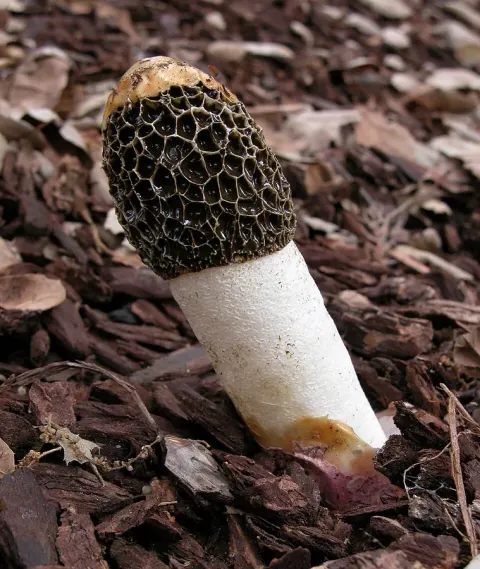
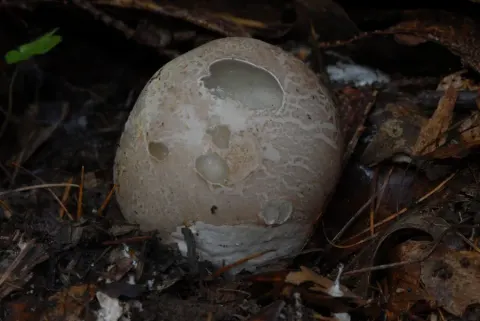
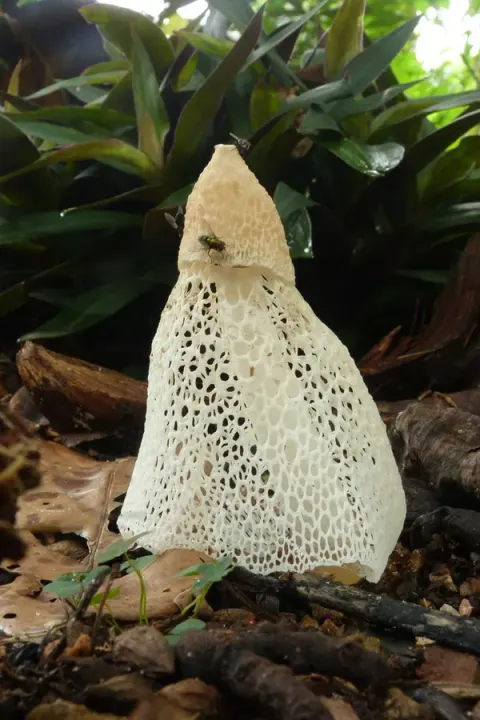
Immature (unopened) specimens of Satyrus rubicundus are spherical to egg-shaped, whitish, and measure 2 – 3 cm long by 1 – 3 cm wide. They occur singly or in groups of two to six eggs that are formed from a common mycelium. They are attached to the substrate by a cordlike rhizomorph. After expanding, the fruit bodies are up to 15 cm tall, and consist of a hollow cylindrical stalk supporting a conical to bell-shaped cap. The orange to scarlet stalk tapers towards to top, and has a pitted surface. The wrinkled cap is scarlet red, and measures 2 – 3 cm high by 1 – 2 cm wide. It is initially covered with a foetid, slimy grayish-olive gleba. The egg case remains at the base of the stalk as a volva. The spores are smooth, elliptical, and measure 3.6–4.2 by 1.6–2.0 μm. Phallus rubicundus is often confused with the similar Mutinus elegans, but the latter species does not have a clearly separated cap and instead bears its gleba on the apex of its pointed stalk. It is also easily confused with Satyrus rugulosus.
Habitat dan peran ekologis
Jamur ini adalah saprobik, dan tumbuh di tanah berpasir, rumput, taman, dan halaman, terutama yang baik dibumbui atau menggunakan kayu mulch. Hal ini tersebar luas di selatan dan timur Amerika Serikat (termasuk Hawaii), mungkin telah menyebar melalui penggunaan mulch kayu impor dalam lansekap. Di Australia it tumbuh terutama di daerah tropis dan subtropis, di daerah yang memiliki kayu dan/atau mulch yang busuk. Di Asia, telah tercatat dari Cina, Jepang, Korea, India, dan Thailand. African locales termasuk Ghana, Nigeria, Kongo, Kenya, dan Afrika Selatan. Hal ini juga dikenal dari Amerika Selatan (Argentina and Brasil) dan Karibia. Jamur itu ditampilkan pada cap Sierra Leonean postage di 1993.
- Habitat atau konteks temuan
- Informasi belum tersedia pada sumber rilis ini.
- Substrat
- Informasi belum tersedia pada sumber rilis ini.
- Peran atau konteks
- Pengurai
Reproduksi
Immature (unopened) specimens of Satyrus rubicundus are spherical to egg-shaped, whitish, and measure 2 – 3 cm long by 1 – 3 cm wide. They occur singly or in groups of two to six eggs that are formed from a common mycelium. They are attached to the substrate by a cordlike rhizomorph. After expanding, the fruit bodies are up to 15 cm tall, and consist of a hollow cylindrical stalk supporting a conical to bell-shaped cap. The orange to scarlet stalk tapers towards to top, and has a pitted surface. The wrinkled cap is scarlet red, and measures 2 – 3 cm high by 1 – 2 cm wide. It is initially covered with a foetid, slimy grayish-olive gleba. The egg case remains at the base of the stalk as a volva.
Catatan identitas dan cakupan
- Nama diterima mengikuti Catalogue of Life Base2026-09-11; uraian mempertahankan konsep dan nama sumber aslinya.
- Original geographic, specimen and life-cycle scope retained; source import awaits individual editorial review.
- Impor dan terjemahan otomatis belum diperiksa editorial per profil. Struktur reproduktif yang disebutkan tidak membuktikan seluruh siklus hidup diketahui.
- Pengukuran pada uraian mengikuti spesimen, kultur, dan metode sumber; angka tidak diperluas ke semua populasi.
Catatan distribusi dalam narasi mengikuti sumbernya. Dokumentasi spesimen atau foto mengikuti catatan sumber. Bukti wilayah Indonesia dan penilaian konservasi tidak disimpulkan dari gambar.
Melihat dengan konteks
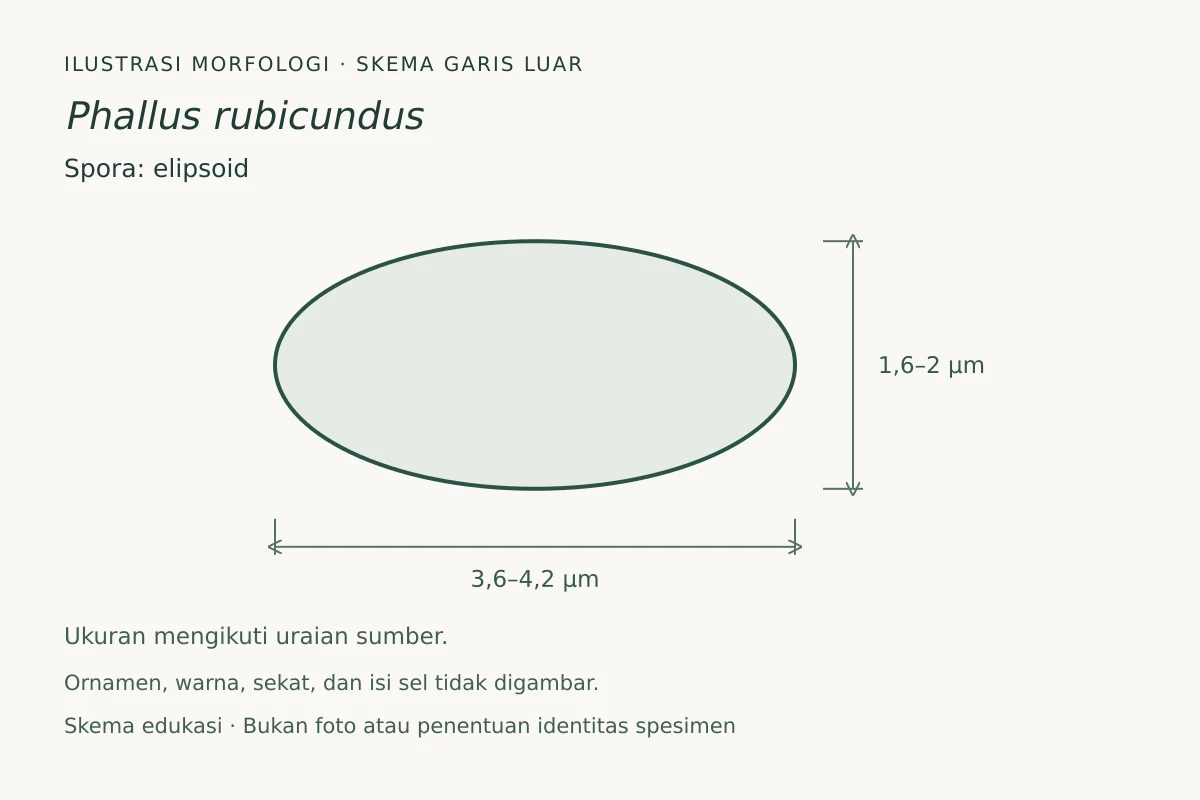
Ilustrasi skematis garis luar spora Phallus rubicundus, berdasarkan uraian sumber; ukuran yang dilaporkan 3,6–4,2 × 1,6–2 µm. Proporsi disederhanakan, bukan salinan satu spesimen. Ornamen permukaan, warna, sekat, dan isi sel tidak direkonstruksi. Spora elipsoid, 3,6–4,2 × 1,6–2,0 µm. Kelas spora tidak disimpulkan dari nama genus. Ornamen, warna, sekat, dan isi sel tidak digambar. Skema edukasi, bukan alat identifikasi.
- Jenis
- Ilustrasi skematis
- Kredit
- Fungi, ilustrasi orisinal (2026); fakta morfologi berdasarkan Wikipedia contributors
- Lisensi
- CC BY-SA 4.0
- Sumber media
- Buka entri sumber
Sumber profil
Rujukan halaman ini
Fungi. Phallus rubicundus. Rilis data fungi-2026-10-12-expansion-2. https://fungi-atlas.mgadib.chatgpt.site/jamur/phallus-rubicundus/.
Status: impor sumber; pemeriksaan editorial per profil belum selesai. Untuk klaim biologis, gunakan rujukan pada bagian terkait dan periksa konteks sumber aslinya.