01 / Morfologi

Ciri dan struktur

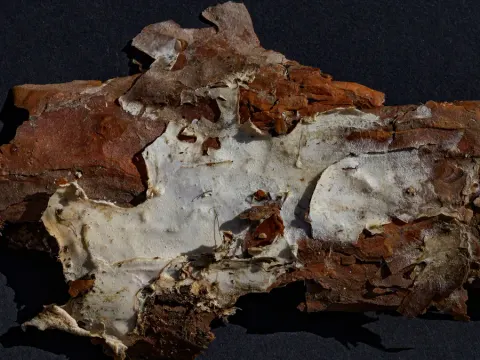
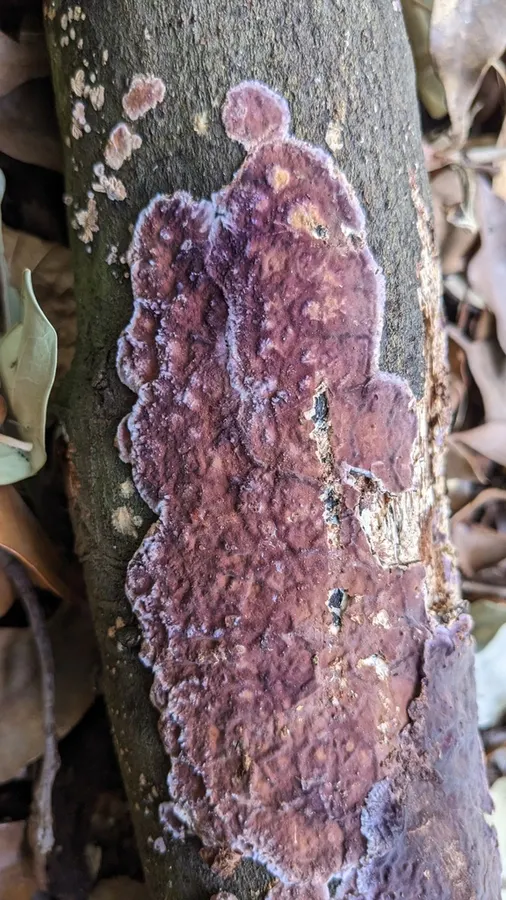
Hymenophore pileate, annual, membranous, effused-reflexed, often resupinate, at first developing as small orbicular colonies merging to form linear areas which may extent to 40 x 4 cm. Pilei laterally extended and narrowly applanate, sometimes imbricate; surface grey or fawn, abhymenial hairs radiately arranged and sometimes concentrically zoned, often imbricated; hymenial surface ranging in colour from cream through buff or ochre to dark umber, often violaceous, heliotrope, or tinted purple, at first even or finely tuberculate, becoming deeply areolately creviced, tending to lift at margins of crevices; margin when resupinate thinning out, fibrillose, concolorous, adherent. Context dingy white, 0.2-1 mm thick, without a cortex, of parallel hyphae and an intermediate layer of ascending hyphae, loosely arranged and embedding metuloid pedicels; generative hyphae 4-6 µm diameter, walls 0.5-1 µm thick, naked, without clamp connections. Metuloids borne on long slender pedicels, extending to the hymenial layer, some projecting to 35 µm and scattered through the context, narrowly fusiform with acute apices, tinted fuscous, 40-190 x 8-16 µm, encrusted with hyaline or tinted crystals which may cover the modified body or be confined to its apical region, occasionally in part encrusted with brown mucilage granules; pedicels of unusual length, some 600 µm long, 5-7 µm diameter, some lightly tinted beneath metuloids. Hymenial layer to 60 µm deep, a loose palisade of basidia, paraphyses, and metuloids. Basidia subclavate, 20-24 x 5-6 µm, bearing 4 spores; sterigmata slender, erect, to 6 µm long.

Sebagian uraian ditampilkan dalam bahasa sumber; terjemahannya belum tersedia atau belum lolos pemeriksaan.

Rujukan: [1]

Pengukuran mengikuti objek, spesimen atau kultur, dan metode yang disebutkan sumber. Baca uraian asli untuk konteks lengkap.

02 / Kehidupan

Habitat dan peran ekologis

DISTRIBUTION: North and South America, Western Europe, Africa, Australia, Tasmania, New Zealand. HABITAT: Dead bark and decorticated wood.

Sebagian uraian ditampilkan dalam bahasa sumber; terjemahannya belum tersedia atau belum lolos pemeriksaan.

Rujukan: [1]

Habitat atau konteks temuan
Informasi belum tersedia pada sumber rilis ini.
Substrat
Informasi belum tersedia pada sumber rilis ini.
Peran atau konteks
Belum dikategorikan pada rilis ini.
Temukan hubungan serupa
03 / Siklus hidup

Reproduksi

Hymenophore pileate, annual, membranous, effused-reflexed, often resupinate, at first developing as small orbicular colonies merging to form linear areas which may extent to 40 x 4 cm. Pilei laterally extended and narrowly applanate, sometimes imbricate; surface grey or fawn, abhymenial hairs radiately arranged and sometimes concentrically zoned, often imbricated; hymenial surface ranging in colour from cream through buff or ochre to dark umber, often violaceous, heliotrope, or tinted purple, at first even or finely tuberculate, becoming deeply areolately creviced, tending to lift at margins of crevices; margin when resupinate thinning out, fibrillose, concolorous, adherent. Context dingy white, 0.2-1 mm thick, without a cortex, of parallel hyphae and an intermediate layer of ascending hyphae, loosely arranged and embedding metuloid pedicels; generative hyphae 4-6 µm diameter, walls 0.5-1 µm thick, naked, without clamp connections.

Sebagian uraian ditampilkan dalam bahasa sumber; terjemahannya belum tersedia atau belum lolos pemeriksaan.

Rujukan: [1]

Sinonim menurut acuan taksonomi rilis: Corticium vinosum; Gloeocystidium intermedium; Hjortstamia crassa; Hymenochaete crassa; Hymenochaete kwangensis; Hymenochaete multispinulosa; Hymenochaete purpurea; Hymenochaete scabriseta; Hymenochaete umbrina; Hymenochaete vinosa; Kneiffia purpurea; Laxitextum crassum; Lloydella purpurea; Lloydella scabriseta; Lloydella vinosa; Lopharia crassa; Lopharia vinosa; Peniophora intermedia; Peniophora purpurea; Peniophora vinosa; Phanerochaete crassa; Porostereum crassum; Stereum crassum; Stereum crassum var. purpureum; Stereum umbrinum; Thelephora crassa
04 / Batas informasi

Catatan identitas dan cakupan

  • Nama diterima mengikuti Catalogue of Life Base2026-09-11; uraian mempertahankan konsep dan nama sumber aslinya.
  • Historical description as cited by BiotaNZ. Preserve explicit New Zealand/locality, host and specimen qualifiers. Distribution is the cited source scope, not a current global range.
  • Impor dan terjemahan otomatis belum diperiksa editorial per profil. Struktur reproduktif yang disebutkan tidak membuktikan seluruh siklus hidup diketahui.
  • Pengukuran pada uraian mengikuti spesimen, kultur, dan metode sumber; angka tidak diperluas ke semua populasi.

Catatan distribusi dalam narasi mengikuti sumbernya. Dokumentasi spesimen atau foto mengikuti catatan sumber. Bukti wilayah Indonesia dan penilaian konservasi tidak disimpulkan dari gambar.

05 / Dokumentasi

Melihat dengan konteks

Dokumentasi Phlebiopsis crassa menurut asosiasi foto pada record takson iNaturalist. Kredit: Atsushi Nakajima. Identitas mengikuti sumber; bukan penentuan spesimen independen.

Jenis
Fotografi
Kredit
(c) Atsushi Nakajima, some rights reserved (CC BY), uploaded by Atsushi Nakajima
Lisensi
CC BY 4.0
Sumber media
Buka entri sumber

Gambar menunjukkan objek menurut identifikasi sumber, bukan verifikasi independen spesimen oleh Fungi. Tidak ada skala baru yang ditambahkan.

06 / Rujukan

Sumber profil

  1. [1] Cunningham, G.H. 1963: The Thelephoraceae of Australia and New Zealand. New Zealand Department of Scientific and Industrial Research, Bulletin. 145. — Lopharia crassaBagian sumber: biota:1cb0defb-36b9-11d5-9548-00d0592d548c:1cb190f6-36b9-11d5-9548-00d0592d548c
    Tanggal penghimpunan sumber: 2026-10-12
    Teks sumber: CC BY 4.0 · Cunningham, G.H. 1963: The Thelephoraceae of Australia and New Zealand. New Zealand Department of Scientific and Industrial Research, Bulletin. 145.
  2. [2] Catalogue of Life Base2026-09-11 — Phlebiopsis crassaBagian sumber: ColDP NameUsage.tsv ID 77B52; accepted species; source 2073
    Tanggal penghimpunan sumber: 2026-10-12
  3. [3] Dokumentasi visual — Phlebiopsis crassaBagian sumber: Individual media record; identification follows the source, not independent determination
    Tanggal penghimpunan sumber: 2026-10-12
    Media sumber: CC BY 4.0 · (c) Atsushi Nakajima, some rights reserved (CC BY), uploaded by Atsushi Nakajima

Adaptasi teks: CC BY 4.0. Cunningham, G.H. 1963: The Thelephoraceae of Australia and New Zealand. New Zealand Department of Scientific and Industrial Research, Bulletin. 145. — Cunningham, G.H. 1963: The Thelephoraceae of Australia and New Zealand. New Zealand Department of Scientific and Industrial Research, Bulletin. 145. — Lopharia crassa

Uraian asli dan riwayat sumber

Riwayat atau halaman sumber

Ringkasan sumber

Hymenophore pileate, annual, membranous, effused-reflexed, often resupinate, at first developing as small orbicular colonies merging to form linear areas which may extent to 40 x 4 cm. Pilei laterally extended and narrowly applanate, sometimes imbricate; surface grey or fawn, abhymenial hairs radiately arranged and sometimes concentrically zoned, often imbricated; hymenial surface ranging in colour from cream through buff or ochre to dark umber, often violaceous, heliotrope, or tinted purple, at first even or finely tuberculate, becoming deeply areolately creviced, tending to lift at margins of crevices; margin when resupinate thinning out, fibrillose, concolorous, adherent.

Revisi sumber

Morfologi sumber

Hymenophore pileate, annual, membranous, effused-reflexed, often resupinate, at first developing as small orbicular colonies merging to form linear areas which may extent to 40 x 4 cm. Pilei laterally extended and narrowly applanate, sometimes imbricate; surface grey or fawn, abhymenial hairs radiately arranged and sometimes concentrically zoned, often imbricated; hymenial surface ranging in colour from cream through buff or ochre to dark umber, often violaceous, heliotrope, or tinted purple, at first even or finely tuberculate, becoming deeply areolately creviced, tending to lift at margins of crevices; margin when resupinate thinning out, fibrillose, concolorous, adherent. Context dingy white, 0.2-1 mm thick, without a cortex, of parallel hyphae and an intermediate layer of ascending hyphae, loosely arranged and embedding metuloid pedicels; generative hyphae 4-6 µm diameter, walls 0.5-1 µm thick, naked, without clamp connections. Metuloids borne on long slender pedicels, extending to the hymenial layer, some projecting to 35 µm and scattered through the context, narrowly fusiform with acute apices, tinted fuscous, 40-190 x 8-16 µm, encrusted with hyaline or tinted crystals which may cover the modified body or be confined to its apical region, occasionally in part encrusted with brown mucilage granules; pedicels of unusual length, some 600 µm long, 5-7 µm diameter, some lightly tinted beneath metuloids. Hymenial layer to 60 µm deep, a loose palisade of basidia, paraphyses, and metuloids. Basidia subclavate, 20-24 x 5-6 µm, bearing 4 spores; sterigmata slender, erect, to 6 µm long.

Revisi sumber

Ekologi sumber

DISTRIBUTION: North and South America, Western Europe, Africa, Australia, Tasmania, New Zealand. HABITAT: Dead bark and decorticated wood.

Revisi sumber

Struktur reproduksi sumber

Hymenophore pileate, annual, membranous, effused-reflexed, often resupinate, at first developing as small orbicular colonies merging to form linear areas which may extent to 40 x 4 cm. Pilei laterally extended and narrowly applanate, sometimes imbricate; surface grey or fawn, abhymenial hairs radiately arranged and sometimes concentrically zoned, often imbricated; hymenial surface ranging in colour from cream through buff or ochre to dark umber, often violaceous, heliotrope, or tinted purple, at first even or finely tuberculate, becoming deeply areolately creviced, tending to lift at margins of crevices; margin when resupinate thinning out, fibrillose, concolorous, adherent. Context dingy white, 0.2-1 mm thick, without a cortex, of parallel hyphae and an intermediate layer of ascending hyphae, loosely arranged and embedding metuloid pedicels; generative hyphae 4-6 µm diameter, walls 0.5-1 µm thick, naked, without clamp connections.

Revisi sumber

Rujukan halaman ini

Fungi. Phlebiopsis crassa. Rilis data fungi-2026-10-12-expansion-2. https://fungi-atlas.mgadib.chatgpt.site/jamur/phlebiopsis-crassa/.

Status: impor sumber; pemeriksaan editorial per profil belum selesai. Untuk klaim biologis, gunakan rujukan pada bagian terkait dan periksa konteks sumber aslinya.