01 / Morfologi

Ciri dan struktur

The cap (pileus) measures 5–10 cm in width, initially hemispherical to convex before expanding with age. Its surface is sticky and slimy (glutinous) with an innately fibrous appearance. The colouration ranges from mustard brown to cocoa brown, featuring a somewhat silky, shining centre and olive-yellowish tint at the margin when young. The gills (lamellae) are notched where they meet the stem (emarginate) and densely arranged (crowded). Their colour transitions from violaceous in young specimens to violet grey and finally pale brownish grey as the mushroom matures. The stem (stipe) measures 3–9 cm in length and 1–1.8 cm in thickness at the top, widening to 2–2.5 cm at the base. It features a distinctive bulb with a clearly defined edge (marginate bulb). Young specimens display a pale violaceous stem that gradually becomes yellowish with age. The universal veil, a protective tissue that covers the immature fruiting body, appears yellow at the margin of the bulb. The flesh (context) varies in colour depending on its location: white in the cap, violaceous in the stem, and initially whitish in the bulb before developing a brownish-yellowish tint. The fungus has a faint flour-like (farinaceous) odour. Dried herbarium specimens (Latin: specimina exsiccata) exhibit a uniformly orange-brown cap, sometimes with a faint greyish tint, and a somewhat paler stem. Under microscopic examination with Melzer's reagent, the spores measure 8.4–10.2 by 5.2–6.1 micrometres (μm) (average 9.3 by 5.8 μm). The spores are strongly lemon-shaped (citriform) with a pronounced beak-like projection. Their surface is moderately covered with sharp wart-like protrusions (verrucose), often containing small coloured droplets (guttules).

Sebagian uraian ditampilkan dalam bahasa sumber; terjemahannya belum tersedia atau belum lolos pemeriksaan.

Rujukan: [1]

Pengukuran mengikuti objek, spesimen atau kultur, dan metode yang disebutkan sumber. Baca uraian asli untuk konteks lengkap.

02 / Kehidupan

Habitat dan peran ekologis

Found in Finland, it grows in northern boreal forests of predominantly Norway spruce (Picea abies). The type specimen was found growing in a grass-herb-spruce forest with spring-fed depressions on calcareous soil.

Sebagian uraian ditampilkan dalam bahasa sumber; terjemahannya belum tersedia atau belum lolos pemeriksaan.

Rujukan: [1]

Habitat atau konteks temuan
hutan
Substrat
Informasi belum tersedia pada sumber rilis ini.
Peran atau konteks
Belum dikategorikan pada rilis ini.
Temukan hubungan serupa
03 / Siklus hidup

Reproduksi

Under microscopic examination with Melzer's reagent, the spores measure 8.4–10.2 by 5.2–6.1 micrometres (μm) (average 9.3 by 5.8 μm). The spores are strongly lemon-shaped (citriform) with a pronounced beak-like projection. Their surface is moderately covered with sharp wart-like protrusions (verrucose), often containing small coloured droplets (guttules). When exposed to iodine, they show a faint to moderate reddish-brown reaction (faintly to moderately dextrinoid). The basidia (spore-producing structures) measure 23–32 by 7–9 μm, bear four spores each, and are club-shaped. Some basidia contain brownish-yellow, foamy contents. The tissue between the gills (lamellar trama) contains thread-like structures (hyphae) that appear yellow and granular-guttulate, though they lack the blood-red droplets found in some related species.

Sebagian uraian ditampilkan dalam bahasa sumber; terjemahannya belum tersedia atau belum lolos pemeriksaan.

Rujukan: [1]

Sinonim menurut acuan taksonomi rilis: Cortinarius boreidionysae
04 / Batas informasi

Catatan identitas dan cakupan

  • Nama diterima mengikuti Catalogue of Life Base2026-09-11; uraian mempertahankan konsep dan nama sumber aslinya.
  • Original geographic, specimen and life-cycle scope retained; source import awaits individual editorial review.
  • Impor dan terjemahan otomatis belum diperiksa editorial per profil. Struktur reproduktif yang disebutkan tidak membuktikan seluruh siklus hidup diketahui.
  • Pengukuran pada uraian mengikuti spesimen, kultur, dan metode sumber; angka tidak diperluas ke semua populasi.

Catatan distribusi dalam narasi mengikuti sumbernya. Dokumentasi spesimen atau foto mengikuti catatan sumber. Bukti wilayah Indonesia dan penilaian konservasi tidak disimpulkan dari gambar.

05 / Dokumentasi

Melihat dengan konteks

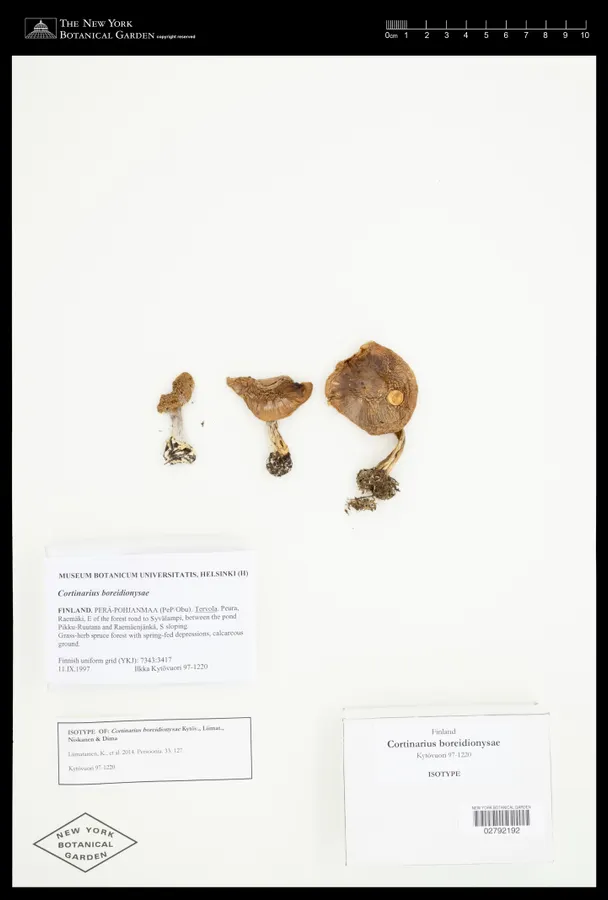
Voucher herbarium Cortinarius boreidionysae (02792192), The New York Botanical Garden. Identifikasi mengikuti record spesimen sumber. Foto bahan, kemasan, atau label herbarium sebagaimana tersedia pada record institusi; bukan foto lapangan atau penentuan spesimen independen.

Jenis
Voucher herbarium
Kredit
The New York Botanical Garden
Lisensi
CC BY 4.0
Sumber media
Buka entri sumber

Gambar menunjukkan objek menurut identifikasi sumber, bukan verifikasi independen spesimen oleh Fungi. Tidak ada skala baru yang ditambahkan.

06 / Rujukan

Sumber profil

  1. [1] Phlegmacium boreidionysae — Wikipedia (en)Bagian sumber: Frozen revision 1312556425
    Tanggal penghimpunan sumber: 2026-10-12
    Teks sumber: CC BY-SA4.0 · Wikipedia contributors
  2. [2] Catalogue of Life Base2026-09-11 — Phlegmacium boreidionysaeBagian sumber: ColDP NameUsage.tsv ID B2NTZ; accepted species; source 2073
    Tanggal penghimpunan sumber: 2026-10-12
  3. [3] Dokumentasi visual — Cortinarius boreidionysaeBagian sumber: Individual media record; identification follows the source, not independent determination
    Tanggal penghimpunan sumber: 2026-10-12
    Media sumber: CC BY 4.0 · The New York Botanical Garden

Adaptasi teks: CC BY-SA 4.0. Wikipedia contributors — Phlegmacium boreidionysae — Wikipedia (en)

Uraian asli dan riwayat sumber

Riwayat atau halaman sumber

Ringkasan sumber

Phlegmacium boreidionysae is a rare species of mushroom-forming fungus in the family Cortinariaceae. Originally described in 2014 as a member of the genus Cortinarius, it was reclassified in 2022 based on genomic data. The specific epithet alludes to both its relationship to Cortinarius dionysae and its northern distribution. The species is characterised by its mustard to cocoa brown cap with a silky centre, gills that transition from violaceous to pale brownish grey, and a stem with a distinctive marginate bulb that changes from pale violet to yellowish with age.

Revisi sumber

Morfologi sumber

The cap (pileus) measures 5–10 cm in width, initially hemispherical to convex before expanding with age. Its surface is sticky and slimy (glutinous) with an innately fibrous appearance. The colouration ranges from mustard brown to cocoa brown, featuring a somewhat silky, shining centre and olive-yellowish tint at the margin when young. The gills (lamellae) are notched where they meet the stem (emarginate) and densely arranged (crowded). Their colour transitions from violaceous in young specimens to violet grey and finally pale brownish grey as the mushroom matures. The stem (stipe) measures 3–9 cm in length and 1–1.8 cm in thickness at the top, widening to 2–2.5 cm at the base. It features a distinctive bulb with a clearly defined edge (marginate bulb). Young specimens display a pale violaceous stem that gradually becomes yellowish with age. The universal veil, a protective tissue that covers the immature fruiting body, appears yellow at the margin of the bulb. The flesh (context) varies in colour depending on its location: white in the cap, violaceous in the stem, and initially whitish in the bulb before developing a brownish-yellowish tint. The fungus has a faint flour-like (farinaceous) odour. Dried herbarium specimens (Latin: specimina exsiccata) exhibit a uniformly orange-brown cap, sometimes with a faint greyish tint, and a somewhat paler stem. Under microscopic examination with Melzer's reagent, the spores measure 8.4–10.2 by 5.2–6.1 micrometres (μm) (average 9.3 by 5.8 μm). The spores are strongly lemon-shaped (citriform) with a pronounced beak-like projection. Their surface is moderately covered with sharp wart-like protrusions (verrucose), often containing small coloured droplets (guttules).

Revisi sumber

Ekologi sumber

Found in Finland, it grows in northern boreal forests of predominantly Norway spruce (Picea abies). The type specimen was found growing in a grass-herb-spruce forest with spring-fed depressions on calcareous soil.

Revisi sumber

Struktur reproduksi sumber

Under microscopic examination with Melzer's reagent, the spores measure 8.4–10.2 by 5.2–6.1 micrometres (μm) (average 9.3 by 5.8 μm). The spores are strongly lemon-shaped (citriform) with a pronounced beak-like projection. Their surface is moderately covered with sharp wart-like protrusions (verrucose), often containing small coloured droplets (guttules). When exposed to iodine, they show a faint to moderate reddish-brown reaction (faintly to moderately dextrinoid). The basidia (spore-producing structures) measure 23–32 by 7–9 μm, bear four spores each, and are club-shaped. Some basidia contain brownish-yellow, foamy contents. The tissue between the gills (lamellar trama) contains thread-like structures (hyphae) that appear yellow and granular-guttulate, though they lack the blood-red droplets found in some related species.

Revisi sumber

Rujukan halaman ini

Fungi. Phlegmacium boreidionysae. Rilis data fungi-2026-10-12-expansion-2. https://fungi-atlas.mgadib.chatgpt.site/jamur/phlegmacium-boreidionysae/.

Status: impor sumber; pemeriksaan editorial per profil belum selesai. Untuk klaim biologis, gunakan rujukan pada bagian terkait dan periksa konteks sumber aslinya.