Ciri dan struktur
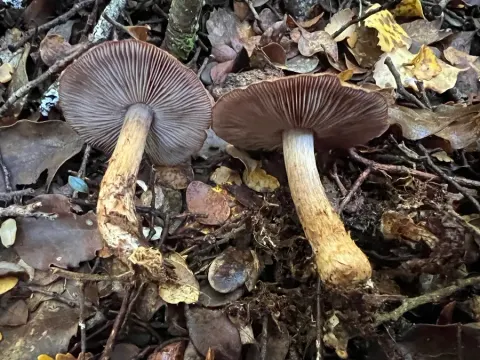
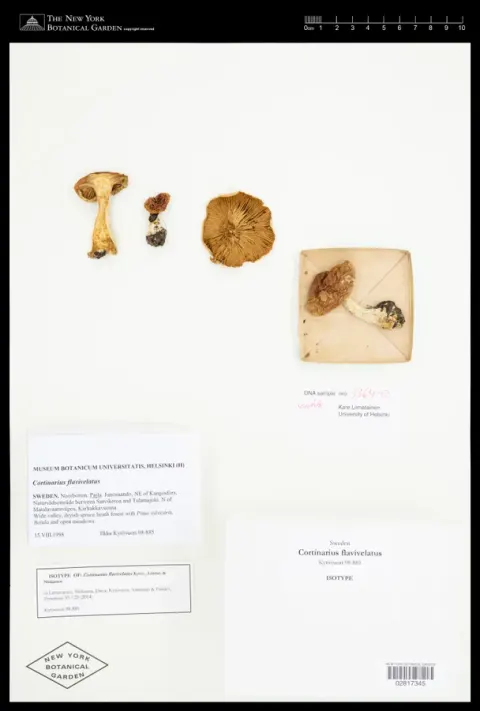
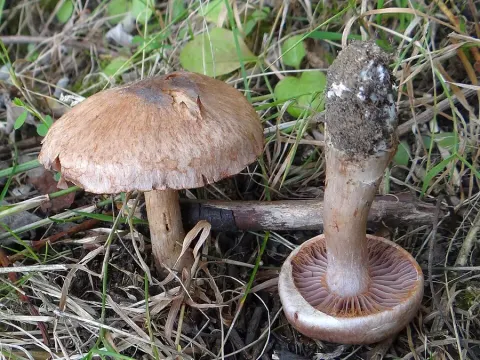
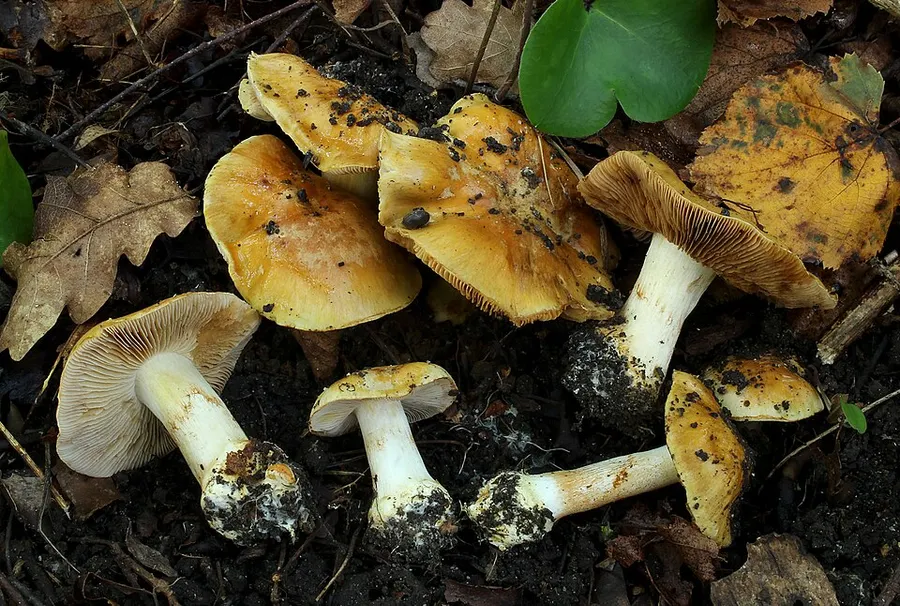
The cap (pileus) of Phlegmacium cruentipellis measures 3–7.5 cm in width, developing from hemispherical to convex before becoming expanded with an unevenly wavy margin. It displays an olivaceous yellowish brown colouration at the centre, transitioning to olivaceous or ochraceous yellow towards the margin. The gills (lamellae) are notched where they meet the stem, almost crowded, pale grey when young and later developing to pale greyish brown. The stem (stipe) is 3–5 cm long, measuring 0.5–1.4 cm thick at its top and widening to 1.5–2.5 cm at its base, featuring a distinctive marginate bulb. Initially whitish, the stem gradually acquires a slight yellow tinge with age. The universal veil appears ochraceous yellow at the bulb margin. The flesh (context) is whitish, and the fungus has no distinctive odour. Dried specimens (Latin: specimina exsiccata) as deposited in herbaria show an orange brown to dirty red brown colouration at the centre of the cap, yellowish brown at the margin, with the stem matching the colour of the cap centre. Microscopically, the spores measure about 10.4 micrometre (μm) in length by 6.1 μm in width, with a ratio of length to width averaging 1.71. They are often strongly lemon-shaped (citriform) with a distinct beak, and feature moderate, sharp surface warts. The spores are fairly faintly to moderately reactive with Melzer's reagent (dextrinoid). The spore-producing cells (basidia) measure 23–34 μm by 7.5–9.5 μm, are club-shaped with four spores each, some containing yellow foamy contents. The gill tissue (lamellar trama) consists of yellowish hyphae, many containing greenish yellowish, oily droplets (guttules).
Habitat dan peran ekologis
It is found in northern Europe—Estonia, Denmark, Norway, and Sweden—where it grows on the ground in temperate and hemiboreal forests dominated by hazel and oak trees, and also in wooded pastures and parks.
- Habitat atau konteks temuan
- hutan
- Substrat
- tanah
- Peran atau konteks
- Belum dikategorikan pada rilis ini.
Reproduksi
Microscopically, the spores measure about 10.4 micrometre (μm) in length by 6.1 μm in width, with a ratio of length to width averaging 1.71. They are often strongly lemon-shaped (citriform) with a distinct beak, and feature moderate, sharp surface warts. The spores are fairly faintly to moderately reactive with Melzer's reagent (dextrinoid). The spore-producing cells (basidia) measure 23–34 μm by 7.5–9.5 μm, are club-shaped with four spores each, some containing yellow foamy contents.
Catatan identitas dan cakupan
- Nama diterima mengikuti Catalogue of Life Base2026-09-11; uraian mempertahankan konsep dan nama sumber aslinya.
- Original geographic, specimen and life-cycle scope retained; source import awaits individual editorial review.
- Impor dan terjemahan otomatis belum diperiksa editorial per profil. Struktur reproduktif yang disebutkan tidak membuktikan seluruh siklus hidup diketahui.
- Pengukuran pada uraian mengikuti spesimen, kultur, dan metode sumber; angka tidak diperluas ke semua populasi.
Catatan distribusi dalam narasi mengikuti sumbernya. Dokumentasi spesimen atau foto mengikuti catatan sumber. Bukti wilayah Indonesia dan penilaian konservasi tidak disimpulkan dari gambar.
Melihat dengan konteks
Dokumentasi Phlegmacium cruentipellis dari Wikimedia Commons. Cortinarius cruentipellis Identifikasi mengikuti record berkas sumber.
- Jenis
- Fotografi
- Kredit
- Balint Dima/Norsk institutt for naturforskning — Balint Dima/Norsk institutt for naturforskning
- Lisensi
- CC BY 4.0
- Sumber media
- Buka entri sumber
Sumber profil
- [1] Phlegmacium cruentipellis — Wikipedia (en)
- [2] Catalogue of Life Base2026-09-11 — Phlegmacium cruentipellis
- [3] Dokumentasi visual — Phlegmacium cruentipellis
Rujukan halaman ini
Fungi. Phlegmacium cruentipellis. Rilis data fungi-2026-10-12-expansion-2. https://fungi-atlas.mgadib.chatgpt.site/jamur/phlegmacium-cruentipellis/.
Status: impor sumber; pemeriksaan editorial per profil belum selesai. Untuk klaim biologis, gunakan rujukan pada bagian terkait dan periksa konteks sumber aslinya.