01 / Morfologi

Ciri dan struktur

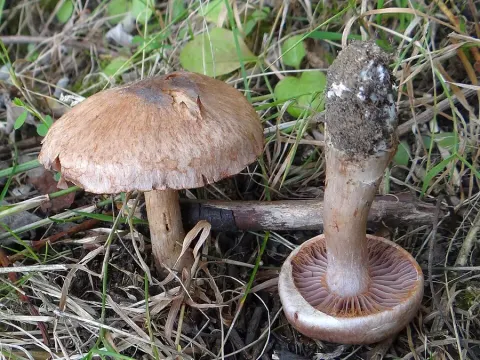
Cortinarius flavivelatus is a mushroom-forming fungus characterised by a medium-sized fruiting body. The pileus (cap) measures 5–8 cm in width, initially hemispherical to convex, later becoming plano-convex. It has a viscid surface with fine, innate fibrils, coloured olive brown to ochraceous brown at the centre, fading to lighter tones at the margin, and displays hygrophanous streaking patterns. The lamellae (gills) are emarginate (a "notched" attachment to the stipe) and densely arranged. They have a distinctive pale-bluish colouration when young, later developing into pale brown with a bluish tint. The stipe (stem) measures 6–10 cm in length, with a thickness of 1–1.8 cm at the apex, widening to 1.5–2.5 cm at the base, making it club-shaped (clavate) to nearly cylindrical in shape. The stipe is predominantly whitish with a bluish tint observable at the apex. A defining feature of this species is its yellow universal veil, which forms girdles on the stipe and has a somewhat viscid texture. The context (flesh) is white throughout the pileus and lower portions of the stipe, while displaying a bluish colour at the stipe apex. The fungus has an indistinct odour and shows no reaction when tested with potassium hydroxide solution (KOH). Dried specimens (Latin: specimina exsiccata) as deposited in herbaria have a warm yellowish to reddish brown pileus and a whitish stipe. Under the microscope, Cortinarius flavivelatus shows distinctive features. The basidiospores are almond to lemon-shaped, measuring about 9.1–10.9 by 5.0–5.9 μm, with a finely warty surface. The mushroom's internal structure contains various coloured elements: the spore-producing cells (basidia) are club-shaped and pale brown; the gill tissue contains dark granules; the stipe surface has entangled threads with reddish-black granules; and the cap cuticle consists of a gelatinous layer of ochre-brown threads over a well-developed reddish-brown layer beneath, both featuring dark brown granular deposits.

Sebagian uraian ditampilkan dalam bahasa sumber; terjemahannya belum tersedia atau belum lolos pemeriksaan.

Rujukan: [1]

Pengukuran mengikuti objek, spesimen atau kultur, dan metode yang disebutkan sumber. Baca uraian asli untuk konteks lengkap.

02 / Kehidupan

Habitat dan peran ekologis

Cortinarius flavivelatus is known to occur only in boreal coniferous forests of Sweden.

Sebagian uraian ditampilkan dalam bahasa sumber; terjemahannya belum tersedia atau belum lolos pemeriksaan.

Rujukan: [1]

Habitat atau konteks temuan
hutan
Substrat
Informasi belum tersedia pada sumber rilis ini.
Peran atau konteks
Belum dikategorikan pada rilis ini.
Temukan hubungan serupa
03 / Siklus hidup

Reproduksi

Under the microscope, Cortinarius flavivelatus shows distinctive features. The basidiospores are almond to lemon-shaped, measuring about 9.1–10.9 by 5.0–5.9 μm, with a finely warty surface. The mushroom's internal structure contains various coloured elements: the spore-producing cells (basidia) are club-shaped and pale brown; the gill tissue contains dark granules; the stipe surface has entangled threads with reddish-black granules; and the cap cuticle consists of a gelatinous layer of ochre-brown threads over a well-developed reddish-brown layer beneath, both featuring dark brown granular deposits.

Sebagian uraian ditampilkan dalam bahasa sumber; terjemahannya belum tersedia atau belum lolos pemeriksaan.

Rujukan: [1]

Sinonim menurut acuan taksonomi rilis: Cortinarius flavivelatus
04 / Batas informasi

Catatan identitas dan cakupan

  • Nama diterima mengikuti Catalogue of Life Base2026-09-11; uraian mempertahankan konsep dan nama sumber aslinya.
  • Original geographic, specimen and life-cycle scope retained; source import awaits individual editorial review.
  • Impor dan terjemahan otomatis belum diperiksa editorial per profil. Struktur reproduktif yang disebutkan tidak membuktikan seluruh siklus hidup diketahui.
  • Pengukuran pada uraian mengikuti spesimen, kultur, dan metode sumber; angka tidak diperluas ke semua populasi.

Catatan distribusi dalam narasi mengikuti sumbernya. Dokumentasi spesimen atau foto mengikuti catatan sumber. Bukti wilayah Indonesia dan penilaian konservasi tidak disimpulkan dari gambar.

05 / Dokumentasi

Melihat dengan konteks

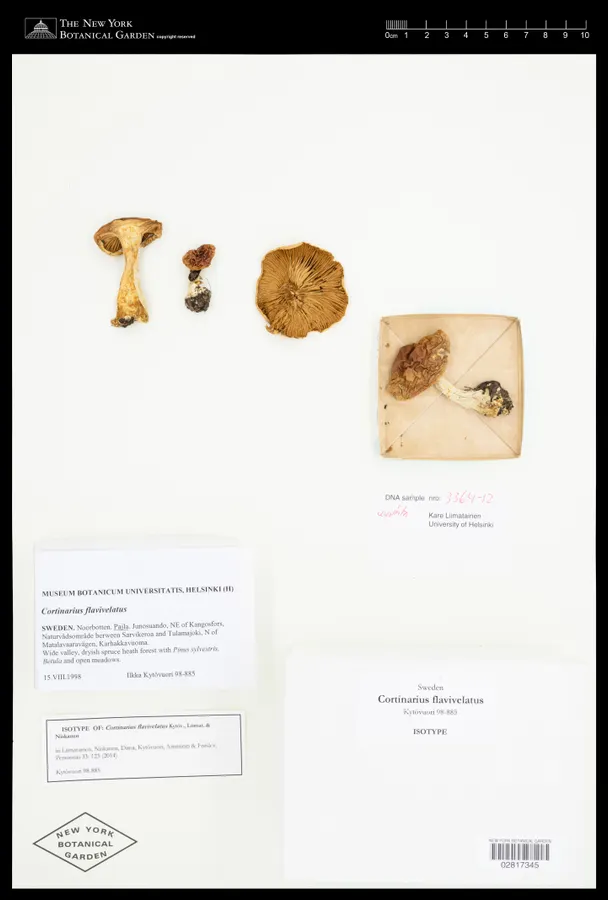
Voucher herbarium Cortinarius flavivelatus (02817345), The New York Botanical Garden. Identifikasi mengikuti record spesimen sumber. Foto bahan, kemasan, atau label herbarium sebagaimana tersedia pada record institusi; bukan foto lapangan atau penentuan spesimen independen.

Jenis
Voucher herbarium
Kredit
The New York Botanical Garden
Lisensi
CC BY 4.0
Sumber media
Buka entri sumber

Gambar menunjukkan objek menurut identifikasi sumber, bukan verifikasi independen spesimen oleh Fungi. Tidak ada skala baru yang ditambahkan.

06 / Rujukan

Sumber profil

  1. [1] Phlegmacium flavivelatum — Wikipedia (en)Bagian sumber: Frozen revision 1312571253
    Tanggal penghimpunan sumber: 2026-10-12
    Teks sumber: CC BY-SA4.0 · Wikipedia contributors
  2. [2] Catalogue of Life Base2026-09-11 — Phlegmacium flavivelatumBagian sumber: ColDP NameUsage.tsv ID B2NYY; accepted species; source 2073
    Tanggal penghimpunan sumber: 2026-10-12
  3. [3] Dokumentasi visual — Cortinarius flavivelatusBagian sumber: Individual media record; identification follows the source, not independent determination
    Tanggal penghimpunan sumber: 2026-10-12
    Media sumber: CC BY 4.0 · The New York Botanical Garden

Adaptasi teks: CC BY-SA 4.0. Wikipedia contributors — Phlegmacium flavivelatum — Wikipedia (en)

Uraian asli dan riwayat sumber

Riwayat atau halaman sumber

Ringkasan sumber

Phlegmacium flavivelatum is a species of mushroom-forming fungus in the family Cortinariaceae. First described in 2014 as Cortinarius flavivelatus, it was reclassified in 2022 based on molecular data. The mushroom features a 5–8 cm viscid cap coloured olive-brown to ochraceous, emarginate (notched) gills that change from pale-bluish to brownish, and a whitish stem with distinctive yellow veil remnants forming girdles. It is closely related to Phlegmacium pini, which differs by having a white veil and larger spores.

Revisi sumber

Morfologi sumber

Cortinarius flavivelatus is a mushroom-forming fungus characterised by a medium-sized fruiting body. The pileus (cap) measures 5–8 cm in width, initially hemispherical to convex, later becoming plano-convex. It has a viscid surface with fine, innate fibrils, coloured olive brown to ochraceous brown at the centre, fading to lighter tones at the margin, and displays hygrophanous streaking patterns. The lamellae (gills) are emarginate (a "notched" attachment to the stipe) and densely arranged. They have a distinctive pale-bluish colouration when young, later developing into pale brown with a bluish tint. The stipe (stem) measures 6–10 cm in length, with a thickness of 1–1.8 cm at the apex, widening to 1.5–2.5 cm at the base, making it club-shaped (clavate) to nearly cylindrical in shape. The stipe is predominantly whitish with a bluish tint observable at the apex. A defining feature of this species is its yellow universal veil, which forms girdles on the stipe and has a somewhat viscid texture. The context (flesh) is white throughout the pileus and lower portions of the stipe, while displaying a bluish colour at the stipe apex. The fungus has an indistinct odour and shows no reaction when tested with potassium hydroxide solution (KOH). Dried specimens (Latin: specimina exsiccata) as deposited in herbaria have a warm yellowish to reddish brown pileus and a whitish stipe. Under the microscope, Cortinarius flavivelatus shows distinctive features. The basidiospores are almond to lemon-shaped, measuring about 9.1–10.9 by 5.0–5.9 μm, with a finely warty surface. The mushroom's internal structure contains various coloured elements: the spore-producing cells (basidia) are club-shaped and pale brown; the gill tissue contains dark granules; the stipe surface has entangled threads with reddish-black granules; and the cap cuticle consists of a gelatinous layer of ochre-brown threads over a well-developed reddish-brown layer beneath, both featuring dark brown granular deposits.

Revisi sumber

Ekologi sumber

Cortinarius flavivelatus is known to occur only in boreal coniferous forests of Sweden.

Revisi sumber

Struktur reproduksi sumber

Under the microscope, Cortinarius flavivelatus shows distinctive features. The basidiospores are almond to lemon-shaped, measuring about 9.1–10.9 by 5.0–5.9 μm, with a finely warty surface. The mushroom's internal structure contains various coloured elements: the spore-producing cells (basidia) are club-shaped and pale brown; the gill tissue contains dark granules; the stipe surface has entangled threads with reddish-black granules; and the cap cuticle consists of a gelatinous layer of ochre-brown threads over a well-developed reddish-brown layer beneath, both featuring dark brown granular deposits.

Revisi sumber

Rujukan halaman ini

Fungi. Phlegmacium flavivelatum. Rilis data fungi-2026-10-12-expansion-2. https://fungi-atlas.mgadib.chatgpt.site/jamur/phlegmacium-flavivelatum/.

Status: impor sumber; pemeriksaan editorial per profil belum selesai. Untuk klaim biologis, gunakan rujukan pada bagian terkait dan periksa konteks sumber aslinya.