Ciri dan struktur
The cap (pileus) of Phlegmacium kytoevuorii measures 6–9 cm in width, initially hemispherical to convex before expanding with age. It displays a finely fibrous surface texture and shows yellow-brown to brown colouration with noticeable moisture-related streaks when wet (hygrophanous). The gills (lamellae) are notched where they meet the stem (emarginate), arranged closely to moderately spaced. They show a colour progression from pale brownish-grey when young to a deeper brown as the fungus matures. The stem (stipe) measures 6–9 cm in length, with a thickness of 1.2–1.5 cm at the top, widening to 2–2.5 cm at the distinctive bulbous base. When young, the stem appears white, gradually developing pale brownish-yellow tones with age. The stem base features a relatively narrow, well-defined bulb with a distinct margin. The flesh (context) ranges from whitish to pale yellow in colour. The fungus has no distinctive odour. When tested with potassium hydroxide (KOH) solution, the cap surface turns brown without reddish tints, while the flesh, mycelium, and bulb margin show no reaction. Dried specimens (Latin: specimina exsiccata) as deposited in herbaria display a dull, dark red-brown colour throughout, with the stem nearly matching the cap's colour. Microscopically, the spores measure 7.5–8.5–9.5 by 5.0–5.3–5.4 micrometres (μm). They are almond-shaped to elliptical (amygdaloid-ellipsoid) with very prominent, separate, and sharply defined surface ornamentation (verrucose). The spores show slight to moderate reddish-brown colouration when treated with Melzer's reagent (dextrinoid). The spore-producing cells (basidia) measure 24–32 by 7.5–9 μm, are club-shaped (clavate), and each produces four spores.
Habitat dan peran ekologis
Phlegmacium kytoevuorii is a species of mushroom-forming fungus in the family Cortinariaceae. Described as a new species in 2014, it is found in coniferous forests of Finland and Sweden. Phlegmacium kytoevuorii is found in coniferous forests of Finland and Sweden.
- Habitat atau konteks temuan
- hutan
- Substrat
- Informasi belum tersedia pada sumber rilis ini.
- Peran atau konteks
- Belum dikategorikan pada rilis ini.
Reproduksi
Microscopically, the spores measure 7.5–8.5–9.5 by 5.0–5.3–5.4 micrometres (μm). They are almond-shaped to elliptical (amygdaloid-ellipsoid) with very prominent, separate, and sharply defined surface ornamentation (verrucose). The spores show slight to moderate reddish-brown colouration when treated with Melzer's reagent (dextrinoid). The spore-producing cells (basidia) measure 24–32 by 7.5–9 μm, are club-shaped (clavate), and each produces four spores. Tissue within the gills consists of pale, transparent yellowish cells containing droplets (guttulate). The uppermost layer of the cap (pileipellis) appears orange overall, with a slightly gelatinous texture. This layer consists of hyphae 5–10 μm wide, featuring fine to strong spiral surface markings (incrustations) and distinctive orange-red granular deposits between cells.
Catatan identitas dan cakupan
- Nama diterima mengikuti Catalogue of Life Base2026-09-11; uraian mempertahankan konsep dan nama sumber aslinya.
- Original geographic, specimen and life-cycle scope retained; source import awaits individual editorial review.
- Impor dan terjemahan otomatis belum diperiksa editorial per profil. Struktur reproduktif yang disebutkan tidak membuktikan seluruh siklus hidup diketahui.
- Pengukuran pada uraian mengikuti spesimen, kultur, dan metode sumber; angka tidak diperluas ke semua populasi.
Catatan distribusi dalam narasi mengikuti sumbernya. Dokumentasi spesimen atau foto mengikuti catatan sumber. Bukti wilayah Indonesia dan penilaian konservasi tidak disimpulkan dari gambar.
Melihat dengan konteks
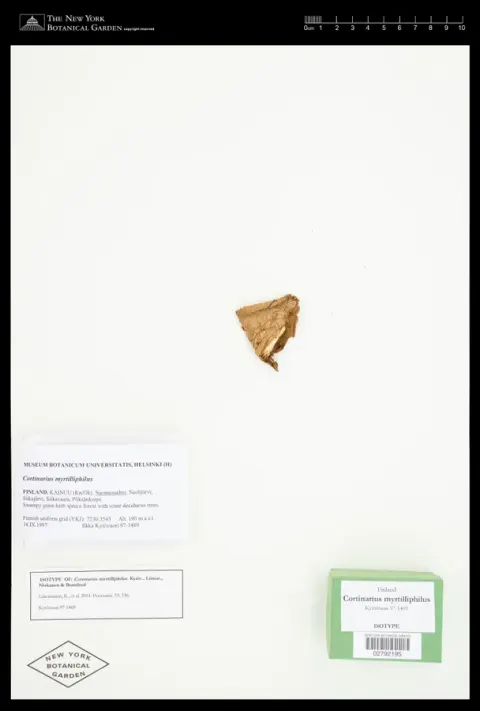
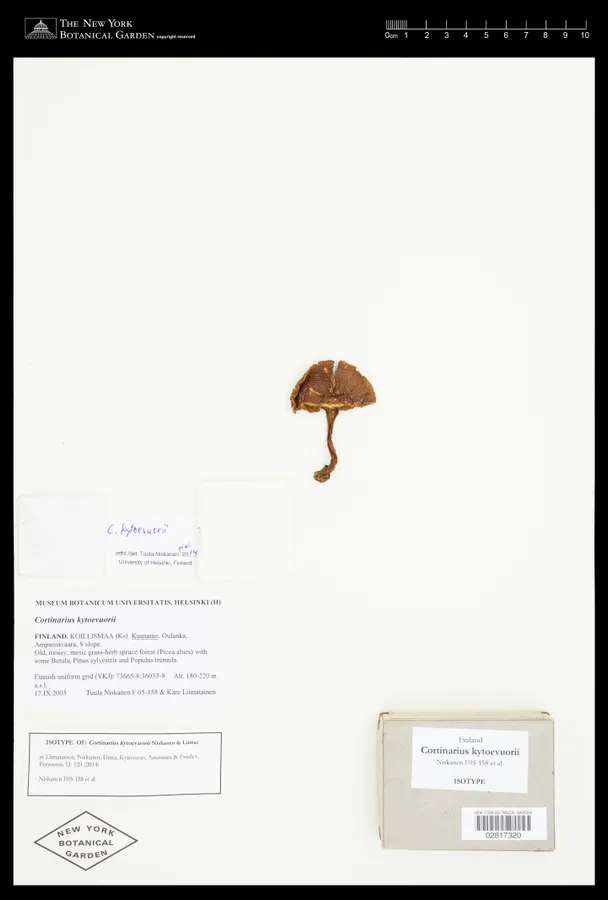
Voucher herbarium Cortinarius kytoevuorii (02817320), The New York Botanical Garden. Identifikasi mengikuti record spesimen sumber. Foto bahan, kemasan, atau label herbarium sebagaimana tersedia pada record institusi; bukan foto lapangan atau penentuan spesimen independen.
- Jenis
- Voucher herbarium
- Kredit
- The New York Botanical Garden
- Lisensi
- CC BY 4.0
- Sumber media
- Buka entri sumber
Sumber profil
- [1] Phlegmacium kytoevuorii — Wikipedia (en)
- [2] Catalogue of Life Base2026-09-11 — Phlegmacium kytoevuorii
- [3] Dokumentasi visual — Cortinarius kytoevuorii
Rujukan halaman ini
Fungi. Phlegmacium kytoevuorii. Rilis data fungi-2026-10-12-expansion-2. https://fungi-atlas.mgadib.chatgpt.site/jamur/phlegmacium-kytoevuorii/.
Status: impor sumber; pemeriksaan editorial per profil belum selesai. Untuk klaim biologis, gunakan rujukan pada bagian terkait dan periksa konteks sumber aslinya.