01 / Morfologi

Ciri dan struktur

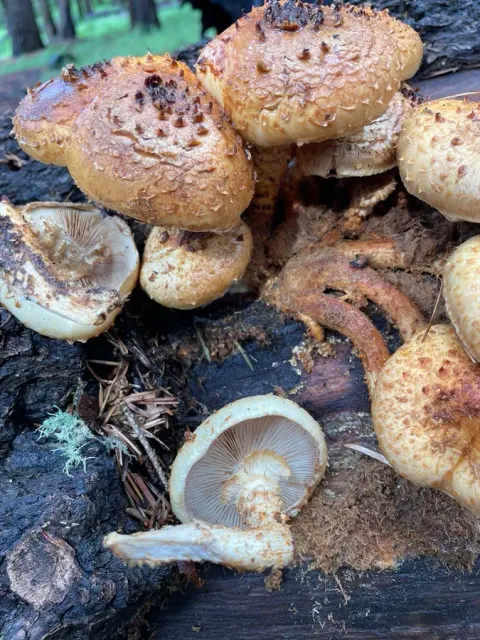
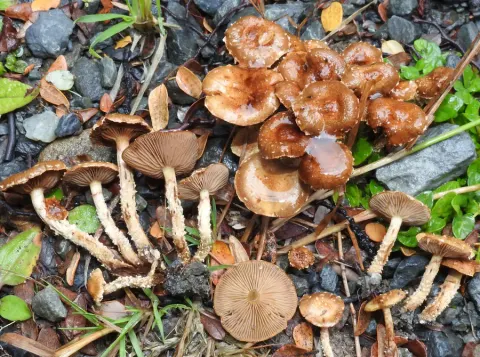
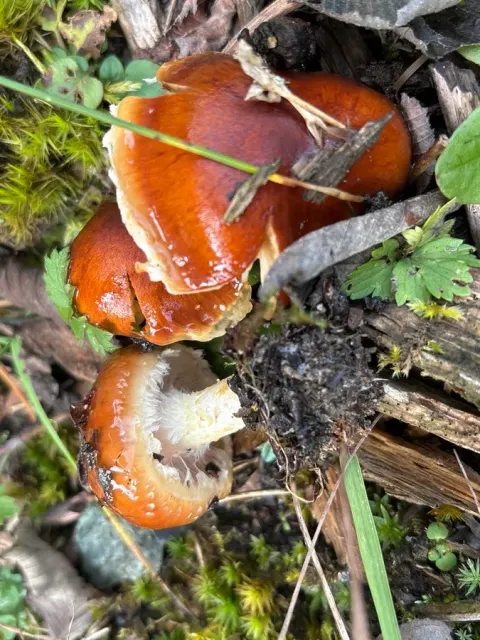
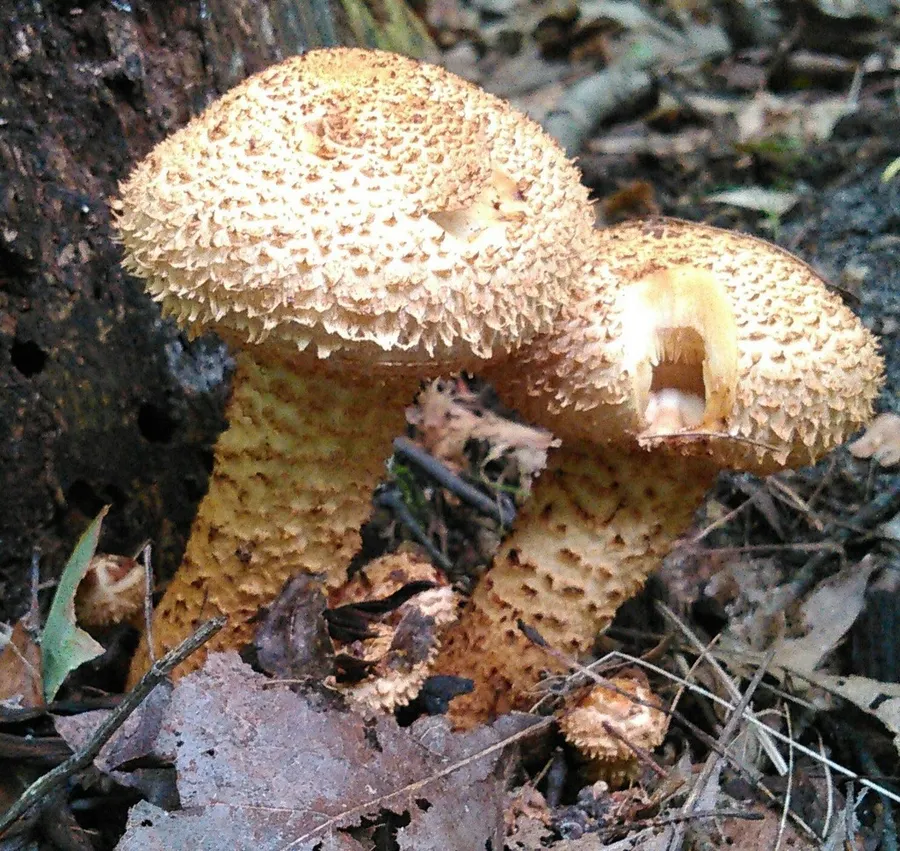
Like other Pholiota mushrooms, P. squarrosa has a scaly cap and stem. The cap ranges from 3 to 12 cm in diameter, and depending on its age, can range in shape from bell-shaped to rounded to somewhat flattened. The cap color is yellowish-brown to tawny in older specimens. The scales on the cap are yellowish to tawny, and recurved. The stem is 4 to 12 cm long by 0.5 to 1.5 cm thick, and roughly equal in width throughout. The partial veil that covers the young gills forms a thick, woolly ring on the upper part of the stem. Above the level of the ring, the stem is bare, while below it is scaly like the cap. The gills are covered by a partial veil when young and have a greenish-brown color; mature gills are rusty brown. They are crowded closely together, attached to the stem (adnate), and usually notched (sinuate). The spore print is cinnamon or rusty brown. The spores are elliptic, smooth-walled, nonamyloid (not absorbing iodine when stained with Melzer's reagent), and measure 6.6–8 by 3.7–4.4 μm. The basidia (spore-bearing cells) are club-shaped, and four-spored, with dimensions of 16–25 by 5–7 μm. Fruit bodies have an odour described variously as resembling garlic, radish, lemon, onion, or skunk, and taste like radish.

Sebagian uraian ditampilkan dalam bahasa sumber; terjemahannya belum tersedia atau belum lolos pemeriksaan.

Rujukan: [1]

Pengukuran mengikuti objek, spesimen atau kultur, dan metode yang disebutkan sumber. Baca uraian asli untuk konteks lengkap.

02 / Kehidupan

Habitat dan peran ekologis

Jamur ini biasanya ditemukan tumbuh dalam kelompok di dasar pohon dan batang. Pholiota squarrosa dianggap sebagai jamur yang putih, yang menggunakan selulosa sebagai sumber karbon, dan memiliki kemampuan untuk menurunkan lignin (yang ada di kayu) menjadi karbon dioksida untuk mengakses molekul selulosa. The fungus can attack a wide variety of deciduous host trees, including sugar maple, red maple, yellow birch, paper birch, American beech, and white ash. It can also attack conifers, like spruce. Jamur ini adalah parasit sekunder, karena menyerang pohon yang sudah lemah karena cedera atau infeksi sebelumnya oleh bakteri atau jamur lainnya. Ia juga berfungsi sebagai saprobe, dan dapat memperoleh nutrisi dengan memecah bahan organik dalam kayu mati. P. squarrosa ditemukan di Eropa Utara America and. Utara American distribution membentang ke utara ke Kanada, dan selatan ke Meksiko, di mana penampilannya terbatas pada hutan konifer. Di Belanda, P. squarrosa adalah salah satu dari banyak jamur yang dapat secara teratur ditemukan berbuah di pelabuhan kayu kuno. Tubuh buah digunakan sebagai sumber makanan utama oleh tupai merah Sciurus vulgaris, dan memiliki kandungan protein yang lebih tinggi daripada jamur lain yang biasanya dikonsumsi oleh spesies ini.

Sebagian uraian ditampilkan dalam bahasa sumber; terjemahannya belum tersedia atau belum lolos pemeriksaan.

Rujukan: [1]

Habitat atau konteks temuan
hutan
Substrat
Informasi belum tersedia pada sumber rilis ini.
Peran atau konteks
Belum dikategorikan pada rilis ini.
Temukan hubungan serupa
03 / Siklus hidup

Reproduksi

The spore print is cinnamon or rusty brown. The spores are elliptic, smooth-walled, nonamyloid (not absorbing iodine when stained with Melzer's reagent), and measure 6.6–8 by 3.7–4.4 μm. The basidia (spore-bearing cells) are club-shaped, and four-spored, with dimensions of 16–25 by 5–7 μm.

Sebagian uraian ditampilkan dalam bahasa sumber; terjemahannya belum tersedia atau belum lolos pemeriksaan.

Rujukan: [1]

Sinonim menurut acuan taksonomi rilis: Agaricus floccosus; Agaricus floccosus var. reflexus; Agaricus reflexus; Agaricus scandinaviae; Agaricus squarrosus; Agaricus squarrosus var. muelleri; Agaricus squarrosus var. reflexus; Agaricus squarrosus var. terrestris; Agaricus squarrosus var. truncigenus; Agaricus squarrosus var. verruculosus; Agaricus verruculosus; Dryophila squarrosa; Dryophila squarrosa var. verruculosa; Dryophila verruculosa; Fungus squarrosus; Gymnopus reflexus; Hypodendrum floccosum; Lepiota squarrosa; Pholiota muelleri; Pholiota squarrosa f. annulosa; Pholiota squarrosa subsp. reflexa; Pholiota squarrosa var. muelleri; Pholiota squarrosa var. verruculosa; Stropharia squarrosa
04 / Batas informasi

Catatan identitas dan cakupan

  • Nama diterima mengikuti Catalogue of Life Base2026-09-11; uraian mempertahankan konsep dan nama sumber aslinya.
  • Original geographic, specimen and life-cycle scope retained; source import awaits individual editorial review.
  • Impor dan terjemahan otomatis belum diperiksa editorial per profil. Struktur reproduktif yang disebutkan tidak membuktikan seluruh siklus hidup diketahui.
  • Pengukuran pada uraian mengikuti spesimen, kultur, dan metode sumber; angka tidak diperluas ke semua populasi.

Catatan distribusi dalam narasi mengikuti sumbernya. Dokumentasi spesimen atau foto mengikuti catatan sumber. Bukti wilayah Indonesia dan penilaian konservasi tidak disimpulkan dari gambar.

05 / Dokumentasi

Melihat dengan konteks

Dokumentasi Pholiota squarrosa menurut asosiasi foto pada record takson iNaturalist. Kredit: steve b. Identitas mengikuti sumber; bukan penentuan spesimen independen.

Jenis
Fotografi
Kredit
no rights reserved, uploaded by steve b
Lisensi
CC0 1.0
Sumber media
Buka entri sumber

Gambar menunjukkan objek menurut identifikasi sumber, bukan verifikasi independen spesimen oleh Fungi. Tidak ada skala baru yang ditambahkan.

06 / Rujukan

Sumber profil

  1. [1] Pholiota squarrosa — Wikipedia (en)Bagian sumber: Frozen revision 1375992546
    Tanggal penghimpunan sumber: 2026-10-12
    Teks sumber: CC BY-SA4.0 · Wikipedia contributors
  2. [2] Catalogue of Life Base2026-09-11 — Pholiota squarrosaBagian sumber: ColDP NameUsage.tsv ID 4GMBH; accepted species; source 2073
    Tanggal penghimpunan sumber: 2026-10-12
  3. [3] Dokumentasi visual — Pholiota squarrosaBagian sumber: Individual media record; identification follows the source, not independent determination
    Tanggal penghimpunan sumber: 2026-10-12
    Media sumber: CC0 1.0 · no rights reserved, uploaded by steve b

Adaptasi teks: CC BY-SA 4.0. Wikipedia contributors — Pholiota squarrosa — Wikipedia (en)

Uraian asli dan riwayat sumber

Riwayat atau halaman sumber

Ringkasan sumber

Pholiota squarrosa, commonly known as the shaggy scalycap, the shaggy Pholiota, or the scaly Pholiota, is a species of mushroom in the family Strophariaceae. Both the cap and the stem are covered in small, pointed scales that are pointed downward and backward. The crowded gills are yellowish, then later rust-brown. The mushroom has an odor that, depending on the author, has been described as resembling garlic, lemon, radish, onion, or skunk. It has a strong taste, resembling radishes. The very similar P. squarrosoides differs in having a paler cap that is sticky between the scales, and smaller spores.

Revisi sumber

Morfologi sumber

Like other Pholiota mushrooms, P. squarrosa has a scaly cap and stem. The cap ranges from 3 to 12 cm in diameter, and depending on its age, can range in shape from bell-shaped to rounded to somewhat flattened. The cap color is yellowish-brown to tawny in older specimens. The scales on the cap are yellowish to tawny, and recurved. The stem is 4 to 12 cm long by 0.5 to 1.5 cm thick, and roughly equal in width throughout. The partial veil that covers the young gills forms a thick, woolly ring on the upper part of the stem. Above the level of the ring, the stem is bare, while below it is scaly like the cap. The gills are covered by a partial veil when young and have a greenish-brown color; mature gills are rusty brown. They are crowded closely together, attached to the stem (adnate), and usually notched (sinuate). The spore print is cinnamon or rusty brown. The spores are elliptic, smooth-walled, nonamyloid (not absorbing iodine when stained with Melzer's reagent), and measure 6.6–8 by 3.7–4.4 μm. The basidia (spore-bearing cells) are club-shaped, and four-spored, with dimensions of 16–25 by 5–7 μm. Fruit bodies have an odour described variously as resembling garlic, radish, lemon, onion, or skunk, and taste like radish.

Revisi sumber

Ekologi sumber

The mushroom is typically found growing in clusters at the base of trees and stumps. Pholiota squarrosa is thought to be a white rot fungus, which use cellulose as a carbon source, and have the ability to degrade the lignin (present in wood) to carbon dioxide to access the cellulose molecule. The fungus can attack a wide variety of deciduous host trees, including sugar maple, red maple, yellow birch, paper birch, American beech, and white ash. It can also attack conifers, like spruce. The fungus is a secondary parasite, in that it attacks trees that have already been weakened from prior injury or infection by bacteria or other fungi. It also functions as a saprobe, and can obtain nutrients by breaking down organic matter in dead wood. P. squarrosa is found in North America and Europe. The North American distribution extends north to Canada, and south to Mexico, where its appearance is restricted to coniferous forests. In the Netherlands, P. squarrosa is one of many mushrooms that can regularly be found fruiting on ancient timber wharves. The fruit bodies are used as a primary food source by the red squirrel Sciurus vulgaris, and have a higher protein content than the other mushrooms typically consumed by this species.

Revisi sumber

Struktur reproduksi sumber

The spore print is cinnamon or rusty brown. The spores are elliptic, smooth-walled, nonamyloid (not absorbing iodine when stained with Melzer's reagent), and measure 6.6–8 by 3.7–4.4 μm. The basidia (spore-bearing cells) are club-shaped, and four-spored, with dimensions of 16–25 by 5–7 μm.

Revisi sumber

Rujukan halaman ini

Fungi. Pholiota squarrosa. Rilis data fungi-2026-10-12-expansion-2. https://fungi-atlas.mgadib.chatgpt.site/jamur/pholiota-squarrosa/.

Status: impor sumber; pemeriksaan editorial per profil belum selesai. Untuk klaim biologis, gunakan rujukan pada bagian terkait dan periksa konteks sumber aslinya.