Ciri dan struktur
Phylloporia crystallina is characterized by pileate, perennial basidiomata with a thin layer of context between individual tube layers, a duplex context with a black line separating the upper tomentum and a lower compacted layer, small pores 9–10 per mm, a monomitic hyphal system, generative hyphae thin- to distinctly thick-walled with simple septa, the absence of cystidia and cystidioles, the presence of large rhomboid crystals in tube trama, broadly ellipsoid basidiospores measuring 2.8–3 × 2–2.3 μm, and growth on angiosperm stump in the Neotropics.
Habitat dan peran ekologis
Phylogenetically (Fig. 1), Phylloporia crystallina is related to P. montana Oliveira-Filho & Gibertoni (Wu et al. 2019). However, P. montana has wider pores (3–5 per mm vs. 9–10 per mm) and larger and cylindrical basidiospores (4–5 × 2–3 μm vs. 2.8–3 × 2–2.3 μm) (Wu et al. 2019). Morphologically, P. crystallina resembles P. crataegi L.W. Zhou & Y.C. Dai by sharing perennial and pileate basidiomata with duplex context, a monomitic hyphal system, interwoven tramal hyphae, the absence of cystidia and cystidioles, and broadly ellipsoid to subglobose basidiospores (Zhou and Dai 2012). However, the latter species differs from P. crystallina by the absence of rhomboid crystals, distinctly longer basidia (8–11 μm vs. 5–7 μm), and growth on living Crataegus in temperate China (Zhou and Dai 2012). In addition, P. crystallina and P. crataegi are phylogenetically distantly related (Fig. 1). P. chrysites (Berk.) Ryvarden is a Neotropical species. It has similar basidiospores as P. crystallina, but the former is readily distinguished from the latter by its annual habit and larger pores (9–10 per mm vs. pores 6–8 per mm, Wu et al. 2022). Trametes lilliputiana Speg. and Pyropolyporus subpectinatus Murrill were originally described from Brazil and Cuba, respectively (Spegazzini 1889; Murrill 1908), and they were treated as synonyms of Phylloporia pectinata (Klotzsch) Ryvarden (Bresadola 1912; Ryvarden 1985; Rajchenberg and Wright 1987).
- Habitat atau konteks temuan
- Informasi belum tersedia pada sumber rilis ini.
- Substrat
- Informasi belum tersedia pada sumber rilis ini.
- Peran atau konteks
- Belum dikategorikan pada rilis ini.
Reproduksi
Phylloporia crystallina is characterized by pileate, perennial basidiomata with a thin layer of context between individual tube layers, a duplex context with a black line separating the upper tomentum and a lower compacted layer, small pores 9–10 per mm, a monomitic hyphal system, generative hyphae thin- to distinctly thick-walled with simple septa, the absence of cystidia and cystidioles, the presence of large rhomboid crystals in tube trama, broadly ellipsoid basidiospores measuring 2.8–3 × 2–2.3 μm, and growth on angiosperm stump in the Neotropics.
Catatan identitas dan cakupan
- Nama diterima mengikuti Catalogue of Life Base2026-09-11; uraian mempertahankan konsep dan nama sumber aslinya.
- Preserve original treatment localities, hosts and substrate scope. Materials examined describe documented specimens, not the full global range.
- Impor dan terjemahan otomatis belum diperiksa editorial per profil. Struktur reproduktif yang disebutkan tidak membuktikan seluruh siklus hidup diketahui.
- Pengukuran pada uraian mengikuti spesimen, kultur, dan metode sumber; angka tidak diperluas ke semua populasi.
Catatan distribusi dalam narasi mengikuti sumbernya. Dokumentasi spesimen atau foto mengikuti catatan sumber. Bukti wilayah Indonesia dan penilaian konservasi tidak disimpulkan dari gambar.
Melihat dengan konteks
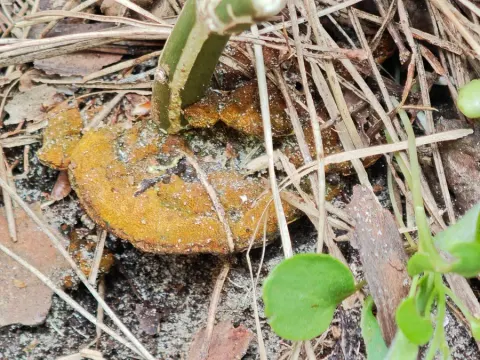
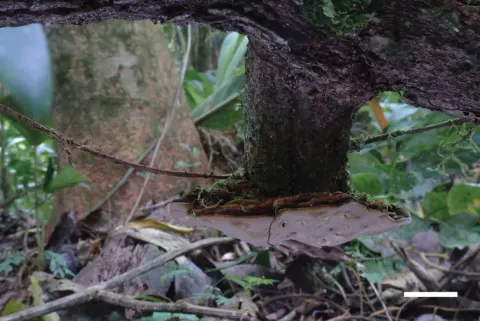
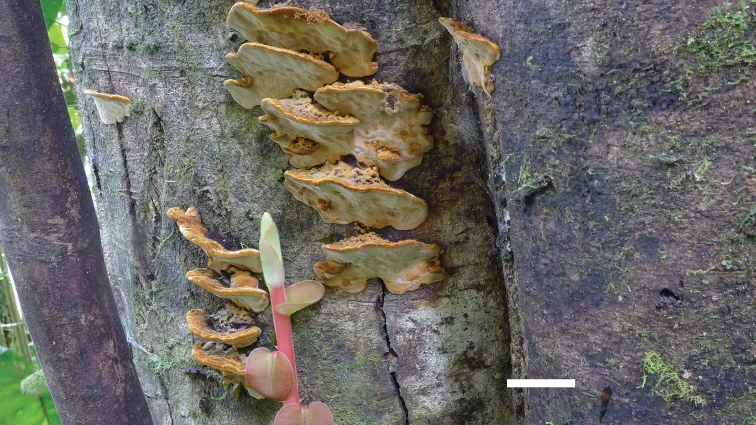
Basidiomata of Phylloporia crystallina (holotype, JV2106/102). Scale bar: 1 cm.
- Jenis
- Pelat ilmiah
- Kredit
- Meng Zhou, Fang Wu, Yu-Cheng Dai, Josef Vlasák
- Lisensi
- CC BY 4.0
- Sumber media
- Buka entri sumber
Dokumentasi tambahan
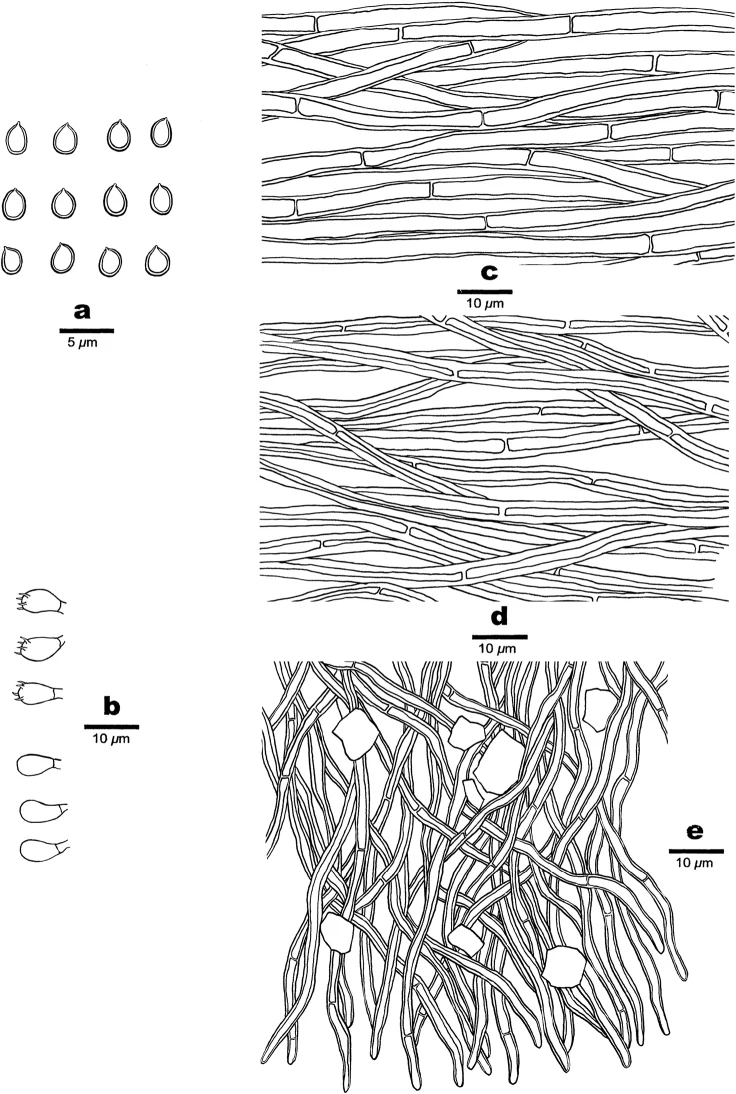
Microscopic structures of Phylloporia crystallina (drawn from the holotype, JV2106/102). a basidiospores b basidia and basidioles c hyphae from upper tomentum d hyphae from lower compacted context e hyphae from dissepiment edge.
Kredit dan penggunaan
Meng Zhou, Fang Wu, Yu-Cheng Dai, Josef Vlasák
Ukuran dan format gambar disesuaikan tanpa pemotongan, retus, atau penambahan skala. Lisensi sumber dipertahankan.
Sumber profil
- [1] Two new species of Phylloporia (Hymenochaetales) from the Neotropics — Phylloporia crystallina
- [2] Catalogue of Life Base2026-09-11 — Phylloporia crystallina
- [3] Dokumentasi visual — Phylloporia crystallina
- [4] Dokumentasi visual — Phylloporia crystallina
Rujukan halaman ini
Fungi. Phylloporia crystallina. Rilis data fungi-2026-10-12-expansion-2. https://fungi-atlas.mgadib.chatgpt.site/jamur/phylloporia-crystallina/.
Status: impor sumber; pemeriksaan editorial per profil belum selesai. Untuk klaim biologis, gunakan rujukan pada bagian terkait dan periksa konteks sumber aslinya.