Ciri dan struktur
Phylloporia sumacoensis is characterized by pileate, perennial basidiomata with a thin layer of context between individual tube layers, a duplex context with a black line separating the upper tomentum and a lower compacted layer, very small pores 10–12 per mm, a monomitic hyphal system, generative hyphae thin- to distinctly thick-walled with simple septa, the hyphae at dissepiment edges bearing fine crystals, presence of cystidioles, broadly ellipsoid to subglobose basidiospores as 3–3.7 × 2.1–2.8 μm, and growth on living liana at medium elevation in the Neotropical cloud forest.
Habitat dan peran ekologis
Ecuador, Guamani, Wild Sumaco Lodge; alt. 1200m; 0°40'S, 77°36'W; 30. Sep. 2021; Vlasák leg.; on living liana in tropical cloud forest; JV2109/73 (holotype BJFC038576, isotype PRM957107). GenBank: ON129552 (ITS); ON006468 (LSU). Phylloporia sumacoensis is characterized by pileate, perennial basidiomata with a thin layer of context between individual tube layers, a duplex context with a black line separating the upper tomentum and a lower compacted layer, very small pores 10–12 per mm, a monomitic hyphal system, generative hyphae thin- to distinctly thick-walled with simple septa, the hyphae at dissepiment edges bearing fine crystals, presence of cystidioles, broadly ellipsoid to subglobose basidiospores as 3–3.7 × 2.1–2.8 μm, and growth on living liana at medium elevation in the Neotropical cloud forest. Phylogenetically, Phylloporia sumacoensis is closely related to two other Neotropical species, P. spathulata (Hook.) Ryvarden sensu auctore and P. ulloae R. Valenz. et al. (Fig. 1). However, P. spathulata differs from P. sumacoensis in having stipitate basidiomata, wider pores (7–9 per mm vs. 10–12 per mm), and the absence of cystidioles (Ryvarden 2004). Phylloporia ulloae differs from P. sumacoensis in having wider pores (6–8 per mm vs. 10–12 per mm) and longer basidia (14.5–16 μm vs. 10–12 μm) (Valenzuela et al. 2011).
- Habitat atau konteks temuan
- hutan
- Substrat
- Informasi belum tersedia pada sumber rilis ini.
- Peran atau konteks
- Belum dikategorikan pada rilis ini.
Reproduksi
Phylloporia sumacoensis is characterized by pileate, perennial basidiomata with a thin layer of context between individual tube layers, a duplex context with a black line separating the upper tomentum and a lower compacted layer, very small pores 10–12 per mm, a monomitic hyphal system, generative hyphae thin- to distinctly thick-walled with simple septa, the hyphae at dissepiment edges bearing fine crystals, presence of cystidioles, broadly ellipsoid to subglobose basidiospores as 3–3.7 × 2.1–2.8 μm, and growth on living liana at medium elevation in the Neotropical cloud forest.
Catatan identitas dan cakupan
- Nama diterima mengikuti Catalogue of Life Base2026-09-11; uraian mempertahankan konsep dan nama sumber aslinya.
- Preserve original treatment localities, hosts and substrate scope. Materials examined describe documented specimens, not the full global range.
- Impor dan terjemahan otomatis belum diperiksa editorial per profil. Struktur reproduktif yang disebutkan tidak membuktikan seluruh siklus hidup diketahui.
- Pengukuran pada uraian mengikuti spesimen, kultur, dan metode sumber; angka tidak diperluas ke semua populasi.
Catatan distribusi dalam narasi mengikuti sumbernya. Dokumentasi spesimen atau foto mengikuti catatan sumber. Bukti wilayah Indonesia dan penilaian konservasi tidak disimpulkan dari gambar.
Melihat dengan konteks
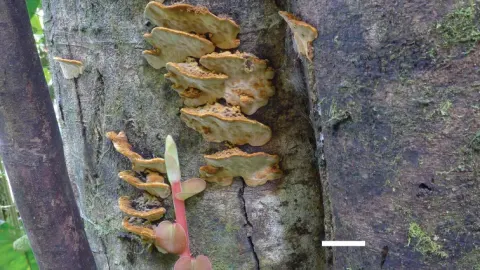
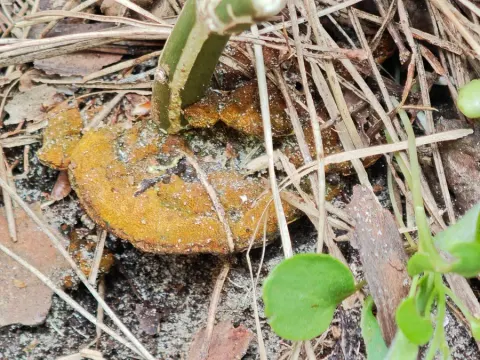
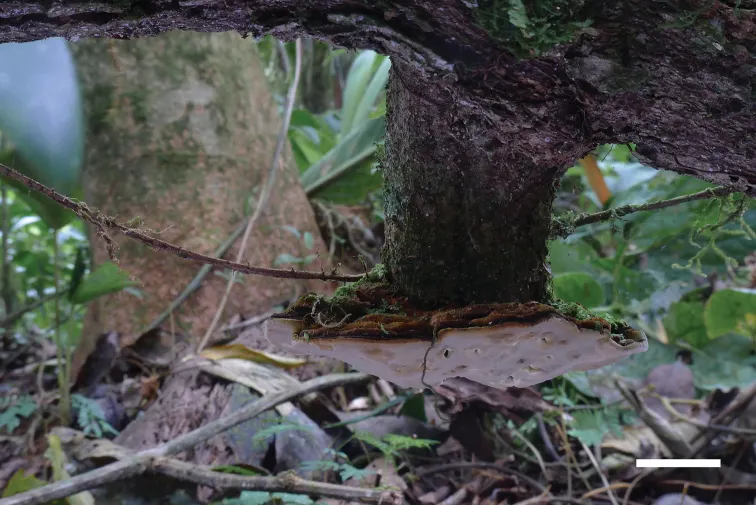
A basidiomata of Phylloporia sumacoensis (holotype, JV2109/73). Scale bar: 1 cm.
- Jenis
- Pelat ilmiah
- Kredit
- Meng Zhou, Fang Wu, Yu-Cheng Dai, Josef Vlasák
- Lisensi
- CC BY 4.0
- Sumber media
- Buka entri sumber
Dokumentasi tambahan
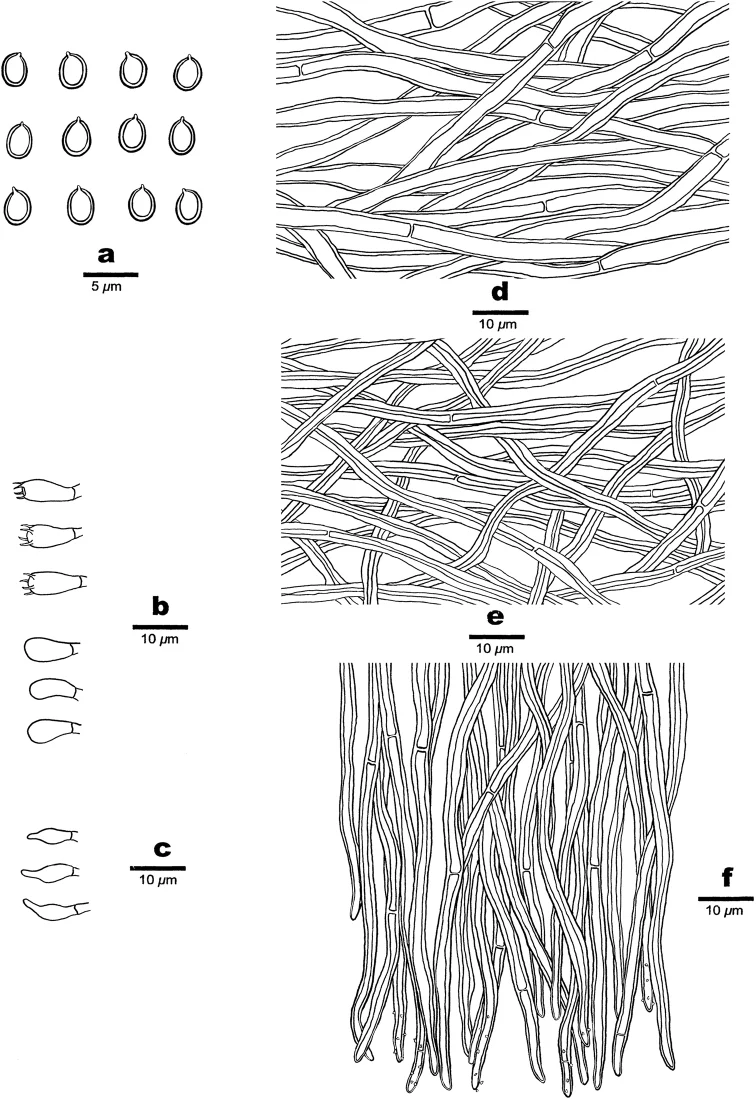
Microscopic structures of Phylloporia sumacoensis (drawn from the holotype, JV2109/73). a basidiospores b basidia and basidioles c cystidioles d hyphae from upper tomentum e hyphae from lower compacted context f hyphae from dissepiment edge.
Kredit dan penggunaan
Meng Zhou, Fang Wu, Yu-Cheng Dai, Josef Vlasák
Ukuran dan format gambar disesuaikan tanpa pemotongan, retus, atau penambahan skala. Lisensi sumber dipertahankan.
Sumber profil
- [1] Two new species of Phylloporia (Hymenochaetales) from the Neotropics — Phylloporia sumacoensis
- [2] Catalogue of Life Base2026-09-11 — Phylloporia sumacoensis
- [3] Dokumentasi visual — Phylloporia sumacoensis
- [4] Dokumentasi visual — Phylloporia sumacoensis
Rujukan halaman ini
Fungi. Phylloporia sumacoensis. Rilis data fungi-2026-10-12-expansion-2. https://fungi-atlas.mgadib.chatgpt.site/jamur/phylloporia-sumacoensis/.
Status: impor sumber; pemeriksaan editorial per profil belum selesai. Untuk klaim biologis, gunakan rujukan pada bagian terkait dan periksa konteks sumber aslinya.